Protein Extraction Machine VS Traditional Protein Separation: Which wins?
Oct 20, 2026
Ask a plant-protein or peptide producer where the margin disappears, and the answer is rarely packaging or freight — it is extraction. Traditional protein separation depends on long soaking, hot-water leaching, alkali dissolution and acid precipitation: proven chemistry, but slow cycles, heavy steam bills and heat-damaged product. The ultrasonic protein extraction machine built by Xi'an Bioland Instrument Co., Ltd. takes a different route, using controlled acoustic cavitation at 40–60 °C to rupture cell walls in 24–40 minutes instead of 6–10 hours. Built from SUS304/316L, fitted with PLC control, CIP cleaning and GMP-compliant design, a Bioland protein extraction machine lifts extraction rates by 50–500 % versus conventional maceration. This article compares both technologies — efficiency, yield, automation, cost — through real customer lines, and explains why a modern protein extraction machine usually wins.
Comparing Efficiency and Processing Performance
Where Traditional Protein Separation Runs Out of Road
Conventional separation depends on diffusion. Solvent must creep through intact cell walls, dissolve the protein, then creep back out. To speed that up, plants raise temperature and extend time — the two things protein tolerates worst. The result is familiar: 6–10 hour cycles, three repeated leaches, darkened colour, lower nitrogen solubility index and a solvent-to-material ratio that inflates downstream evaporation load. Traditional kettles also give the operator almost no real process feedback, so yield drifts from batch to batch and quality complaints follow.
Cavitation Physics Behind a High-Performance Protein Extraction Machine
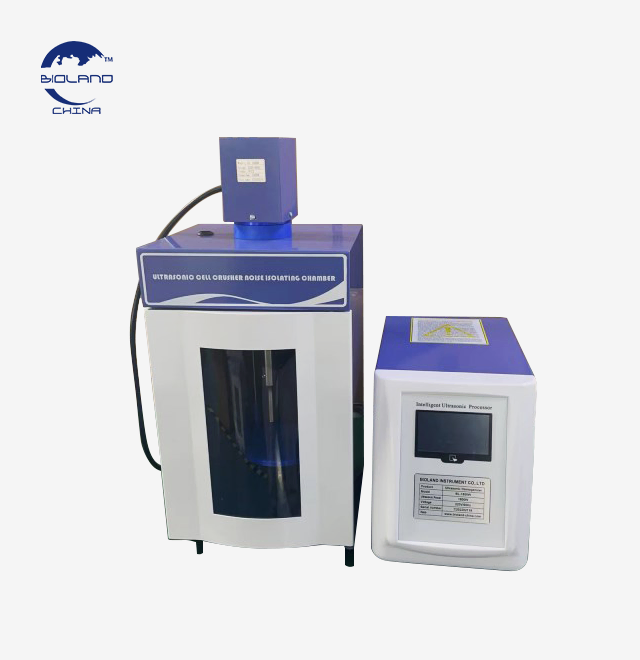
An ultrasonic protein extraction machine generates micro-bubbles inside the solvent. When those bubbles collapse, localised shear and micro-jets perforate the cell wall, so the protein does not have to diffuse out slowly — it is released mechanically. Because the driving force is physical rather than thermal, the protein extraction machine works effectively at 40–60 °C, protecting heat-labile globulins, albumins and peptides. Extraction is also independent of molecular weight and polarity, which is why the same platform handles proteins, polysaccharides, flavonoids and pigments.
Application Case — Soy Protein Isolate Workshop, Henan
The customer's pain point: an eight-hour alkali-soak line delivering only 62 % protein recovery, with dark-coloured isolate and constant complaints about solubility from their beverage clients.
Bioland instrument supplied two BL-TN-C500L ultrasonic units. Working pH dropped from 9.5 to 8.5, temperature held at 55 °C, extraction time cut to 35 minutes per stage, with online concentration monitoring on the discharge line.
Result after six months: recovery rose to 78.4 %, full cycle fell from 8 hours to 2.2 hours, alkali consumption dropped 30 %, and the whiter, more soluble isolate won a repeat contract.
One Machine, Many Extraction Processes
Few buyers run a single raw material all year. A Bioland instrument protein extraction machine supports ultrasonic low-temperature extraction, solvent extraction, Soxhlet dynamic extraction, hot reflux, water or alcohol precipitation and percolation in the same vessel. That is why the identical platform is sold as a stevia extraction machine, a tincture extraction machine, a tea extraction machine or a propolis extraction machine. One protein extraction machine can process soy protein in spring and mushroom polysaccharides in autumn, simply by changing programme recipes and basket configuration.
Differences in Yield, Speed and Process Control
Yield: The 50–500 % Improvement Explained
The headline figure surprises people, so it is worth breaking down. For easily leached materials such as whey or defatted soy flour, users typically see 15–30 % gains. For stubborn matrices — fish frames, mushroom mycelium, oilseed meal, Ganoderma fruiting bodies — improvements of 100–500 % are common, because traditional leaching simply never opens those cells. A properly sized protein extraction machine converts that locked fraction into sellable product, and since raw material is usually 60–70 % of cost, yield is where payback actually lives.
Speed: 24–40 Minutes Against a 6–8 Hour Cycle
Best extraction rates on a Bioland instrument protein extraction machine are normally reached within 24–40 minutes — a reduction of more than two-thirds against traditional decoction. Shorter residence also means less thermal degradation, less oxidation and less hydrolysis of sensitive peptides. Downstream, the integrated evaporator handles 20–200 kg/h of evaporation depending on model, so concentration keeps pace with extraction instead of becoming the bottleneck. In practice, a plant that ran two batches per shift can run six with the same protein extraction machine footprint.
Application Case — Marine Fish Protein Peptide Line, Shandong
Pain point: enzymatic hydrolysis of cod frames took six hours, enzyme cost was punishing, and degree-of-hydrolysis varied ±3.1 % between batches, producing bitter off-flavours.
Bioland instrument installed a BL-TN-C300L unit as an ultrasonic pre-treatment stage — 28 minutes at 50 °C before enzymolysis, with automatic discharge into the hydrolysis tank.
Outcome: hydrolysis shortened to 3.5 hours, soluble protein recovery up 23 %, enzyme dosage cut 18 %, and DH variance tightened to ±0.9 %. Bitterness complaints stopped; the customer ordered a second line within a year.
Temperature and Vacuum Control That Protects Structure
Process control is the quiet advantage. Every Bioland instrument protein extraction machine runs with jacket pressure at 0.09–0.3 MPa, system vacuum at −0.085 MPa and evaporation temperature adjustable from 60–100 °C, so concentration happens under reduced pressure and protein never sees destructive heat. Secondary steam condenses and returns to the extractor as fresh solvent, giving continuous reflux until the liquor runs clear. Operators set parameters once; the protein extraction machine reproduces them batch after batch, which is exactly what traditional open kettles cannot do.
How Automation Changes Protein Separation Methods
PLC Control, Online Monitoring and Automatic Discharge
An intelligent PLC system replaces operator judgement with recorded data. Ultrasonic power, frequency, temperature, vacuum, timing and pump sequencing are stored as recipes; online concentration monitoring tells the protein extraction machine when to stop; automatic discharge and in-line filtration move liquor onward without manual transfer. For a producer running three shifts, this converts a skilled-labour problem into a software problem. One trained supervisor can oversee several vessels, and every batch on the protein extraction machine leaves a traceable record.
CIP, GMP Compliance and Audit-Ready Documentation
Food, nutraceutical and pharmaceutical buyers audit hygiene before they audit yield. Bioland builds in CIP in-line cleaning, three-layer insulation, sanitary welds, demisters on both extractor and evaporator vapour outlets, and full SUS304/316L contact surfaces. Equipment complies with GMP/FDA requirements and carries CE and ISO certification, with IQ/OQ documentation supplied on request. That documentation package is often what allows a customer's protein extraction machine to be qualified for export-grade production within weeks rather than months.
Application Case — Mushroom Polysaccharide and Protein Co-Extraction, Fujian
Pain point: a shiitake and Ganoderma processor used three sequential four-hour hot-water leaches, achieved only 3.8 % polysaccharide yield, degraded the protein fraction, and burned enormous steam.
Bioland instrument supplied a BL-TN-C200L ultrasonic extraction–concentration unit with dual-stage programming, 58 °C working temperature and 40-minute cycles.
Results: polysaccharide yield climbed to 6.9 %, co-recovered protein became a second saleable product, steam consumption fell 45 %, and water usage dropped by a third. Ultrasonic extraction of mushrooms turned a cost centre into two revenue streams.
From Batch Craft to Continuous, Repeatable Production
Automation also changes plant layout. Continuous feeding and continuous discharge allow pipelined, automated concentration instead of bucket-and-pump handling. Materials move under vacuum, exposure to air falls, and cross-contamination risk drops. For contract manufacturers switching between a coffee extraction machine recipe, a quercetin programme and a protein programme in one week, this repeatability is decisive — the equipment, not the operator, guarantees the result.
Cost Factors Between Modern and Traditional Systems
Solvent, Steam and Electricity: Where Money Actually Goes
Traditional lines look cheap on the quotation and expensive on the utility bill. Because cavitation replaces prolonged boiling, a Bioland instrument protein extraction machineuses motor power of only 2.7–3.5 kW and steam consumption of 25–250 kg/h depending on model, while cutting solvent-to-material ratio and therefore evaporation duty. Ethanol and other solvents are recovered through the condenser, oil separator and receiver, typically above 95 %. Across a year, those savings on a single protein extraction machine often exceed the price difference against a conventional tank set.
Labour, Floor Space and Lost Batches
Shorter cycles mean fewer operator hours per tonne. Integrated extraction and concentration means one skid instead of two rooms. And because parameters are locked in software, the cost that nobody budgets for — the rejected batch — largely disappears. Customers regularly report scrap rates falling from 4–6 % to under 1 % after switching to an automated protein extraction machine, which on high-value peptides or pigments can pay for the equipment on its own.
Application Case — Stevia and Chilli Oleoresin Dual-Purpose Plant, Yunnan
Pain point: the client had two seasonal materials — stevia leaf in summer, chilli in winter — but could not justify two dedicated lines or two sets of operators.
Bioland instrument engineered one 500 L system with quick-change extraction baskets, ethanol recovery and two stored recipes, functioning as a stevia extraction machine and a chilli oleoresin extraction plant.
Delivered results: steviol glycoside yield up 19 %, extraction time down from 4 hours to 50 minutes, capsaicin colour value stable batch-to-batch, and full payback inside 14 months.
Five-Year Total Cost of Ownership
Compare honestly over five years: purchase price, utilities, solvent losses, labour, maintenance, rejected product and lost yield. Traditional separation usually wins only on line one. By year two, the higher recovery of a protein extraction machine has closed the gap; by year five, most Bioland users are ahead by a multiple of the original investment. Add a one-year warranty with lifetime maintenance support and spare parts availability, and the ownership risk narrows further.
Choosing the Right Solution for Protein Processing
Sizing: From BL-TN-C50L Pilot to BL-TN-C500L Production
Bioland instrument's range runs 50 L, 100 L, 200 L, 300 L and 500 L, with evaporation capacity of 20, 50, 70, 100 and 200 kg/h respectively. Universities and R&D centres usually start with a 50 L or 100 L protein extraction machine for method development, then scale using the same power density and geometry so results transfer cleanly. Compressed air requirement is 0.5–0.6 MPa across all models. Choosing the right protein extraction machine size is about daily throughput, solvent type and evaporation load — our engineers calculate all three before quoting.
Technology parameter
Model
BL-TN-C50L
BL-TN -C100L
BL-TN -C200L
BL-TN -C300L
BL-TN -C500L
Volume (L)
50
100
200
300
500
Evaporation capacity (kg/h)
20
50
70
100
200
Motor power(KW)
2.7
2.7
2.7
3.5
3.5
Steam consumption(kg/h)
25
60
90
120
250
System vacuum (MPa)
-0.085
-0.085
-0.085
-0.085
-0.085
Pressure of jacket(MPa)
0.09~0.3
0.09~0.3
0.09~0.3
0.09~0.3
0.09~0.3
Compressed air (MPa)
0.5~0.6
0.5~0.6
0.5~0.6
0.5~0.6
0.5~0.6
Evaporation temperature(°C)
60~100
60~100
60~100
60~100
60~100
Configuration, Structure and Safe Operation
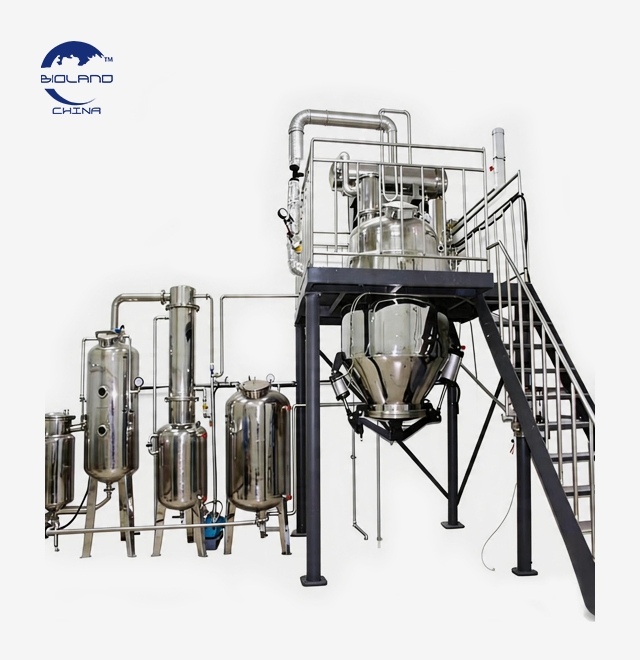
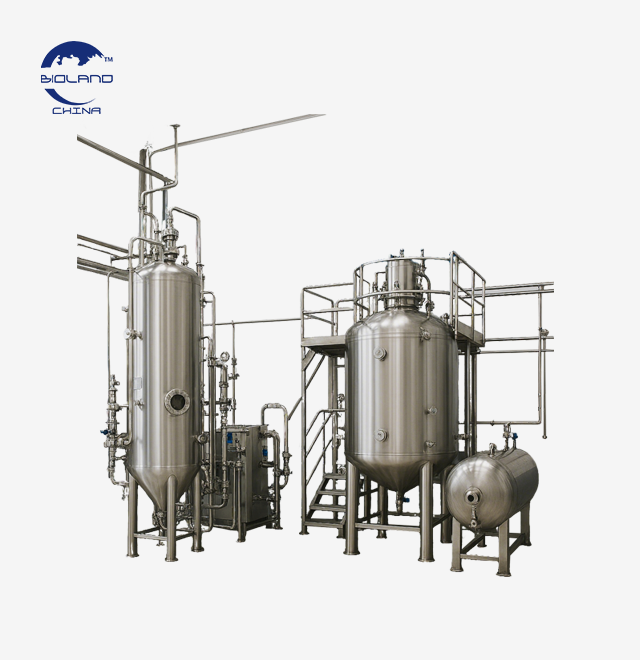
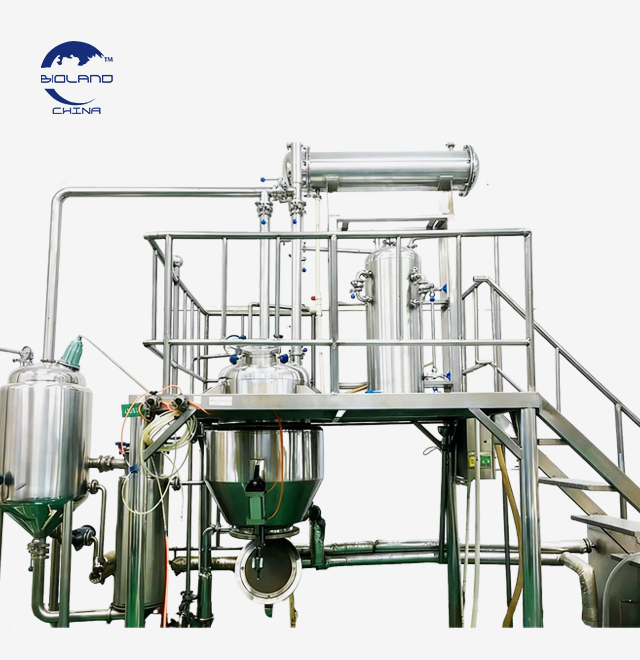
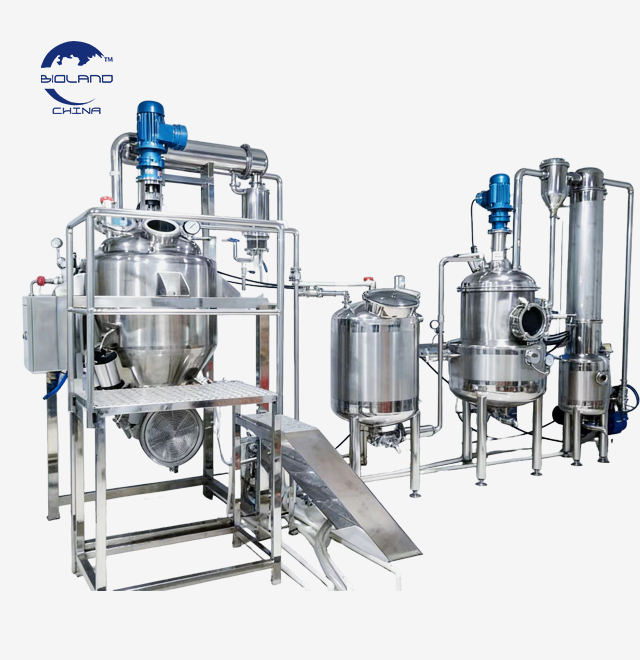
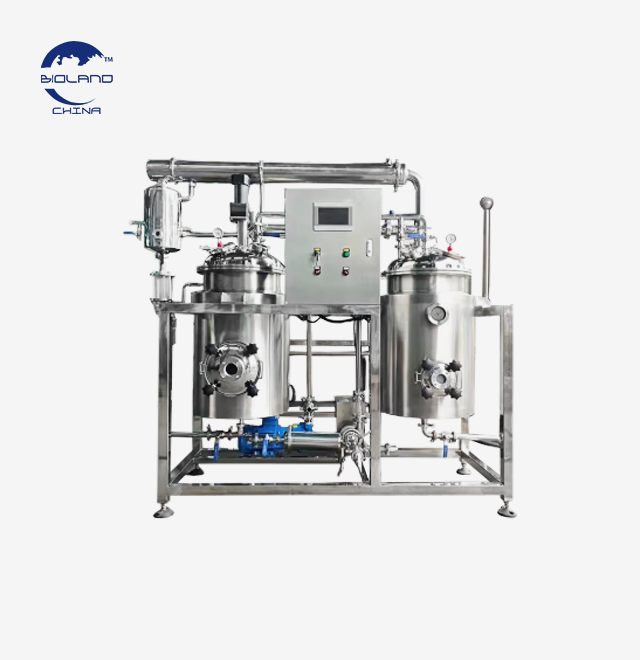
A complete system comprises the ultrasonic generator and transducers, extraction tank, tubular heater, evaporator, condenser, oil separator, oil receiver, liquid pump, metering tank, storage tank, filter, vacuum pump and control cabinet, with demisters fitted at vapour outlets. Thermal-oil heating replaces steam where no boiler exists. The protein extraction machine operates under negative, atmospheric or positive pressure, with interlocks on vacuum and temperature, explosion-proof options for ethanol service, and clear SOPs supplied so that safe operation of the protein extraction machine is trained, not improvised.
OEM/ODM, Certification and Delivery Confidence
Xi'an Bioland Instrument Co., Ltd. has spent more than 15 years in distillation, concentration, reaction, extraction, separation, filtration, purification, crystallisation, emulsification, mixing and drying equipment, exporting to Europe, Southeast Asia and beyond. We welcome OEM and ODM orders: customised systems ship in roughly 30 business days, standard units in 5–7 days, by sea, rail or air. CE and ISO certification, GMP/FDA-compliant construction and an in-house R&D team stand behind every protein extraction machine we build.
Service After the Machine Lands
Our commitment does not end at payment. During manufacturing, a dedicated specialist sends weekly photos or video of your build. On completion, detailed inspection media is issued for your approval before shipment, or you may schedule a Factory Acceptance Test at our plant. Installation guidance, recipe development for tea polyphenols, flavonoids, propolis or plant pigment extraction, operator training and lifetime maintenance follow. Buying a protein extraction machine from Bioland instrument means buying a process, not a steel vessel.
Conclusion
So, which wins? For small artisanal volumes with no yield pressure, traditional separation still functions. For anyone measuring recovery, cycle time, energy cost and audit compliance, the ultrasonic protein extraction machine wins decisively: 50–500 % higher extraction rates, 24–40 minute cycles, 40–60 °C protection of protein structure, automated PLC control and integrated vacuum concentration. Real lines in soy protein, marine peptides, mushroom polysaccharides, stevia and chilli oleoresin confirm it with numbers, not adjectives. Bioland's advantage is that we deliver the whole solution — sizing, recipe, certification, training and lifetime support — so your protein extraction machine becomes a profit centre rather than a capital line item.
FAQ
1. How much yield improvement can I expect?
Typically 50–500 % over traditional leaching, depending on matrix. Soy and whey see 15–30 %; mushroom, fish frames and oilseed meal see far more.
2. What sizes are available?
50 L to 500 L (BL-TN-C50L–C500L), with 20–200 kg/h evaporation capacity. Larger custom volumes are available on request.
3. Can one machine handle different raw materials?
Yes. The same platform runs stevia, tea, coffee, propolis, tincture, flavonoid, quercetin and pigment programmes via stored recipes.
4. Is the equipment GMP compliant?
Yes — SUS304/316L, CIP cleaning, CE and ISO certified, GMP/FDA compliant.
5. What is the delivery time?
5–7 days standard; around 30 business days for customised systems.
Ready to Stop Losing Protein in the Tank? Talk to Bioland Instrument
Every locked cell wall in your raw material is money you already paid for. Bioland Instrument turns it into product. With 15+ years in extraction, concentration, reaction and separation technology, CE/ISO certification, GMP/FDA-compliant construction, an in-house R&D and engineering team, and proven lines in soy protein, fish peptides, stevia, chilli oleoresin, mushroom polysaccharides and natural pigments, we design the protein extraction machine around your process — not the other way round. Full OEM/ODM support, competitive factory pricing, 30-day custom lead time, one-year warranty with lifetime maintenance, weekly production photos and video, and optional FAT at our facility. Send us your material, target compound and daily throughput, and we'll return a costed solution. Contact us at info@biolandequip.com— let's engineer your yield upward.
References
1. Chemat, F., Rombaut, N., Sicaire, A.-G., Meullemiestre, A., Fabiano-Tixier, A.-S., & Abert-Vian, M. (2017). Ultrasound assisted extraction of food and natural products: Mechanisms, techniques, combinations, protocols and applications — A review. Ultrasonics Sonochemistry, 34, 540–560.
2. Kadam, S. U., Tiwari, B. K., Álvarez, C., & O'Donnell, C. P. (2015). Ultrasound applications for the extraction, identification and delivery of food proteins and bioactive peptides. Trends in Food Science & Technology, 46(1), 60–67.
3. Preece, K. E., Hooshyar, N., & Zuidam, N. J. (2017). Whole soybean protein extraction processes: A review. Innovative Food Science & Emerging Technologies, 43, 163–172.
4. Ozuna, C., Paniagua-Martínez, I., Castaño-Tostado, E., Ozimek, L., & Amaya-Llano, S. L. (2015). Innovative applications of high-intensity ultrasound in the development of functional food ingredients: Production of protein hydrolysates and bioactive peptides. Food Research International, 77, 685–696.
5. Vilkhu, K., Mawson, R., Simons, L., & Bates, D. (2008). Applications and opportunities for ultrasound assisted extraction in the food industry — A review. Innovative Food Science & Emerging Technologies, 9(2), 161–169.
6. Mason, T. J., Paniwnyk, L., & Lorimer, J. P. (1996). The uses of ultrasound in food technology. Ultrasonics Sonochemistry, 3(3), S253–S260.
The reactor is beautifully mirror-polished and fully complies with GMP requirements for the pharmaceutical industry. The performance is excellent! Overall, we are very satisfied! We also provided with some feedback on our process improvements, which we hope will be helpful.
2024-04-09
Laboratory
Excellent and professional service. Always reply our questions very fast. All reactors and chiller we received are good too.
2024-02-15
Research Institute
Quality is beyond our expectation actually. After we got the extraction equipment and started using it, the performance was beyond our expectation. Very easy to use and very efficient to run. Service always respond us very quickly. Was also very helpful to help us. Thanks Bioland team. Very happy to work with you.
2023-11-20
Biotech Company
We are happy about the new purchase as always. Equipment and services are both good.
2023-08-05
Instrument Lab
This is the second order with Bioland instrument and everything is good as the first dateText.
2023-05-12
Global Trading Partner
Bioland instrument team is very helpful and professional. The sales helped us select the right equipment for our application, and their logistics people handled the transportation and customs declaration for our shipment. All that saved us a lot of work.