Borosilicate Glass Reactor vs. Metal Reactor: Full Technical Comparison for Industrial Applications
Jul 24, 2026
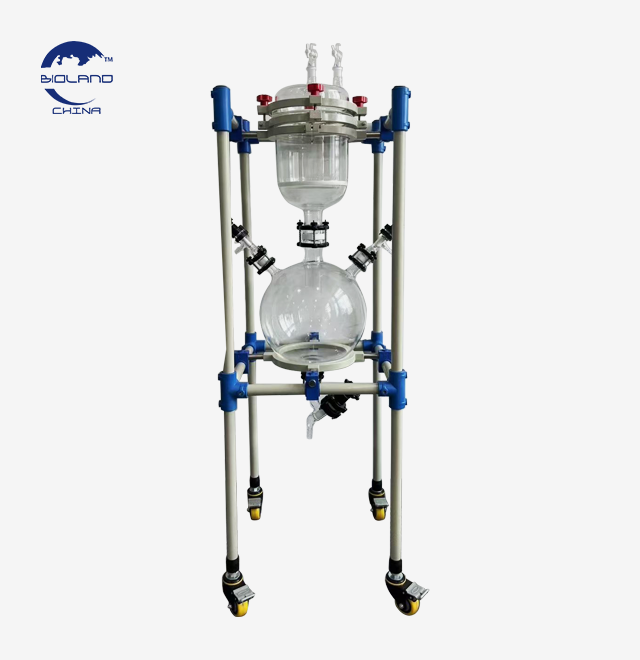
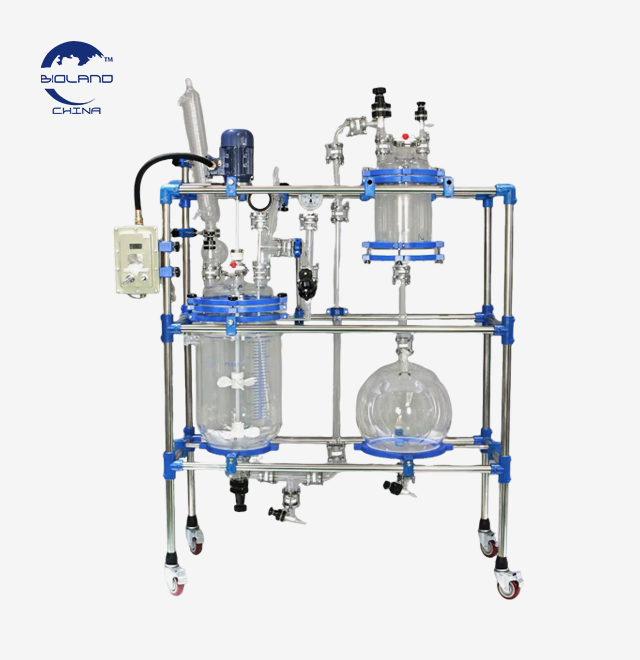
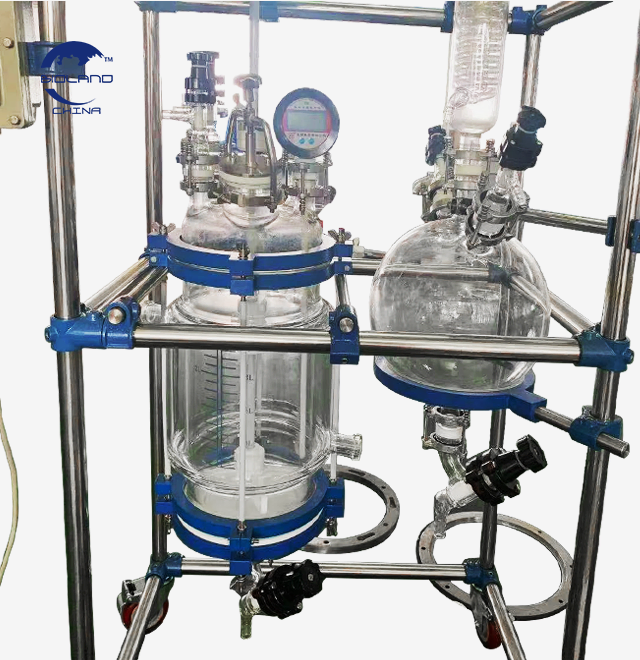
One of the most important equipment decisions an industrial process engineer will have to make is between aborosilicate glass reactor and a metal tank. If they make the wrong choice, it can slowly lower the quality of the product, make fixing take longer, and raise the cost of long-term upkeep. Real production data from Bioland Instrument's borosilicate glass reactor line are used in this guide to compare the two reactor families in terms of materials, heat transfer, working limits, and selection criteria. Bioland's reactors are made from GG17 borosilicate glass and allow engineers to see every step of the process. They are also resistant to strong acids and solvents without releasing contaminants, and they can keep precise temperatures over a very large range. These are all benefits that stainless steel and alloy vessels simply can't match for many chemical and pharmaceutical processes.
Material Differences and Chemical Compatibility Comparison
The choice of material is the only thing that determines whether a reactor will last years of harsh chemistry or only a few months. This is where a borosilicate glass reactor and a metal vessel are very different. Glass is a chemically inert and non-reactive surface that doesn't add any ions or particles to a batch. Metal reactors, on the other hand, depend on the alloy grade and passivation quality to keep them from corroding. When manufacturers do acid digestion, halogenated solvent recovery, or high-purity synthesis, they always find that a borosilicate glass reactor gets rid of a type of contamination risk that steel equipment can only handle and never completely get rid of.
GG17 Borosilicate Glass Composition and Corrosion Resistance
Every Bioland borosilicate glass reactor is made of GG17 borosilicate glass, which is made up of silica and boron trioxide. It has a surface that can withstand strong acids, strong bases, and harsh organic solvents without breaking down after many cycles. This mix gives the glass great structural stability when temperatures change, so even after years of switching between hot and cold steps in the process, the jars will still close properly. Chemical engineers who design long-lasting equipment for acidic or caustic media always say that GG17 glass is one of the most durable non-metallic reactor materials on the market right now.
Metal Reactor Materials: Stainless Steel and Alloy Limitations
Higher alloys like Hastelloy and stainless steel are very strong mechanically, but they don't fight rust very well because they have a passivation layer that can break down when they are exposed to chlorides, strong acids, or gritty slurries for a long time. When that layer is broken, pitting and localized corrosion can let metal ions go straight into the stream of products. In a borosilicate glass reactor, this failure mode doesn't happen at all because there is no metal surface for aggressive media to attack.
Chemical Compatibility with Acids, Bases, and Solvents
When process scientists work with strong nitric acid, sulfuric acid, or chlorine solvents, they need materials that have been tested to last for a long time. In these situations, a borosilicate glass reactor always works better than stainless steel. Most halogens, chemical liquids, and oxidizing agents can't break down glass. In a metal system, these things would need expensive custom alloys to work. This matching benefit is very useful when making medicinal intermediates, because even small changes in the materials can ruin a whole lot of production.
Contamination Risk: Metal Ion Leaching vs Inert Glass Surfaces
Metal ion contamination is a long-term quality risk in stainless steel reactors that work with acidic or chelating chemicals, since even well-passivated surfaces can allow trace leaching to happen over long production runs. This kind of risk is not present in a borosilicate glass reactor, which is why it is the best choice for making biologically active molecules, chiral intermediates, and other high-purity chemicals when analysis requirements don't allow for trace metal interference. For this reason, quality teams that check extractable and leachable profiles often choose glass equipment.
Heat Transfer and Performance Comparison of Reactor Types
The difference between a reactor that just works and one that really speeds up the process is its thermal performance. In this case, the choice between a borosilicate glass reactor and a metal tank relies on the application. Glass jacket designs allow for great, even heat transfer over a wide temperature range while still being completely clear. Metal reactors, on the other hand, often heat up faster in bulk but make it harder to see what's going on inside. For pilot-scale and specialty production work, engineers who want to control temperature and see the process better are choosing borosilicate glass reactors more and more.
Double-Jacketed Design and Temperature Range Comparison
Bioland's double-jacketed borosilicate glass reactor can work at temperatures ranging from -80 degrees Celsius for low-temperature condensation to 300 degrees Celsius for high-temperature reactions. This is a temperature range that is on par with or better than many metal jacketed systems. When heating or cooling media are spread out evenly through the glass jacket, there aren't many temperature differences across the vessel wall. This is very important for reactions that are affected by hot spots in one place. Metal reactors can also reach wide ranges, but to handle the same amount of heat stress, they usually need stronger walls and heavy jackets.
Vacuum Performance and Distillation Efficiency
When combined with a borosilicate glass reactor, integrated vacuum systems can reach as low as -9.75 megapascals, which increases the efficiency of evaporation and reflux during the distillation and solvent recovery steps. With this level of vacuum performance, distillation, concentration, and reaction can all happen in the same glass vessel, so there is no need to move the material between machines. Metal reactors can also maintain a deep vacuum, but they don't always let you see in real time that a distillation or concentration step is going as planned.
Stirring, Mixing, and Reaction Control Precision
As important as controlling the temperature is controlling the motion. A well-designed borosilicate glass reactor has clear walls and a variable-frequency moving motor that lets users see the mixing quality, the formation of emulsions, and the suspension of particles. Since workers can't see inside a steel tank that is shut, metal reactors use indirect clues like torque readings or sample holes to guess how the mixture is mixing. This direct visual feedback loop cuts down on the time needed to fix problems during process development and trials of scaling up.
Thermal Shock Resistance and Cycling Stability
Any reactor material is put under a lot of stress when it is heated and cooled over and over again. GG17 borosilicate glass is specially made to handle big changes in temperature without cracking. This is an important property for demanding batch schedules that need quick changes between hot reaction and cold crystallization stages. When compared to less specialized glass equipment, a borosilicate glass reactor built to this standard keeps its shape over thousands of temperature cycles. This means that seals don't need to be replaced as often, and the tank doesn't need to be inspected as often.
Advantages and Limits of Glass and Metal Reactors
There are pros and cons to every reactor material. Knowing when a borosilicate glass reactor works best and when metal equipment is still the best choice helps engineers avoid making costly mistakes when choosing a tank for a process that doesn't work well with metal. Glass is the best when it comes to clarity of vision and chemical inertness, but metal systems are still the best when extreme pressure ratings or very large single-vessel capacities are needed. These trade-offs are shown in real client projects that show how they work in production settings.
Visual Process Monitoring: The Core Advantage of Glass
The best thing about borosilicate glass reactors is that they are fully transparent. This means that workers can see color changes, precipitation, crystal formation, and phase separation as they happen, instead of just reading sensor readings. This makes it easier to see when there are problems with the process, helps with more accurate mechanism studies, and gives quality teams visual proof that they can use for process characterization reports. No matter how many monitors are put in, metal reactors can't allow this amount of direct viewing.
Case Study: South American Biopharmaceutical Fermentation Optimization
A South American biopharmaceutical company was having trouble with not having enough dissolved oxygen, fermentation cycles that took too long, and keeping the clean, tightly controlled environment that chiral intermediate synthesis needed. Their old equipment didn't have the thermal accuracy and visual feedback they needed to find process deviations early enough to fix them.
Bioland Instrument made a fifty-liter double-layer borosilicate glass reactor just for the client's fermentation broth. The fan design was designed to work best with that broth. The efficiency of dissolved oxygen went up by 30%, the fermentation cycle got shorter, and the clear tank let workers see how the color and precipitation changed during the synthesis process.
The sealed construction also provided inert gas protection for chiral intermediates that are sensitive to oxidation. This gave the client a repeatable, high-purity process that was based on the chemical inertness and visibility that can only be found in large glass equipment.
Case Study: European Precious Metals Solvent Extraction Line
A European company that processes precious metals needed to replace old, undersized separation equipment that wasn't working well enough to support a planned increase in capacity. They also didn't have much control over how the highly corrosive extraction chemistry was used on a large scale with their current setup.
Bioland Instrument provided four 200-liter double-layer borosilicate glass reactors and nine 50-liter explosion-proof rotating evaporators. These were designed for production with high levels of corrosiveness and risk and were approved to ExdIIBT4 explosion-proof standards.
With double-jacketed temperature control from -80 to 200 degrees Celsius, modular manufacturing cut delivery times by 40%, the client started production fifteen days early, and annual output capacity went up by 30%. The machines have also run for over 1,000 hours without any problems.
When Metal Reactors Still Make Sense
Metal reactors are still the best choice for processes that need to be under very high pressure, for very long single-vessel production runs that are too big for glass, or for situations where resistance to mechanical impact is more important than visual monitoring. A borosilicate glass reactor isn't meant to replace all metal vessels in a facility. Instead, it's designed to do specific work, like transparent, chemically neutral, carefully controlled reaction and separation work, where glass really does perform better than steel.
Selecting Reactors Based on Industrial Process Requirements
In the end, the best reactor type is the one that matches the chemistry, scale, and price to the best material for the job. Bioland Instrument doesn't just sell equipment from a web page; they work directly with process engineering teams to help make this choice. A borosilicate glass reactor is best for processes that need to be acidic, very pure, or physically inspected. On the other hand, metal systems work best for processes that need to be under a lot of pressure or make a lot of samples. The technical team's suggestions are based on fifteen years of manufacturing experience in the pharmaceutical, chemical, and precious metals industries.
Matching Reactor Type to Process Chemistry and Scale
When engineers are looking at new equipment, they should start by looking at the process chemistry. A borosilicate glass reactor is usually best for highly acidic, oxidation-sensitive, or high-purity uses. On the other hand, metal construction may still be needed for extreme pressure or very high-volume continuous processes. Before suggesting a specific design, Bioland's technical team looks at the reaction conditions, goal output, and current plant infrastructure. This keeps them from making the common and expensive mistake of not defining enough equipment early on in a project.
OEM/ODM Customization for Non-Standard Applications
Because industrial processes don't usually follow a single standard design, Bioland's borosilicate glass reactor line can be heavily customized through OEM and ODM. The size, shape, and internal structure of the vessels can be changed to meet specific testing or production needs. Customers can ask for a fully explosion-proof system with PLC automation, built-in temperature control, lifting and rotating mechanisms, filtration, crystallization, ultrasonic-assisted crystallization, tail gas absorption, or a fractional distillation column that is attached. All of these features are custom-made, not taken from a standard template.
Certification, Lead Time, and Cost Considerations
Clear goals from the start help with planning a budget and a timeline. Bioland keeps the prices of its borosilicate glass reactors low while ensuring that all of them are CE and ISO certified for easy regulatory acceptance. Custom orders usually ship within thirty working days, while normal setups are ready in five to seven days. You can choose between shipping by sea, rail, or air to fit your project's needs. All units meet GMP and FDA standards, which takes away a big source of doubt from the buying process.
Why Global Manufacturers Choose Bioland Instrument
With more than fifteen years of experience in the field, Xi'an Bioland Instrument Co., Ltd. is a professional company that designs, builds, and sells equipment for heating, cooling, vacuuming, crystallization, mixing, drying, emulsification, reaction, extraction, separation, filtration, purification, crystallization, emulsification, and refrigeration. The company makes a wide range of products, including ultrasonic plant extraction machines, ethanol extraction equipment, jacketed glass reactors, filter reactors, Nutsche filter reactors, high-shear homogenizers, vacuum spray dryers, and freeze dryers. These products are used all over the world in biopharmaceuticals, drug synthesis, food, cosmetics, and laboratories. Every borosilicate glass reactor that the company ships to Europe, Southeast Asia, and other places is backed by a top technical team that is ISO certified and safety guaranteed. The company welcomes OEM and ODM orders from customers who need engineering support that is suited to their needs.
Conclusion
A borosilicate glass reactordelivers chemical inertness, full visual monitoring, and precise wide-range temperature control that metal vessels cannot fully match for corrosive or high-purity processes, while metal reactors still hold their place for extreme pressure or very large-scale runs. Bioland Instrument's real client results, from a thirty percent dissolved oxygen improvement in biopharmaceutical fermentation to a thirty percent capacity gain in precious metals extraction, demonstrate how the right reactor choice directly drives measurable production outcomes.
FAQ
Q1: When should a manufacturer choose a borosilicate glass reactor over a metal reactor?
Glass suits corrosive, high-purity, or visually monitored processes such as pharmaceutical intermediate synthesis, while metal reactors remain better for extreme pressure or very large continuous production volumes.
Q2: Does a borosilicate glass reactor introduce contamination risk like metal vessels?
No. GG17 borosilicate glass is chemically inert and does not leach metal ions, making it preferred for high-purity and biologically active compound synthesis.
Q3: What temperature range can Bioland's borosilicate glass reactor handle?
The double-jacketed design operates from minus eighty to three hundred degrees Celsius, with vacuum performance reaching minus zero point zero nine five megapascals.
Q4: Can Bioland customize a borosilicate glass reactor for specific processes?
Yes. Bioland offers OEM/ODM customization covering vessel size, automation level, explosion-proof configuration, and accessories such as distillation columns or crystallization units.
Q5: How long does it take to receive a customized borosilicate glass reactor?
Customized units typically ship within thirty business days, while standard configurations are generally ready in five to seven days.
Talk to Bioland Instrument About Your Next Reactor Upgrade
If your current metal equipment is limiting visibility, driving up contamination risk, or struggling with corrosive chemistry, a borosilicate glass reactor from Bioland Instrument may be the upgrade your process needs. With more than fifteen years of manufacturing experience, CE and ISO certification, and a technical team that has solved fermentation, extraction, and scale-up challenges for clients across South America, Europe, and beyond, Bioland Instrument builds reactors engineered for real production performance, not just laboratory demonstrations.
Whether you need a standard configuration ready within days or a fully customized, explosion-proof, PLC-automated system built to your drawings, our engineers will guide you from initial consultation through Factory Acceptance Test. Every order includes weekly photo and video progress updates, a one-year warranty, and lifetime maintenance support, so you always know exactly where your equipment stands. Contact our technical team today at info@biolandequip.com to discuss your process requirements, request a customized quotation, or schedule a consultation with our engineering team. Let Bioland Instrument help you choose the right reactor for your next production milestone.
References
1. Perry, R. H., and Green, D. W. Perry's Chemical Engineers' Handbook. McGraw-Hill Professional.
2. Levenspiel, O. Chemical Reaction Engineering. John Wiley & Sons.
3. Sinnott, R. K. Chemical Engineering Design. Butterworth-Heinemann.
4. International Council for Harmonisation. ICH Q7: Good Manufacturing Practice Guide for Active Pharmaceutical Ingredients.
The reactor is beautifully mirror-polished and fully complies with GMP requirements for the pharmaceutical industry. The performance is excellent! Overall, we are very satisfied! We also provided with some feedback on our process improvements, which we hope will be helpful.
2024-04-09
Laboratory
Excellent and professional service. Always reply our questions very fast. All reactors and chiller we received are good too.
2024-02-15
Research Institute
Quality is beyond our expectation actually. After we got the extraction equipment and started using it, the performance was beyond our expectation. Very easy to use and very efficient to run. Service always respond us very quickly. Was also very helpful to help us. Thanks Bioland team. Very happy to work with you.
2023-11-20
Biotech Company
We are happy about the new purchase as always. Equipment and services are both good.
2023-08-05
Instrument Lab
This is the second order with Bioland instrument and everything is good as the first dateText.
2023-05-12
Global Trading Partner
Bioland instrument team is very helpful and professional. The sales helped us select the right equipment for our application, and their logistics people handled the transportation and customs declaration for our shipment. All that saved us a lot of work.