What Is the Working Principle of Borosilicate Glass Reactor System Design?
Jul 23, 2026
Process engineers can judge equipment based on more than just what it says on the box when they know how a borosilicate glass reactor works. This is also why this design has become the standard for visible, precisely controlled chemical synthesis. At its heart, a borosilicate glass reactor has a glass tank that is chemically neutral, a double jacket for controlling temperature, a controlled stirring system, and flexible flange connections that let the same equipment be used for reaction, distillation, extraction, and crystallization. Every borosilicate glass reactor that Bioland Instrument makes is based on these principles. This gives companies that make medicines, chemicals, and precious metals a clear platform where the working mechanism, not just the glass, gives them measurable process control.
Main Components of a Borosilicate Glass Reactor System
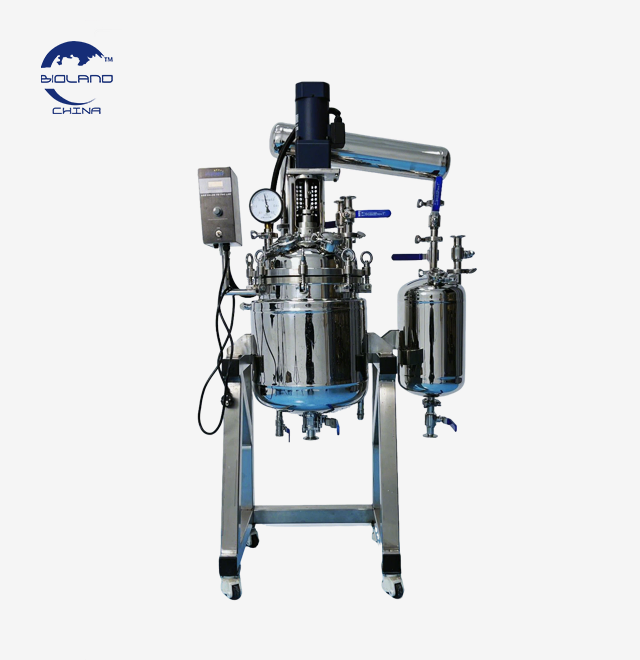
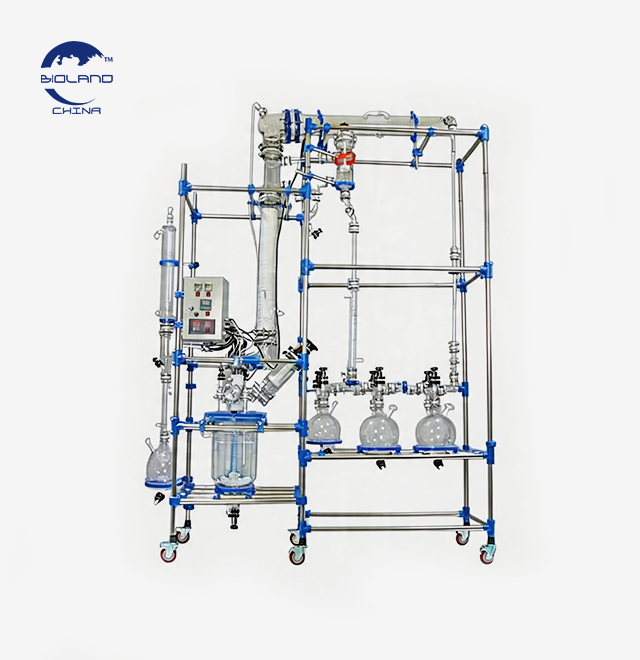
There is a set of parts that go into every borosilicate glass reactor, and knowing how they are put together helps explain why the design works so differently than a metal vessel that is sealed. Each part of the borosilicate glass reactor—the body, the jacket, the lid, the stirring assembly, and the extra connections—is important for controlling the reaction in its own way. Bioland sets up each reactor so that these parts work together as a single, GMP-ready system, rather than a bunch of separate parts that are bolted together.
Reactor Vessel Body and seven-Neck Flange Lid Configuration
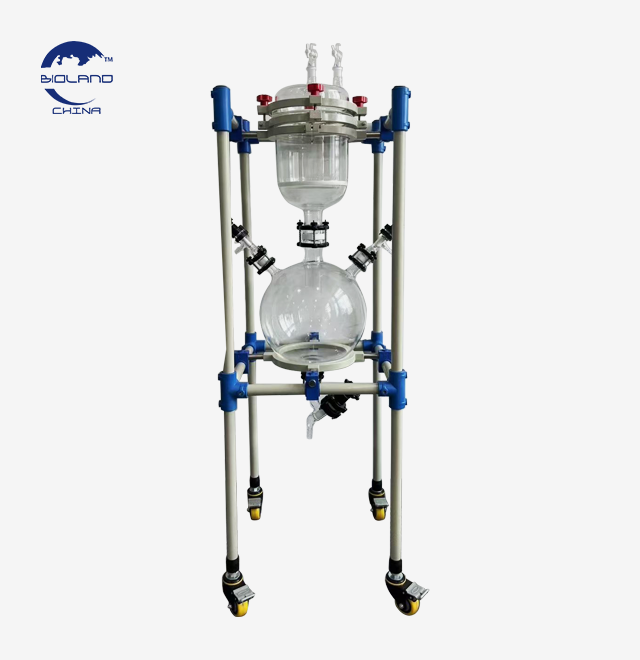
A Bioland borosilicate glass reactor has a cylinder-shaped body made of a single piece of glass or jacketed glass that is sealed with a standard seven-neck flange lid. This type of lid can hold condensers, dropping funnels, temperature probes, and vacuum lines in a variety of ways. With this flange design, the same reactor body can quickly switch between work like distillation, extraction, catalytic reaction, and crystallization by just switching out the parts that go in each neck. Manufacturers who use a wide range of process chemicals like this modularity because it means they don't have to use a separate vessel for each unit operation.
Double-Jacket Structure for Temperature Control
The double-jacket structure on a borosilicate glass reactor wraps around the inner reaction chamber and moves heating or cooling fluid through a sealed outer glass layer. This spreads heat evenly across the vessel wall without the process media and the temperature control fluid coming into direct contact with each other. For low-temperature condensation, this jacket design can work at -80 degrees Celsius. For high-temperature processes, it can work at 300 degrees Celsius. Localized hot spots that can damage sensitive reaction chemistry can't happen because the heat is spread evenly through the jacket.
Stirring Motor, Shaft, and Impeller Assembly
A motor with a changeable frequency moves a shaft and propeller down through the flange lid and into the reaction medium. This gives workers the ability to change the mixing speed to suit the viscosity, particle suspension, or gas-to-liquid mass transfer needs. The borosilicate glass reactor body is completely clear, so this stirring action can be seen the whole time. This way, operators can make sure that the mixing is even instead of just relying on torque or power readings. Spark-free and quiet motor action also makes it safe to use in places with a lot of solvents.
Condenser, Dropping Funnel, and Vacuum Connections
A borosilicate glass reactor has extra flange ports that can connect to a dropping funnel for controlled reagent addition, a reflux condenser to recover volatile solvents, and a vacuum line for distillation or degassing steps. All of these can be used together without changing the design of the core vessel. Because the ports are set up in a flexible way, one borosilicate glass reactor can be quickly changed to work with a different process step. Engineers like that these links use standard ground-glass joints, which makes installation and future updates of the equipment easier.
How Stirring, Heating, and Cooling Systems Operate
Inside a borosilicate glass reactor, mechanical and thermal systems work together to create the controlled environment needed for regulated chemical synthesis. Knowing how these systems work is important for understanding the process consistency that makes this equipment useful. The speed of stirring, the temperature of the jacket, and the amount of pressure can all be changed separately. This gives workers fine-grained control over the reaction dynamics instead of a fixed, one-setting process. Real data from production shows how this operational flexibility leads to results that can be measured.
Variable-Frequency Stirring Motor Mechanism
A borosilicate glass reactor has an electronic variable-frequency motor that changes the speed of the stirring. This means that operators can fine-tune the agitation for a wide range of purposes, from gently mixing biological material that is sensitive to shear to vigorously mixing needed for fast catalytic reactions. This accuracy is very important for dissolved oxygen transfer in fermentation-style processes, where the shape of the rotor and the speed at which it rotates affect how well gas dissolves into the liquid phase.
Case Study: South American Biopharmaceutical Fermentation Optimization
A South American biotech business had trouble with dissolved oxygen efficiency, a long fermentation cycle, and inaccurate process control that made it harder to get intermediate purity in chiral synthesis that is sensitive to oxidation. The way things were set up before wasn't able to provide the clean, tightly controlled environment that their chemistry needed.
Bioland Instrument made a fifty-liter double-layer borosilicate glass reactor just for the client's fermentation broth. The impeller design was optimized to work best with that broth. This change to the machinery made the liquid oxygen work 30% better and cut the fermentation cycle overall.
The clear container let workers see how the color and precipitation changed during the synthesis process. This made the final product more pure by allowing for faster changes to be made in the process. The sealed design also helped protect the oxygen-sensitive chiral intermediates that the client was making from oxygen.
Jacket Heating and Cooling Circuit Operation
A borosilicate glass reactor has a sealed outer jacket that a heating or cooling fluid constantly flows through. This fluid transfers thermal energy through the glass wall to raise or lower the process temperature at a rate that is exactly controlled by the user. There is no chance of thermal fluid poisoning because the circuit never comes into direct touch with the reaction medium. This is a big benefit over designs where the heating elements are inside the tank. One jar can easily move from the reflux stage to the cooling stage to the crystallization stage thanks to this closed-loop process.
Integrated Vacuum System for Distillation and Reflux
A vacuum line connected through the flange lid lets a borosilicate glass reactor work at -9.75 megapascals, which speeds up the evaporation process during distillation and makes reflux more effective when recovering solvents. When the system pressure is low, the boiling point of process liquids goes down. This keeps heat-sensitive chemicals from breaking down during the concentration steps. This vacuum coupling is a big part of the reason why one reactor can do both reaction and separation further down the line without needing extra equipment.
Role of Glass Properties in Reactor Performance
However, the material itself is not inactive. The chemical and physical qualities of borosilicate glass directly affect how well a borosilicate glass reactor works in real-world production situations. Thermal stability, chemical inertness, and visual clarity are all properties that help control reactions and are not just nice to have. Bioland chooses GG17 borosilicate glass because its qualities can be measured and are shown to have practical benefits that are supported by client data.
GG17 Borosilicate Glass Composition and Thermal Stability
The Bioland borosilicate glass reactorsare made of GG17 borosilicate glass, which is made up of silica and boron trioxide. This glass has a low coefficient of thermal expansion, which is what keeps the vessel from cracking during rapid heating and cooling cycles. The fact that this material stays the same size under heat stress is what makes the double-jacket temperature control system work in the first place. A less stable material would break in the same temperature range. Dimensional stability over time is another thing that makes flange seals reliable even after years of use.
Case Study: European Precious Metals Solvent Extraction Line
A European company that processes valuable metals needed to replace old, small separate equipment that wasn't working well enough to support a planned new production line. They also couldn't expand their capacity because they couldn't make the equipment any different, which was a big problem.
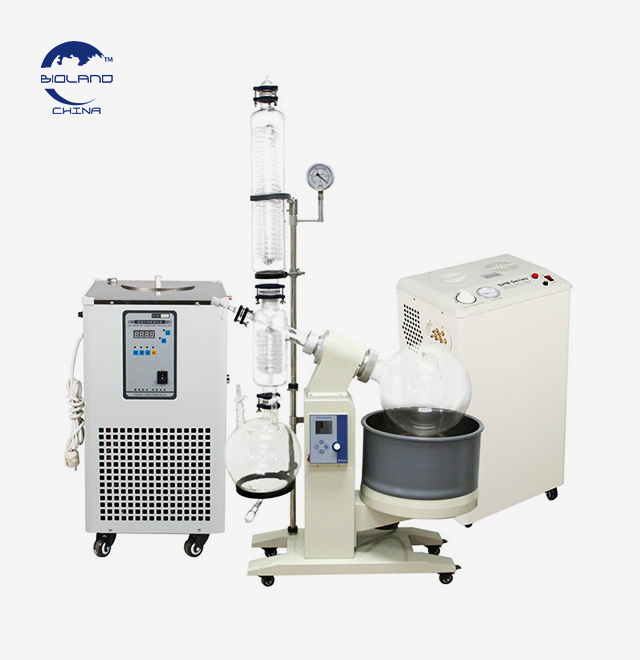
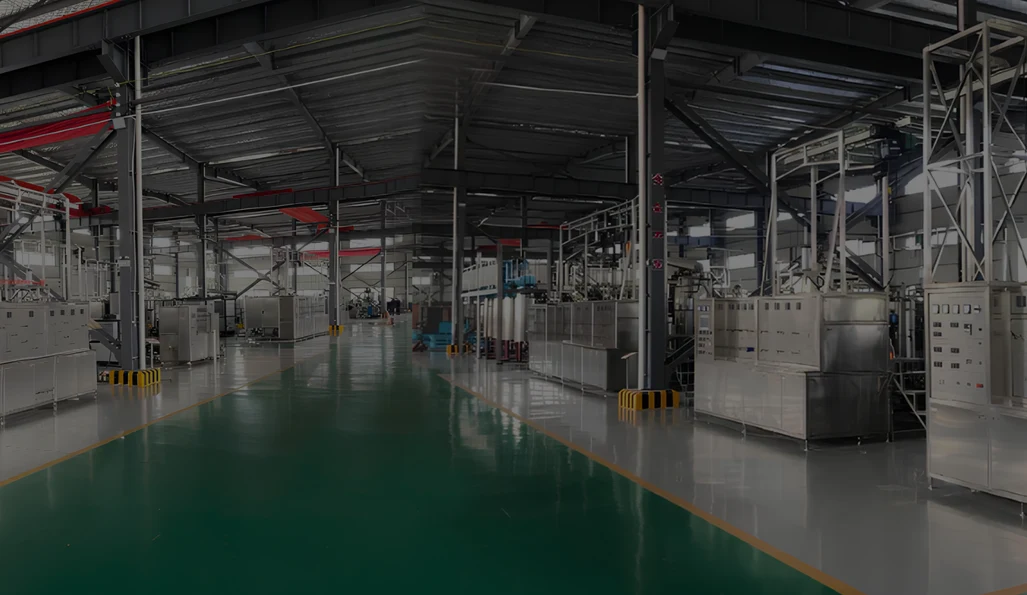
Bioland Instrument provided four 200-liter double-layer borosilicate glass reactors and nine 50-liter explosion-proof rotary evaporators. These were designed to work in harsh, high-risk production environments and were certified to ExdIIBT4 explosion-proof standards.
The delivery time was cut by forty percent thanks to modular manufacturing. This allowed the client to start production fifteen days early, increase annual output capacity by thirty percent, and record over 1,000 fault-free operating hours using precise double-jacketed temperature control from -80 to 200 degrees Celsius.
Chemical Inertness and Contamination Prevention
A borosilicate glass reactor doesn't add any metal ions or leached particles to the process stream because GG17 glass doesn't react with strong acids, strong bases, or aggressive organic solvents. Metal vessels can only come close to this property by carefully choosing the alloy and passivating them. This inertness is most important in high-purity synthesis, where even a small amount of pollution can make a whole production run useless. Material compatibility inspection teams always find it easier to check glass equipment against standards for what can be extracted and what can be leached.
Transparency as a Functional Design Element
The optical clarity in aborosilicate glass reactorisn't just for looks; it's also a real-time diagnostic tool that lets operators see color changes, crystal formation, and phase separation as they happen, instead of using indirect sensor data to guess what's going on with the reaction. This lets you see early on when the process isn't going as planned, and it gives quality engineers written visual proof to back up process characterization reports. In other words, the glass is analyzing things in a way that a metal container that is shut up can't.
Design Factors for Safe and Efficient Operation
A working principle is only useful if it can be used safely on a large scale, and a borosilicate glass reactor's reliability in harsh industrial conditions depends on a number of engineering choices. Explosion-proof construction, double closing, and the ability to make changes to the design all play a role in determining whether a design can be turned from a lab idea into reliable industrial equipment. When Bioland Instrument makes a borosilicate glass reactor, these safety and dependability issues are thought about from the very beginning of the planning process.
Explosion-Proof and PLC Automation Design
Bioland has a fully explosion-proof borosilicate glass reactor that can be used for solvent-heavy synthesis. The temperature, stirring speed, and process sequencing are all controlled by a PLC. With automated control, changes to important process parameters that depend on the operator are taken out. This makes the case for reproducibility stronger, which is what regulators want during process validation. This automation layer is what turns a well-designed vessel into a real production system that can be used again and again, instead of just a lab tool that needs to be operated by hand.
Sealing Systems and Leak Prevention
The connection points on a borosilicate glass reactor are sealed with both PTFE and metal to prevent leaks during long production runs. The structure of the tank, which can be lifted and rotated, makes it easier to charge, discharge, and clean between batches. These choices for seals directly lower the maintenance work that quality teams have to keep up with under change-control procedures. This is because fewer seal failures mean fewer departure reports and less unexpected downtime for a facility's production schedule.
OEM/ODM Customization for Process-Specific Requirements
Because industrial chemistry doesn't usually come in a standard form, Bioland's borosilicate glass reactor line can be fully customized for OEM and ODM orders. The size, shape, material, and internal structure of the vessels can be changed to meet specific experimental or production needs. All of our clients can have a fully explosion-proof system built just the way they want it, complete with PLC automation, temperature control, lifting and rotating mechanisms, filtration, crystallization, ultrasonic-assisted crystallization, tail gas absorption, or a fractional distillation column that is attached.
Conclusion
Four systems work together to make aborosilicate glass reactor work: a modular glass body, a double jacket for precise temperature control, a variable-frequency stirring mechanism, and GG17 glass, which is chemically inert and keeps all processes visible and free of contamination. Bioland Instrument's real client results, which include a 30% increase in dissolved oxygen and a 30% increase in the amount of precious metals that can be extracted, show that this design directly leads to measurable improvements in production performance.
FAQ
Q1: What are the main components of a borosilicate glass reactor?
The core components include the glass vessel body, a five-neck flange lid, a double jacket for temperature control, a variable-frequency stirring assembly, and vacuum, condenser, and dropping funnel connections.
Q2: How does the jacket on a borosilicate glass reactor control temperature?
Heating or cooling fluid circulates through a sealed outer jacket, transferring thermal energy through the glass wall from minus eighty to three hundred degrees Celsius without contacting the process media directly.
Q3: Why is transparency important in a borosilicate glass reactor design?
Transparency lets operators observe color changes, crystallization, and phase separation in real time, catching process deviations early and supporting more accurate reaction control.
Q4: Can a borosilicate glass reactor be customized for specific processes?
Yes. Bioland offers OEM/ODM customization covering vessel size, explosion-proof configuration, automation level, and accessories such as distillation columns or crystallization units.
Q5: What makes GG17 glass suitable for reactor construction?
GG17 borosilicate glass resists strong acids, bases, and solvents while withstanding rapid thermal cycling without cracking, making it chemically inert and dimensionally stable under demanding process conditions.
Talk to Bioland Instrument About Your Reactor Design Needs
If you want equipment engineered around a working principle that genuinely improves process control, not just glass for its own sake, a borosilicate glass reactor from Bioland Instrument delivers exactly that. With more than fifteen years of manufacturing experience, CE and ISO certification, and a technical team that has solved fermentation, extraction, and scale-up challenges for clients across South America, Europe, and beyond, Bioland Instrument builds reactors engineered for real production performance. Whether you need a standard configuration ready within days or a fully customized, explosion-proof, PLC-automated system built to your drawings, our engineers will guide you from initial consultation through Factory Acceptance Test.
Every order includes weekly photo and video progress updates, a one-year warranty, and lifetime maintenance support, so you always know exactly where your equipment stands. Contact our technical team today at info@biolandequip.comto discuss your process requirements, request a customized quotation, or schedule a consultation with our engineering team. Let Bioland Instrument help you understand exactly how the right reactor design solves your production challenge.
References
1. Perry, R. H., and Green, D. W. Perry's Chemical Engineers' Handbook. McGraw-Hill Professional.
2. Levenspiel, O. Chemical Reaction Engineering. John Wiley & Sons.
3. Schott AG. Borosilicate Glass 3.3: Properties and Applications in Process Engineering. Technical Reference Series.
4. Paul, E. L., Atiemo-Obeng, V. A., and Kresta, S. M. Handbook of Industrial Mixing: Science and Practice. Wiley-Interscience.
5. Sinnott, R. K. Chemical Engineering Design. Butterworth-Heinemann.
6. International Council for Harmonisation. ICH Q7: Good Manufacturing Practice Guide for Active Pharmaceutical Ingredients.
The reactor is beautifully mirror-polished and fully complies with GMP requirements for the pharmaceutical industry. The performance is excellent! Overall, we are very satisfied! We also provided with some feedback on our process improvements, which we hope will be helpful.
2024-04-09
Laboratory
Excellent and professional service. Always reply our questions very fast. All reactors and chiller we received are good too.
2024-02-15
Research Institute
Quality is beyond our expectation actually. After we got the extraction equipment and started using it, the performance was beyond our expectation. Very easy to use and very efficient to run. Service always respond us very quickly. Was also very helpful to help us. Thanks Bioland team. Very happy to work with you.
2023-11-20
Biotech Company
We are happy about the new purchase as always. Equipment and services are both good.
2023-08-05
Instrument Lab
This is the second order with Bioland instrument and everything is good as the first dateText.
2023-05-12
Global Trading Partner
Bioland instrument team is very helpful and professional. The sales helped us select the right equipment for our application, and their logistics people handled the transportation and customs declaration for our shipment. All that saved us a lot of work.