Solid Phase Reactor System for Peptide Synthesis Manufacturing Guide
Jul 15, 2026
Scaling peptide synthesis from bench to pilot production depends on one core piece of equipment doing three jobs at once: reacting, filtering, and crystallizing without ever exposing the batch to open air. A well-engineered solid phase reactor is what makes that possible, and Xi'an Bioland Instrument builds its solid phase reactor line specifically for peptide drug development, thymosin preparation, antimicrobial peptide screening, and peptide carrier material synthesis, combining explosion-proof pressure-rated construction, a large-diameter PTFE filtration device, and precise -20°C to 200°C temperature control. This manufacturing guide walks through the core components behind a reliable solid phase reactor, how to optimize the synthesis process step by step, how to scale up production, and how to evaluate quality and performance once the system is running in a real production environment.
Key Components and Design Principles of Solid Phase Reactor Systems
The Filtration Device as the Functional Core
Every solid phase reactor depends on its filtration device as the operational heart of the system, since peptide synthesis alternates repeatedly between coupling, washing, and filtration steps within the same vessel. Bioland equips each solid phase reactor with a sintered PTFE filtration core as standard, with stainless steel, titanium, or various filter cloth and membrane options available so the medium matches the specific resin and peptide chemistry being processed. A large-diameter filtration surface also speeds up each wash cycle, which matters directly for total batch time across a multi-step synthesis sequence.
Agitation and Mixing for Uniform Coupling Reactions
Consistent peptide chain growth depends on uniform contact between resin, reagents, and coupling agents, which is why a solid phase reactor requires programmable agitation rather than fixed-speed mixing. Even distribution during each coupling cycle reduces incomplete reactions and truncated sequences, directly improving the purity of the final peptide product before it ever reaches the purification stage.
Core Components Working Together as One System
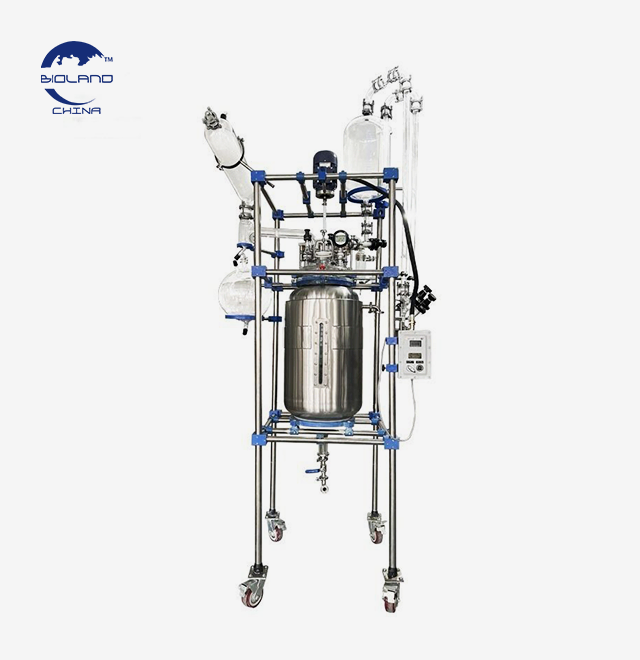
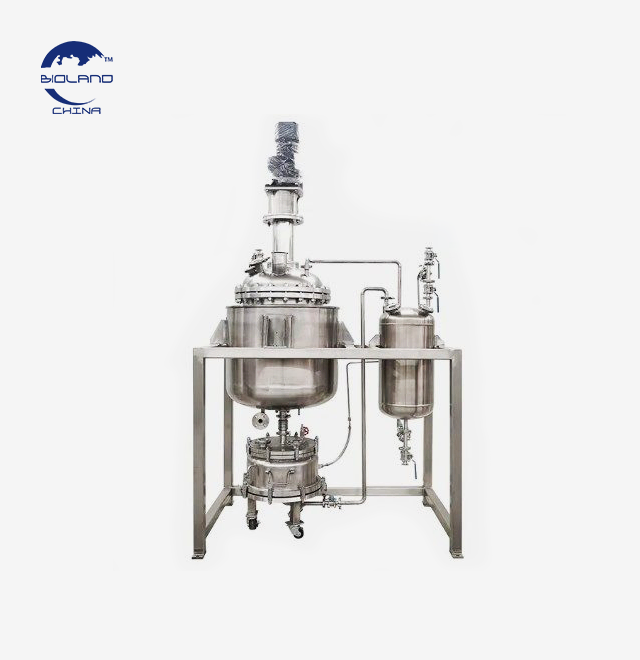
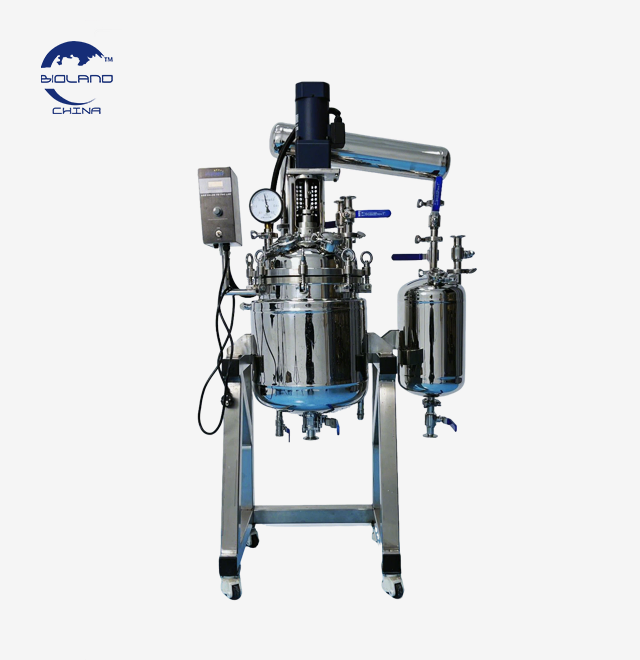
A reliable solid phase reactor depends on several linked components: the filtration device that separates resin from solution, the agitation unit that controls mixing uniformity, the heating and cooling circuit that governs solubility and reaction rate, and the pumping and piping network that moves solvent and reagent through each wash cycle without introducing air or moisture. A PLC control system with touchscreen interface ties these components together into one automated sequence rather than requiring manual adjustment at every stage.
Integrated Heating and Cooling Circuit
A solid phase reactor built on GG17 borosilicate glass supports a working temperature range of -20°C to 200°C, and this range can be extended further by pairing the reactor with a stainless steel high-and-low temperature integrated unit for demanding synthesis steps. Precise thermal control across the jacket influences solubility and reaction kinetics at each stage, which is essential for consistent yield across multi-step peptide synthesis sequences. Programmed temperature transitions between coupling, deprotection, and washing steps also help maintain resin swelling consistency, which directly affects reagent access throughout the synthesis cycle.
Case Study: Chiral Intermediate Synthesis Under Nitrogen Protection
A European biopharmaceutical company developing a chiral API intermediate needed to guarantee reaction completeness while avoiding acid and base corrosion from prior equipment. Bioland Instrument supplied a customized 100L glass solid phase reactor that ran reaction under nitrogen protection at 0–5°C with full visual monitoring, then moved directly into crystallization and filtration within the same sealed vessel.
Step-by-Step Process Optimization for Peptide Synthesis Production
Establishing Controlled Reaction Conditions
Peptide coupling reactions inside a solid phase reactor perform best under tightly controlled temperature and inert-gas conditions, since oxygen exposure and thermal fluctuation both increase side-reaction rates. Running the coupling step at low temperature under nitrogen protection, as demonstrated in the European chiral intermediate project, keeps side products to a minimum and improves overall sequence fidelity before the peptide chain moves to the next cycle. Documenting these conditions for each product run also gives process engineers a reliable reference for troubleshooting the next scale-up phase.
Programmed Cooling for Crystallization Precision
Once synthesis is complete, a solid phase reactor uses jacket cooling to lower solubility gradually and encourage clean crystallization, and controlling the cooling rate directly determines crystal quality. A rate of roughly 1–2°C per hour, rather than rapid uncontrolled cooling, produced uniform crystals that avoided impurity inclusion and lifted purity above 99.5% with a 15% yield improvement in the same chiral intermediate case.
Direct Filtration Without Material Transfer
Switching a solid phase reactor from crystallization directly into filtration mode, using the same PTFE filtration device, eliminates the material transfer step that introduces contamination risk between separate vessels. Mother liquor can often be recycled directly from this integrated step, reducing solvent consumption while keeping the entire reaction-crystallization-filtration sequence inside one transparent, contamination-controlled system. For peptide manufacturers running dozens of coupling and wash cycles per batch, this integration removes a meaningful source of cumulative yield loss.
Case Study: Solid-Phase Catalyst Synthesis at High Temperature
A Polish chemical producer developing palladium and platinum catalysts needed a solid phase reactor able to withstand 150°C reaction conditions without deactivating the catalyst or corroding under aggressive organic-ligand chemistry. Bioland customized a 50L glass solid phase reactor that completed the high-temperature reaction and then filtered the solid catalyst directly, recovering over 90% of residual precious metal from the mother liquor.
Scale-Up Strategies for Efficient Peptide Manufacturing Operations
Matching Reactor Volume to Production Stage
Peptide manufacturers typically move through a 20L to 30L solid phase reactor for early process development, a 50L system for pilot-scale validation, and a 100L or larger unit for production-level batches, allowing the same reaction and filtration principles to scale without re-optimizing the chemistry at every stage. This staged approach reduces the risk of unexpected yield loss when a process finally reaches commercial volume, since the same filtration device geometry and agitation logic carry through from development to production.
Explosion-Proof Safety at Increasing Batch Sizes
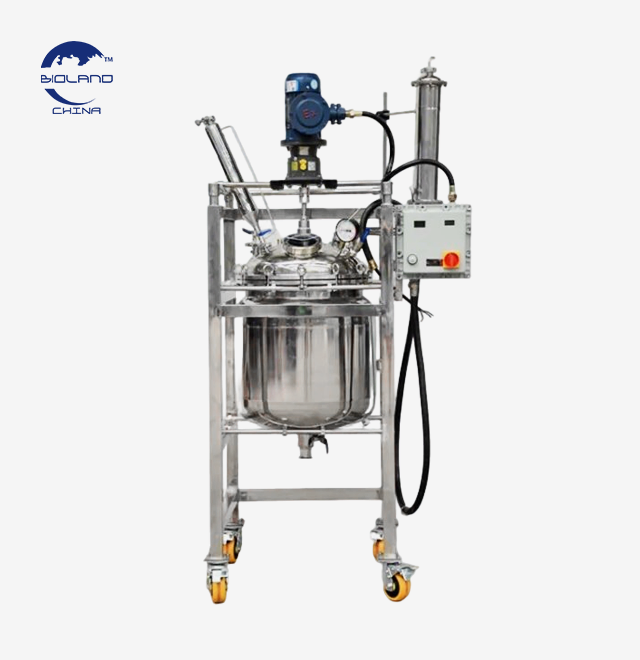
As batch volume grows, so does the risk profile of solvent-heavy peptide synthesis, and a solid phase reactor rated for explosion-proof operation across 20L, 30L, 50L, and 100L volumes keeps that risk under control through high-strength pressure-bearing construction and a certified explosion-proof control system. This safety margin matters most during scale-up, when higher solvent volumes and longer reaction times increase exposure time to hazardous conditions, and it gives operations managers a documented basis for safety compliance as production volumes grow.
PLC Automation for Repeatable Multi-Batch Production
Bioland's solid phase reactor line supports full PLC-controlled automation with an integrated touchscreen interface, allowing operators to program coupling, washing, cooling, and filtration steps once and repeat them precisely across every subsequent batch. This level of automation is what allows a facility to scale from a handful of development runs to dozens of production batches without introducing operator-to-operator variability, which matters increasingly as regulatory scrutiny of peptide manufacturing consistency continues to grow.
Case Study: Modular Delivery for Fast Facility Commissioning
Beyond the pharmaceutical and catalyst cases above, Bioland's modular manufacturing approach — building the vessel, jacket, filtration device, and control panel in parallel — has cut delivery timelines by roughly 40% on complex multi-unit orders for clients scaling new production lines, helping facilities begin commissioning weeks ahead of a sequential build schedule. This same modular strategy applies directly to a solid phase reactor scale-up project, where matching vessel, jacket, and control components can be built and tested together before final assembly on site.
Quality Control and Performance Evaluation in Peptide Reactor Systems
Monitoring Purity and Yield Through Process Data
Evaluating a solid phase reactor's performance starts with tracking purity and yield against baseline targets after every batch, since a properly tuned reactor should deliver consistent results across sequential runs. In the European chiral intermediate case, purity above 99.5% and a 15% yield improvement over the client's previous process became the ongoing benchmark for every subsequent batch through the same reactor. Building this kind of batch-over-batch dataset from a single solid phase reactor gives quality teams an early warning system for gradual process drift.
Full Transparency for In-Process Verification
Because a solid phase reactorbuilt from GG17 glass is fully transparent, quality teams can visually confirm reaction completion, monitor crystal formation, and check filtration clarity in real time rather than relying solely on end-of-batch lab analysis. This visual verification catches deviations early enough to adjust the process before an entire batch is compromised, and it gives operators a practical, low-cost supplement to analytical testing at every stage of the synthesis cycle.
Routine Maintenance to Sustain Long-Term Performance
Ongoing performance depends on regular inspection of the PTFE filtration device, agitator seals, and jacket circulation, since gradual wear in any of these components can shift filtration speed or temperature accuracy over time. A solid phase reactor with a quick-release filtration design simplifies this maintenance, keeping cleaning validation and element replacement fast between different peptide or intermediate campaigns. Scheduling this inspection on a fixed interval, rather than reactively after a slowdown appears, keeps a solid phase reactor performing at its rated specification across years of continuous use.
Bioland's Certification and After-Sales Quality Assurance
Our company is CE and ISO certified, with an in-house R&D team boasting years of engineering experience, and every customized solid phase reactor includes a one-year quality warranty with lifetime maintenance support. During production, a dedicated specialist tracks progress weekly with photos or videos, and clients may schedule a Factory Acceptance Test at our facility once the equipment is ready, giving buyers documented quality assurance before the reactor ever leaves the factory. This same weekly tracking process applies whether the order is a single development-scale unit or a multi-reactor production line.
Conclusion
A well-designed solid phase reactor brings reaction, crystallization, and filtration together in one transparent, explosion-proof system, giving peptide and fine chemical manufacturers the process control needed to scale from development to production without losing purity or yield. Bioland Instrument's PTFE filtration device, precise -20°C to 200°C temperature range, and full PLC automation options, backed by CE/ISO certification and documented quality processes, make it a proven, dependable platform for peptide synthesis manufacturing at any scale.
FAQ
Q1: What makes a solid phase reactor suitable for peptide synthesis?
Its integrated reaction, filtration, and crystallization design keeps the peptide chain sealed from contamination while supporting the repeated coupling and washing cycles synthesis requires.
Q2: What temperature range does Bioland's solid phase reactor support?
The GG17 glass construction supports -20°C to 200°C, extendable further with a paired high-and-low temperature integrated unit.
Q3: Can the reactor scale from lab development to production volume?
Yes, Bioland offers 20L to 100L-plus volumes with consistent filtration and automation principles across every scale.
Q4: Is explosion-proof construction available for solvent-heavy synthesis?
Yes, every volume from 20L to 100L can be built to certified explosion-proof standards for hazardous solvent environments.
Q5: How is filtration medium selected for different peptide chemistries?
Bioland offers PTFE, stainless steel, titanium, and various filter cloth or membrane options matched to resin type and particle characteristics.
Build Your Peptide Manufacturing Line With Bioland Instrument
Ready to scale your peptide synthesis process without sacrificing purity or safety? Bioland Instrument's solid phase reactor combines explosion-proof construction, a large-diameter PTFE filtration device, and precise temperature control across 20L to 100L volumes, backed by more than 15 years of manufacturing experience and CE/ISO/GMP certification. Every order includes weekly production tracking, a one-year warranty, lifetime maintenance, and optional Factory Acceptance Testing. Contact Bioland Instrument at info@biolandequip.com to discuss a customized solid phase reactor for your peptide manufacturing line today.
References
1. Merrifield, R.B. (1963). Solid Phase Peptide Synthesis. I. The Synthesis of a Tetrapeptide. Journal of the American Chemical Society, 85(14), 2149-2154.
2. Chan, W.C., and White, P.D., eds. (2000). Fmoc Solid Phase Peptide Synthesis: A Practical Approach. Oxford University Press.
3. Perry, R.H., and Green, D.W. (2019). Perry's Chemical Engineers' Handbook, 9th Edition. McGraw-Hill Education.
4. Rushton, A., Ward, A.S., and Holdich, R.G. (2008). Solid-Liquid Filtration and Separation Technology, 2nd Edition. Wiley-VCH.
5. U.S. Food and Drug Administration. (2021). Current Good Manufacturing Practice (cGMP) Regulations for Pharmaceutical Production. FDA Publications.
6. Sinnott, R.K., and Towler, G. (2019). Chemical Engineering Design, 6th Edition. Butterworth-Heinemann.
The reactor is beautifully mirror-polished and fully complies with GMP requirements for the pharmaceutical industry. The performance is excellent! Overall, we are very satisfied! We also provided with some feedback on our process improvements, which we hope will be helpful.
2024-04-09
Laboratory
Excellent and professional service. Always reply our questions very fast. All reactors and chiller we received are good too.
2024-02-15
Research Institute
Quality is beyond our expectation actually. After we got the extraction equipment and started using it, the performance was beyond our expectation. Very easy to use and very efficient to run. Service always respond us very quickly. Was also very helpful to help us. Thanks Bioland team. Very happy to work with you.
2023-11-20
Biotech Company
We are happy about the new purchase as always. Equipment and services are both good.
2023-08-05
Instrument Lab
This is the second order with Bioland instrument and everything is good as the first dateText.
2023-05-12
Global Trading Partner
Bioland instrument team is very helpful and professional. The sales helped us select the right equipment for our application, and their logistics people handled the transportation and customs declaration for our shipment. All that saved us a lot of work.