How to Reduce Clogging in Glass Filter Reactor Systems
Jul 16, 2026
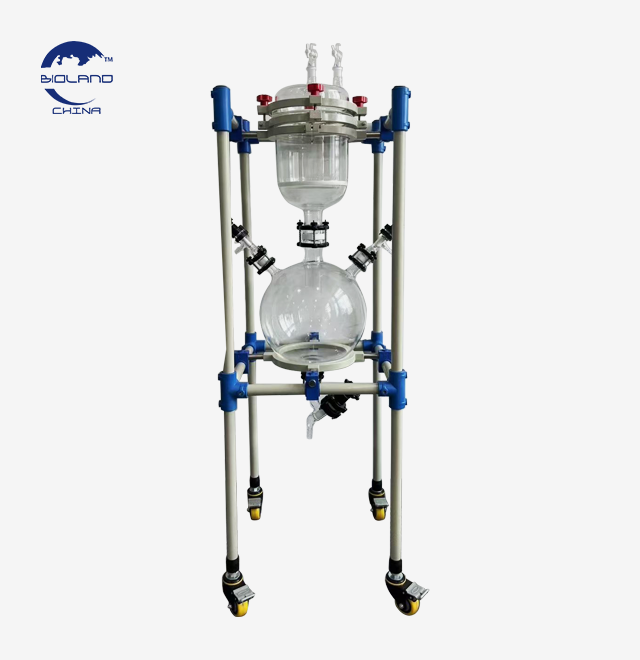
When solids and liquids are separated, clogging is the most annoying problem that can happen. A well-designedglass filter reactoris the key to a smooth production run for people who do crystallization, filtration, and solid-phase synthesis all in one vessel. Xi'an Bioland Instrument's glass filter reactor is based on a large-diameter PTFE filtration device, an explosion-proof pressure-rated construction, and precise -80°C to 200°C dual-jacket temperature control. This gives producers of pharmaceuticals, fine chemicals, and precious metals a reaction-crystallization-filtration platform that is designed to not get clogged. This guide talks about why clogging happens, what design features stop it, how to run and keep a system so that the filter stays stable, and what to think about when looking for long-term dependability.
Common Causes of Clogging in Glass Filter Reactor Systems
Uncontrolled Crystallization Rate and Particle Size
Most of the time, a glass filter reactor gets clogged because the cooling or crystallization rate is not managed, which makes small, uneven particles instead of uniform crystals. When the temperature drops too quickly, fines (small crystals) form faster than they can grow evenly. These fines pack tightly against the filter medium, blocking flow and making the process take much longer than it should.
Case Study: Chiral API Intermediate Crystallization for a European Pharmaceutical Client
A European biopharmaceutical company working on a chiral API intermediate had a lot of problems, including reactions that didn't finish, low crystallization purity and yield, and acid-base chemistry that broke down old equipment. Bioland Instrument made a special 100L glass filter reactor so that reaction, crystallization, and filtration could all happen at the same time in a sealed order. This stopped the fine particles that the client had been having problems with when they used different vessels for processing.
Filter Medium Mismatch and Pore Blinding
If you pick a filtering medium that doesn't match the particle size or crystal shape, tiny solids will get stuck in the surface of the filter instead of sitting on top of it. This is called pore blindness. As a standard, a properly specified glass filter reactorhas a sintered PTFE core. Other options include stainless steel, titanium, or different types of filter cloth and membranes, so the medium matches the crystal habit instead of being a generic default. One of the most common and easy ways to avoid repeat clogging during a production campaign is to choose the wrong medium at the start.
Inadequate Agitation During Crystal Formation
If there isn't enough or consistent stirring during the crystallization phase, the crystals can stick together and trap the mother liquor, making a gel-like layer that blocks the filter almost right away after it starts to filter. Programmable stirring in a glass filter reactor keeps the suspension constant as it cools. This makes crystals that can be filtered out instead of clumps that block the filter bed.
The Core Components Behind Reliable Filtration Performance
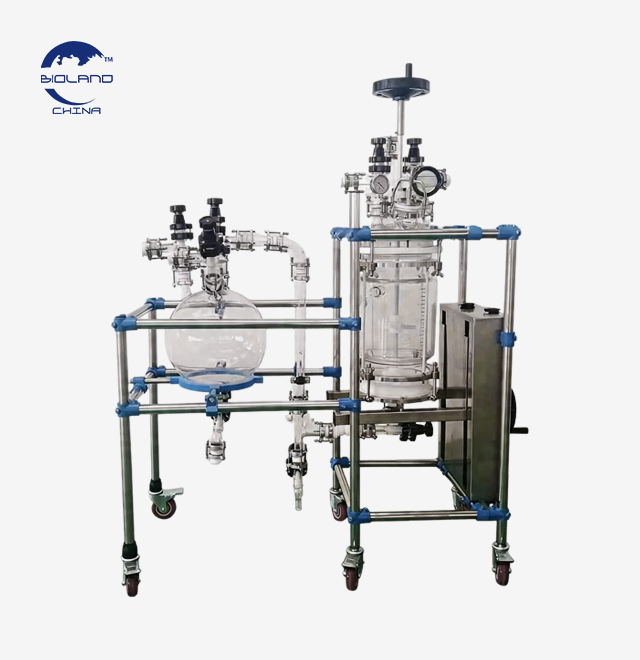
Several interconnected parts work together to make a glass filter reactor system: the filtration device, the agitation and mixing unit (which controls crystal growth), the heating and cooling circuit (which controls solubility), and the pipe and pump network (which moves material without adding air). These parts are connected by a PLC control system with a tablet interface. This lets the system work automatically and over and over again without having to be adjusted by hand at each step.
Equipment Design Features That Help Prevent Blockage
Large-Diameter PTFE Filtration Device as Standard
Every Bioland glass filter reactor is equipped as standard with a sintered PTFE filtration device, and the large-diameter design increases available filtration area relative to batch volume, reducing the flux rate through any single point on the filter surface. Lower localized flux means fewer fine particles are driven into the pores under pressure, which is one of the primary mechanical reasons clogging develops in undersized filtration systems. High-speed filtration performance also shortens overall cycle time, which matters directly for throughput on facilities running multiple batches per week.
Case Study: Precious-Metal Catalyst Recovery for a Polish Chemical Producer
A Polish chemical company recovering palladium and platinum catalysts faced low recovery rates, corrosive attack on equipment, catalyst deactivation from high-temperature solid-phase reactions, and poor solid-liquid separation efficiency. Bioland customized a 50L glass filter reactor to run solid-phase reaction at 150°C followed directly by PTFE filtration, recovering over 90% of residual precious metal from the mother liquor while avoiding the catalyst deactivation the client's prior equipment had caused.
A glass filter reactor that keeps reaction, crystallization, and filtration inside one sealed vessel avoids the material transfer steps that introduce air, moisture, or cross-contamination between stages. For the European pharmaceutical client, this integration meant the reaction ran under nitrogen protection at 0–5°C, crystallization proceeded at a controlled 1–2°C per hour cooling rate through the jacket, and filtration began immediately without exposing the crystal slurry to open air, lifting purity above 99.5% and yield by roughly 15%.
Full Transparency for Real-Time Blockage Detection
Because a glass filter reactor is fully transparent, operators can watch filtration flow visually and catch the early signs of blinding — a slowing meniscus, a cloudy filtrate, or visible cake buildup — long before flow stops entirely. This visibility lets operators adjust vacuum, pressure, or agitation in real time rather than discovering a clog only after the batch has already stalled.
Operating and Maintenance Practices to Maintain Stable Filtration
Controlling Cooling and Crystallization Rate
Because crystal quality directly determines filterability, operators running a glass filter reactor should program cooling rates rather than relying on ambient jacket temperature drift. Controlled rates around 1–2°C per hour, as used in the European chiral intermediate case, consistently produce larger, more uniform crystals that filter faster and resist blinding compared with rapid, uncontrolled cooling.
Solvent Selection and Concentration Control
Selecting the correct solvent and maintaining proper concentration ensures the target solid dissolves fully before crystallization and precipitates cleanly afterward. Operators running a glass filter reactor should monitor both temperature and concentration together, since a solvent system that is too concentrated encourages rapid, uncontrolled nucleation that produces the fine particles most likely to clog the filter. Documenting solvent-solubility curves for each product run through the glass filter reactor also gives operators a reference point for troubleshooting the next time filtration slows unexpectedly.
Routine Cleaning and Filter Element Maintenance
A glass filter reactorwith a quick-release PTFE filtration device simplifies cleaning and element replacement between batches, preventing residual solids from one campaign from contaminating or partially blocking the next. Regularly monitoring filtration speed and pressure against baseline values helps operators schedule cleaning proactively rather than waiting for a full blockage to force an unplanned stop. Facilities running multiple fine chemical or pharmaceutical products through the same glass filter reactor benefit most from this routine, since cross-batch residue is a frequent hidden cause of gradual flow decline.
Bioland's Weekly Production Tracking and After-Sales Support
Our company is CE and ISO certified, with an in-house R&D team boasting years of engineering experience, and every customized glass filter reactor includes a one-year quality warranty with lifetime maintenance support. During production, a dedicated specialist tracks progress weekly with photos or videos, and clients may schedule a Factory Acceptance Test at our facility once the equipment is ready, ensuring the filtration system performs as specified from first use.
Key Considerations for Long-Term System Reliability
Explosion-Proof Construction for Hazardous Solid-Phase Synthesis
Bioland's glass filter reactor is available in fully explosion-proof configurations built on industrial-grade safety standards, with high-strength pressure-bearing construction rated for 20L, 30L, 50L, and 100L volumes under high-pressure synthesis conditions. This certified explosion-proof performance removes a major long-term risk factor for facilities running solid-phase peptide synthesis, thymosin preparation, or antimicrobial peptide screening under demanding safety requirements. Peptide carrier material synthesis in particular relies on a glass filter reactor's combination of chemical stability and mechanical strength to sustain repeated reaction cycles without degrading filtration performance.
Non-Standard Customization for Specific Process Needs
According to customer needs and experimental or production requirements, Bioland customizes a glass filter reactor in size, shape, structure, and automation level, including electric lifting, PLC-controlled full automation, integrated temperature control, crystallization, ultrasonic crystallization, and rectification combination configurations. This customization capability lets clients solve process-specific clogging risks — unusual particle morphology, unusually viscous mother liquor, or extreme temperature swings — rather than adapting their process to a fixed standard vessel. Clients with unique reaction chemistries can request a fully engineered glass filter reactor rather than choosing between a limited set of catalog sizes.
Wide Temperature Range for Consistent Crystal Formation
A GG17 borosilicate glass filter reactor supports a working range of -80°C to 200°C, or -20°C to 200°C on solid-phase synthesis configurations, giving operators the temperature control needed to keep crystallization rates consistent from batch to batch. Consistent crystal formation is directly tied to long-term filtration reliability, since inconsistent crystal size distribution is what causes intermittent clogging episodes over a production campaign. A glass filter reactor can also pair with a stainless steel high-and-low temperature integrated unit, extending precise heating and cooling control across an even wider process range for demanding pharmaceutical and organic synthesis work.
Choosing a Manufacturer With Proven Fine Chemical and Pharmaceutical Experience
Xi'an Bioland Instrument Co.,Ltd. is a professional manufacturer and solution provider for R&D, production, and sales of distillation, concentration, reaction, extraction, separation, filtration, purification, crystallization, emulsification, mixing, and drying equipment, with more than 15 years of experience supporting these processes with heating, cooling, and vacuum devices. Selecting a glass filter reactor supplier with this depth of engineering history matters for long-term reliability, since design details like filter medium selection, jacket sizing, and agitator geometry are refined through years of solving exactly the clogging problems fine chemical producers face.
Conclusion
Clogging in a glass filter reactoralmost always traces back to uncontrolled crystallization, a mismatched filter medium, or inconsistent agitation, and each of these causes can be engineered around with the right equipment. Bioland Instrument's large-diameter PTFE filtration device, integrated reaction-crystallization-filtration design, and explosion-proof, fully customizable construction give pharmaceutical, fine chemical, and precious-metals producers a proven path to stable, high-yield filtration batch after batch.
FAQ
Q1: What is the most common cause of clogging in a glass filter reactor?
Uncontrolled crystallization rate is the leading cause, producing fine, irregular particles that pack against the filter medium and restrict flow.
Q2: Does the filtration medium need to be customized for each process?
Yes, Bioland offers PTFE, stainless steel, titanium, and various filter cloth or membrane options to match specific particle size and crystal morphology.
Q3: Can a glass filter reactor handle high-temperature solid-phase synthesis?
Yes, explosion-proof configurations support high-pressure solid-phase reactions up to 150°C across 20L to 100L volumes.
Q4: How does reaction-crystallization-filtration integration reduce clogging?
Keeping all three steps in one sealed vessel avoids material transfer that introduces air, moisture, or contamination, producing cleaner, more filterable crystals.
Q5: What temperature range supports consistent crystal formation?
Bioland's glass filter reactor operates from -80°C to 200°C, allowing controlled cooling rates that produce uniform, filter-friendly crystals.
Solve Your Filtration Challenges With Bioland Instrument
If clogging, low yield, or inconsistent crystal quality is slowing down your production line, Bioland Instrument can help you engineer a solution rather than just sell you a vessel. Our glass filter reactor combines a large-diameter PTFE filtration device, integrated reaction-crystallization-filtration design, and explosion-proof construction rated for 20L to 100L volumes, backed by more than 15 years of manufacturing experience, CE and ISO certification, and GMP/FDA-compliant construction. Every order includes weekly production updates with photos or videos, a one-year quality warranty, lifetime maintenance support, and the option to schedule a Factory Acceptance Test before shipment.
Whether you need standard filtration or a fully customized, PLC-automated system with electric lifting and integrated temperature control, our engineering team will help you specify the right configuration at a competitive price. Contact Bioland Instrument today at info@biolandequip.com to discuss your filtration and crystallization challenges and get a customized glass filter reactor built for stable, long-term operation.
References
1. Perry, R.H., and Green, D.W. (2019). Perry's Chemical Engineers' Handbook, 9th Edition. McGraw-Hill Education.
The reactor is beautifully mirror-polished and fully complies with GMP requirements for the pharmaceutical industry. The performance is excellent! Overall, we are very satisfied! We also provided with some feedback on our process improvements, which we hope will be helpful.
2024-04-09
Laboratory
Excellent and professional service. Always reply our questions very fast. All reactors and chiller we received are good too.
2024-02-15
Research Institute
Quality is beyond our expectation actually. After we got the extraction equipment and started using it, the performance was beyond our expectation. Very easy to use and very efficient to run. Service always respond us very quickly. Was also very helpful to help us. Thanks Bioland team. Very happy to work with you.
2023-11-20
Biotech Company
We are happy about the new purchase as always. Equipment and services are both good.
2023-08-05
Instrument Lab
This is the second order with Bioland instrument and everything is good as the first dateText.
2023-05-12
Global Trading Partner
Bioland instrument team is very helpful and professional. The sales helped us select the right equipment for our application, and their logistics people handled the transportation and customs declaration for our shipment. All that saved us a lot of work.