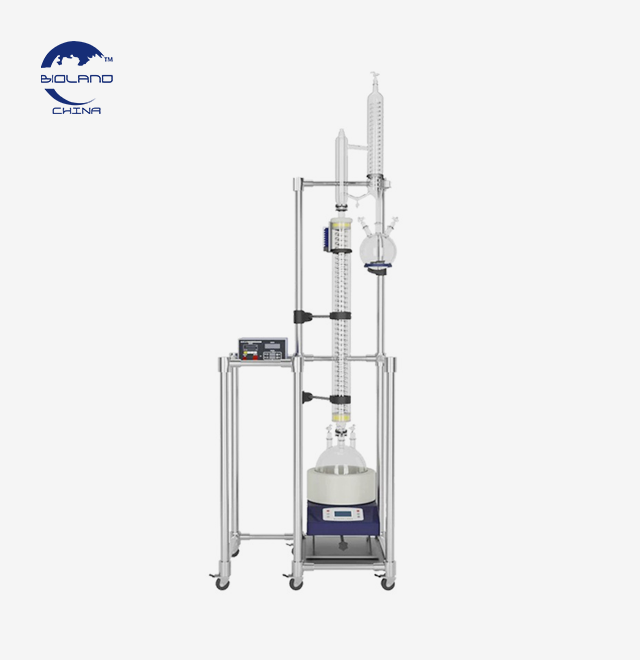
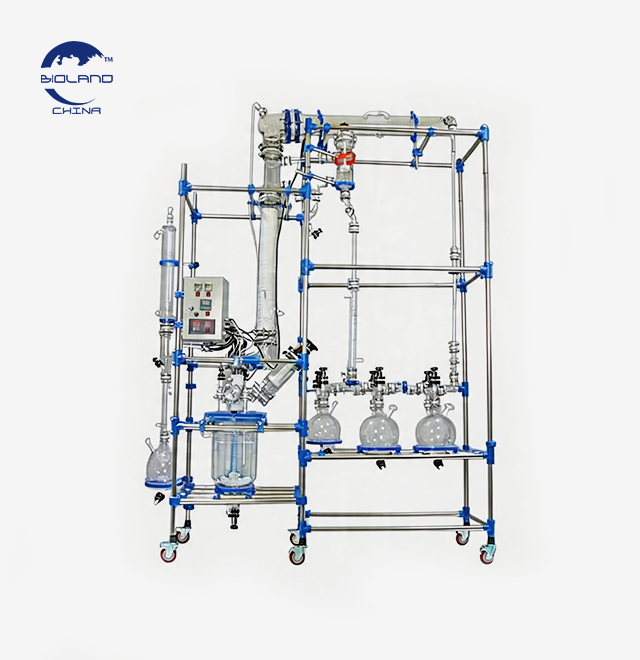
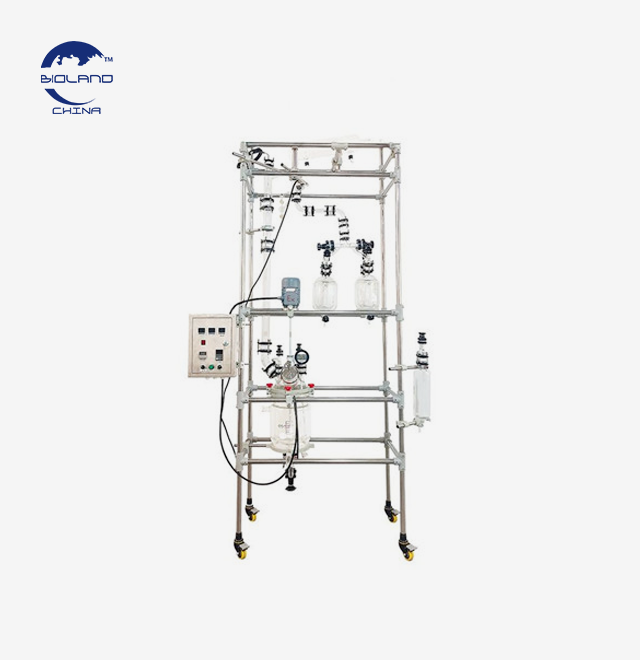
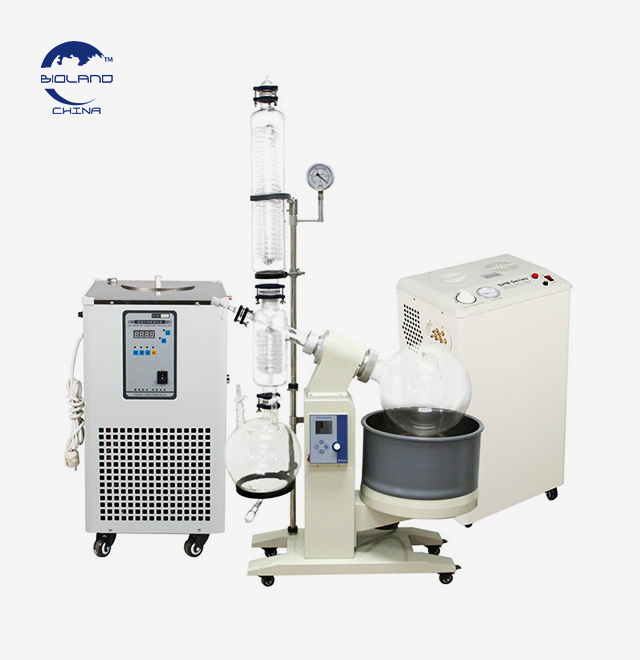
Temperature drift is one of the fastest ways to ruin an otherwise well-designed synthesis, turning a clean reaction into a mixture of side products or an inconsistent crystallization batch. Even a few degrees of unplanned variation can shift reaction selectivity, trigger unwanted side reactions, or produce crystals with the wrong particle size distribution. A chemical glass reactor built around a dual-jacket shell, transparent GG17 borosilicate construction, and precise circulation control is engineered specifically to prevent that drift. Xi'an Bioland Instrument Co., Ltd. has spent more than 15 years refining how a chemical glass reactor holds temperature steady across a working range from -80°C to 300°C, giving pharmaceutical, chemical, and biotech clients the accuracy needed for sensitive fermentation, crystallization, and catalytic processes. This article walks through the factors, systems, design choices, and monitoring methods that make temperature control accuracy possible in a Bioland chemical glass reactor, illustrated with real customer results.
Key factors affecting temperature control precision in glass reactors
Several variables determine how precisely a chemical glass reactor can hold a target temperature: jacket design, media circulation rate, reaction mass volume, and how quickly heat generated by the reaction itself is removed. Getting all of these right is what separates a reactor that merely reaches a setpoint from one that holds it steadily throughout the entire batch, and overlooking any single factor can undo the benefit of getting the others right.
Dual-jacket heat transfer efficiency
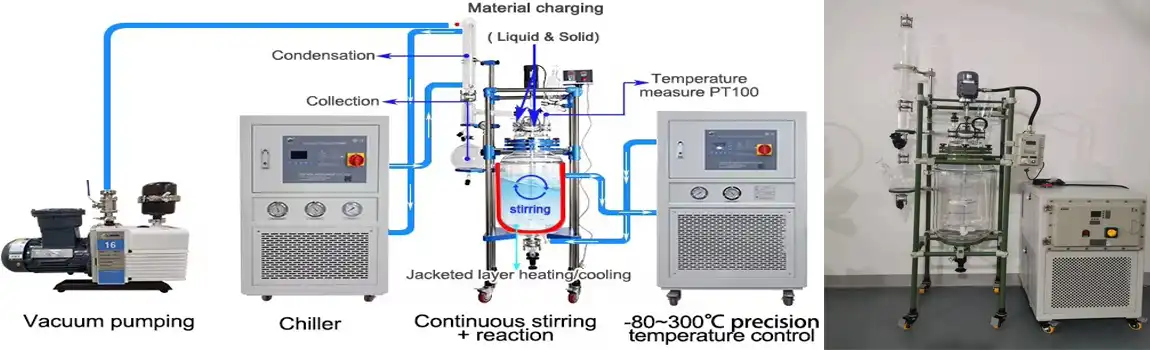
A chemical glass reactor with a dual-jacket shell circulates heating or cooling media around the vessel wall independently of the reaction mass, which is the single biggest factor in temperature control precision. Bioland's dual-jacket design supports a working range from roughly -80°C for low-temperature condensation up to 300°C for high-temperature synthesis, letting one chemical glass reactor serve multiple process stages without swapping equipment.
Reaction mass volume and heat load
Larger batch volumes generate more total heat during exothermic reactions, so a chemical glass reactor sized correctly for the batch volume maintains tighter control than an undersized or oversized vessel. Bioland engineers size the jacket surface area and media flow rate to match expected heat load, which is one of the customization steps built into every non-standard chemical glass reactor order.
Agitation speed and thermal uniformity
Uneven mixing creates hot spots and cold spots inside a chemical glass reactor even when the jacket itself is holding a stable temperature, since heat needs to move from the vessel wall through the reaction mass. Bioland customizes stirring paddle geometry to viscosity and reaction type, improving thermal uniformity and helping the chemical glass reactor hold accurate temperature throughout the vessel rather than just near the wall.
Case snippet: dissolved-oxygen and thermal control in fermentation
A South American biopharmaceutical company faced insufficient dissolved-oxygen efficiency and imprecise temperature control that limited product purity in oxidation-sensitive synthesis. Bioland customized a 50-liter double-layer chemical glass reactor with a redesigned agitator, raising dissolved-oxygen efficiency by roughly 30% while holding sterile, precisely controlled temperature conditions needed for pharmaceutical intermediate synthesis.
Role of heating and cooling systems in reaction temperature stability
The heating and cooling circuit attached to a chemical glass reactor does most of the actual work of holding temperature stable, and its responsiveness determines how quickly the system corrects for disturbances like reagent addition or exothermic reaction onset. A sluggish circuit that takes minutes to respond will always struggle to hold tight tolerances, no matter how well the rest of the vessel is designed.
Wide-range circulation for heating and cooling in one system
Bioland's chemical glass reactor uses a single dual-jacket circuit capable of both heating and cooling, so operators can move from a low-temperature crystallization step to a high-temperature reflux step without disconnecting and reconnecting separate heating and cooling equipment. This continuity is a major reason the chemical glass reactor holds tighter temperature accuracy than setups built from separate heating baths and chillers.
Vacuum-assisted temperature management
A chemical glass reactor paired with a vacuum system reaching approximately -0.095 MPa allows lower-temperature distillation and reflux, which protects heat-sensitive compounds while still achieving efficient solvent recovery. Because vacuum reduces the boiling point of solvents, it gives the chemical glass reactor another lever for temperature stability beyond jacket circulation alone.
Response speed during exothermic reaction onset
The moment an exothermic reaction begins releasing heat, the heating and cooling circuit of a chemical glass reactor needs to respond quickly to prevent temperature overshoot, since excess heat can accelerate side reactions or degrade sensitive intermediates. Bioland's dual-jacket system is designed for fast media turnover specifically to catch these transitions before they affect product quality.
Case snippet: precision temperature control in precious metals extraction
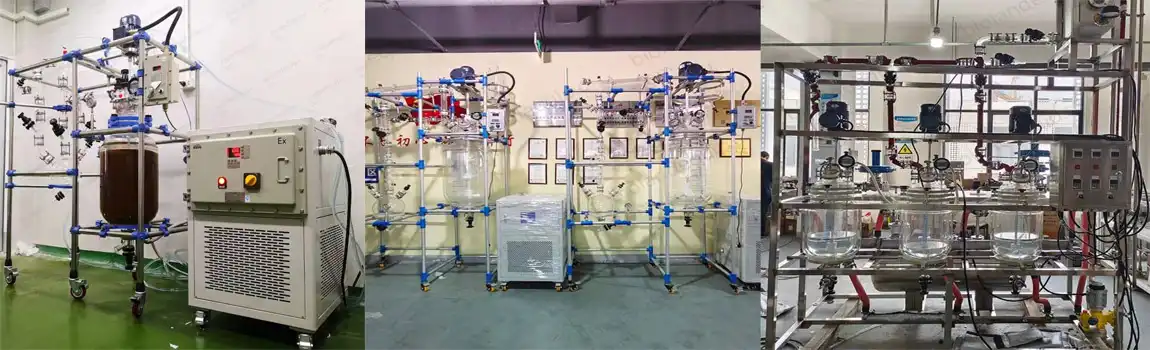
A European precious-metals producer needed precise temperature control across a highly corrosive solvent extraction process that traditional equipment could not scale or control accurately. Bioland supplied four 200-liter explosion-proof double-layer chemical glass reactor units engineered to ExdIIBT4 standards, holding temperature between -80°C and 200°C. The client reached 1,000+ fault-free operating hours and a 30% capacity increase after switching to the customized system.
How reactor design improves thermal efficiency and process control
Beyond the jacket and circulation system, the overall design of a chemical glass reactor affects how efficiently heat moves through the vessel and how easily operators can adjust process conditions in response to what they observe. Small design details, like flange placement and glass wall thickness, add up to meaningful differences in how consistently the vessel performs across hundreds of production cycles.
Transparent glass construction for real-time thermal judgment
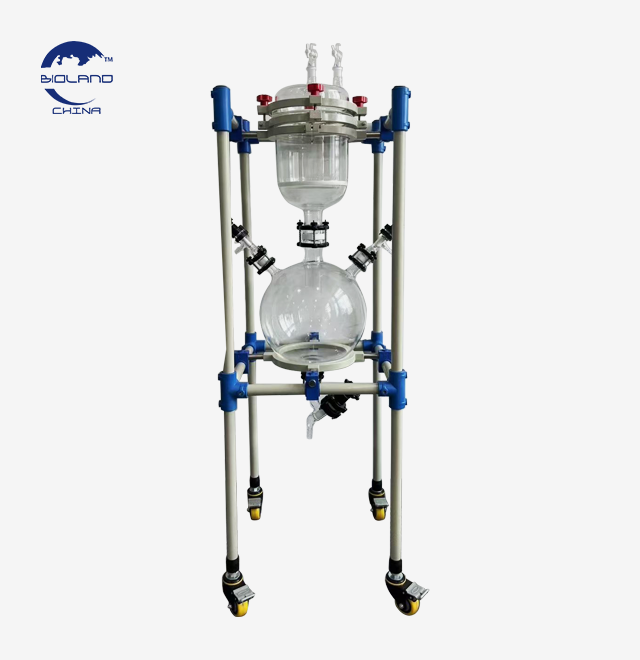
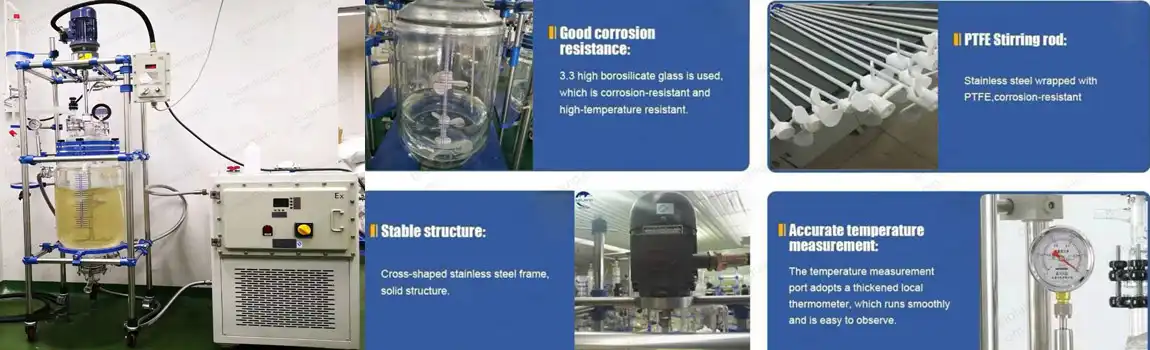
Because a chemical glass reactor uses fully transparent GG17 borosilicate glass, operators can visually confirm reaction behavior — color change, gas evolution, reflux rate — that often signals a temperature-related issue before a sensor reading alone would show it clearly. This visual feedback lets technicians intervene early, protecting both product quality and equipment safety.
Modular flange configuration for process flexibility
Standard flange ports on a chemical glass reactor, such as a five-neck lid, connect condensers, dropping funnels, temperature probes, and vacuum pumps in fixed positions, letting one chemical glass reactor adapt to distillation, extraction, catalytic, or crystallization workflows without redesigning the thermal setup each time. This modularity keeps temperature control consistent even as the process itself changes between stages.
Chemical resistance protecting long-term thermal performance
GG17 glass resists strong acids, strong bases, and organic solvents without leaching metal ions, which matters for temperature accuracy too: corrosion inside a metal vessel over repeated cycles can degrade jacket surfaces and reduce heat transfer efficiency over time. A chemical glass reactor avoids this gradual performance decline, holding its original thermal accuracy far longer than corrosion-prone alternatives.
Sealing and drive system contributing to stable operation
Bioland's chemical glass reactor uses double-protection sealing — PTFE combined with mechanical seals — alongside a variable-frequency, spark-free drive motor, which keeps agitation speed steady and prevents the vibration or leakage that can disrupt consistent thermal contact between the jacket and vessel wall. Stable mechanical operation is a quieter but still important contributor to temperature control accuracy.
Temperature monitoring methods for reliable chemical reaction performance
Even the best-designed heating and cooling system needs accurate monitoring to confirm the chemical glass reactor is actually holding its target temperature, and to create the documentation records regulated industries require. Without reliable monitoring, operators are effectively trusting the equipment rather than verifying its actual performance batch after batch.
Real-time probe placement and calibration
Temperature probes inserted through dedicated flange ports on a chemical glass reactor provide continuous readings from inside the reaction mass rather than relying solely on jacket temperature, which can differ meaningfully from the actual reaction temperature depending on heat load. Regular calibration of these probes is essential to keep readings accurate over the equipment's operating life.
PLC-integrated data logging for documentation
A chemical glass reactor with PLC-integrated controls can automatically log temperature, pressure, and agitation data throughout each batch, creating a timestamped record that supports GMP-style documentation requirements without adding manual recording work for the operator. This automated logging is increasingly requested by pharmaceutical and biotech clients preparing for regulatory validation.
Combining visual and instrumented monitoring
The most reliable approach pairs instrumented temperature readings with the visual monitoring a transparent chemical glass reactor already provides, letting operators cross-check sensor data against what they can actually observe happening inside the vessel. This combination catches problems that either method alone might miss, such as a probe reading that looks normal while localized hot spots are visible in the reaction mass.
Company strength behind consistent thermal performance
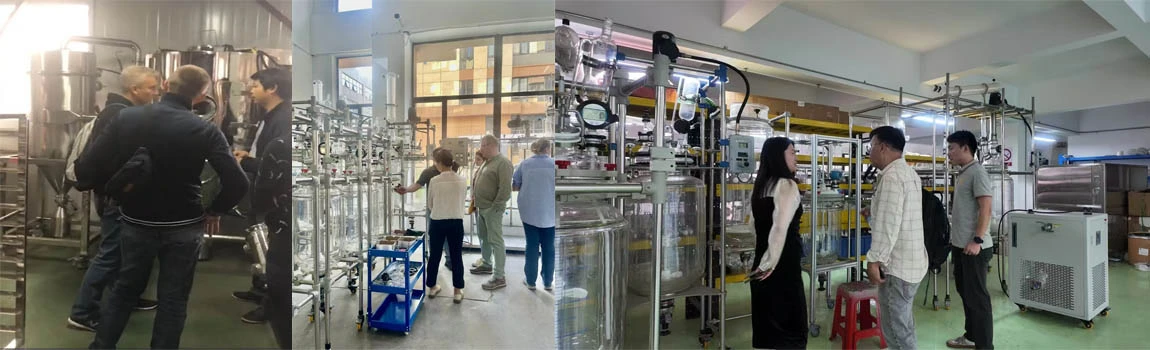
Xi'an Bioland Instrument Co., Ltd. is a professional manufacturer and solution provider for R&D, production, and sales of distillation, concentration, reaction, extraction, separation, filtration, purification, crystallization, emulsification, mixing, and drying equipment, alongside supporting heating, cooling, and vacuum devices, with more than 15 years of experience in the field. Every Bioland chemical glass reactor carries ISO safety certification and CE marking, is manufactured to GMP/FDA-aligned standards, and is backed by a dedicated specialist tracking weekly production progress with photos or video, plus optional Factory Acceptance Testing before shipment.
Conclusion
Temperature control accuracy in a chemical glass reactor depends on dual-jacket heat transfer, responsive heating and cooling circuits, thoughtful vessel design, and reliable monitoring, all working together consistently. Bioland's chemical glass reactor platform delivers this accuracy across a -80°C to 300°C range, backed by 15-plus years of engineering experience, CE/ISO/GMP/FDA-aligned manufacturing, and full customization support, giving pharmaceutical, chemical, and biotech clients the thermal precision their processes demand from lab trial through pilot production.
FAQ
Q1: What temperature range can a Bioland chemical glass reactor hold?
A: The dual-jacket design supports roughly -80°C to 300°C depending on configuration.
Q2: Does vacuum help with temperature control?
A: Yes, vacuum reduces solvent boiling points, giving another lever for thermal stability.
Q3: Can the chemical glass reactor log temperature data automatically?
A: Yes, PLC-integrated options provide automated, timestamped logging for documentation.
Q4: Does agitation affect temperature accuracy?
A: Yes, poor mixing creates hot and cold spots even with a stable jacket temperature.
Q5: Can the reactor be customized for explosion-proof environments?
A: Yes, units can be built to ExdIIBT4 standards for hazardous processes.
Get Precise Temperature Control for Your Next Process
If temperature drift, inconsistent batches, or scale-up uncertainty are affecting your production line, a chemical glass reactor from Xi'an Bioland Instrument Co., Ltd. can give you the thermal precision your process needs. With more than 15 years of engineering experience, CE and ISO certification, and GMP/FDA-aligned manufacturing, Bioland builds every chemical glass reactor with dual-jacket heat transfer covering -80°C to 300°C, transparent GG17 glass for real-time visual monitoring, and full OEM/ODM customization including explosion-proof construction and PLC-based automation.
Our engineers size jacket surface area and agitator geometry to your specific batch volume and heat load, rather than shipping a generic configuration. Every order is tracked weekly by a dedicated specialist with photos or video, and Factory Acceptance Testing is available before shipment, so you know exactly what you're receiving. Whether you're scaling a sensitive fermentation process, running exothermic synthesis, or need tight crystallization temperature control, our team can recommend the right chemical glass reactor configuration for your process. Contact us at info@biolandequip.com to discuss your requirements and request a quote.
References
1. Perry, R. H., and Green, D. W. (Eds.). Perry's Chemical Engineers' Handbook. McGraw-Hill.
2. Levenspiel, O. Chemical Reaction Engineering. John Wiley & Sons.
3. Incropera, F. P., DeWitt, D. P., Bergman, T. L., and Lavine, A. S. Fundamentals of Heat and Mass Transfer. John Wiley & Sons.
4. Paul, E. L., Atiemo-Obeng, V. A., and Kresta, S. M. (Eds.). Handbook of Industrial Mixing: Science and Practice. John Wiley & Sons.
5. Seborg, D. E., Edgar, T. F., Mellichamp, D. A., and Doyle, F. J. Process Dynamics and Control. John Wiley & Sons.
6. Nauman, E. B. Chemical Reactor Design, Optimization, and Scaleup. John Wiley & Sons.