What Is the Difference Between Glass Reactor and Steel Reactor Systems
Jul 16, 2026
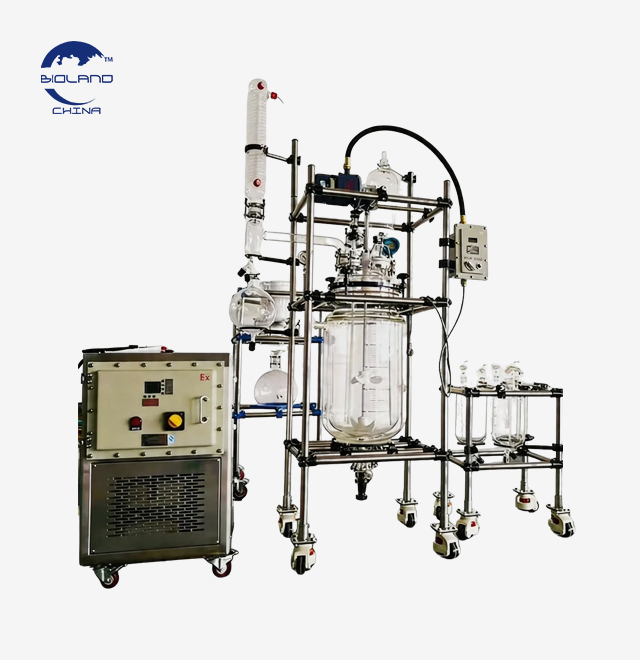
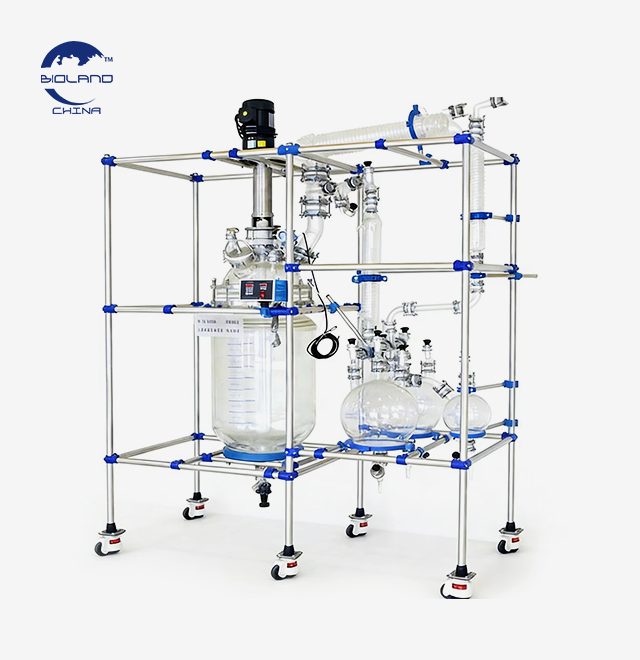
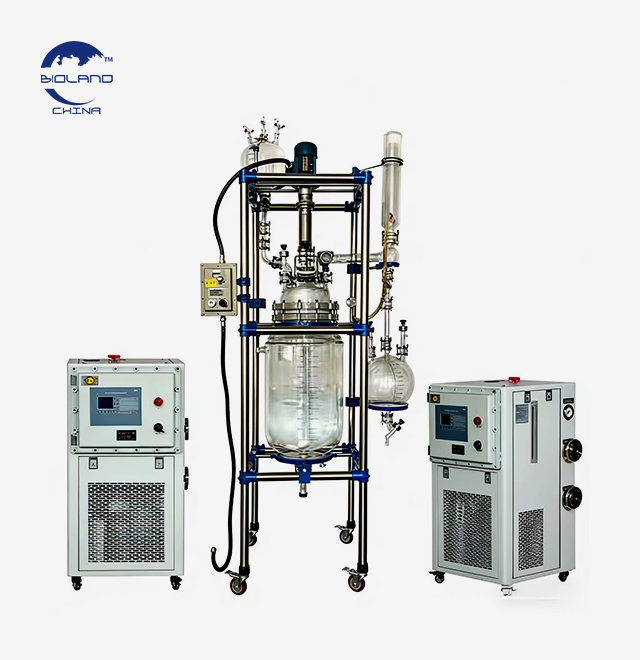
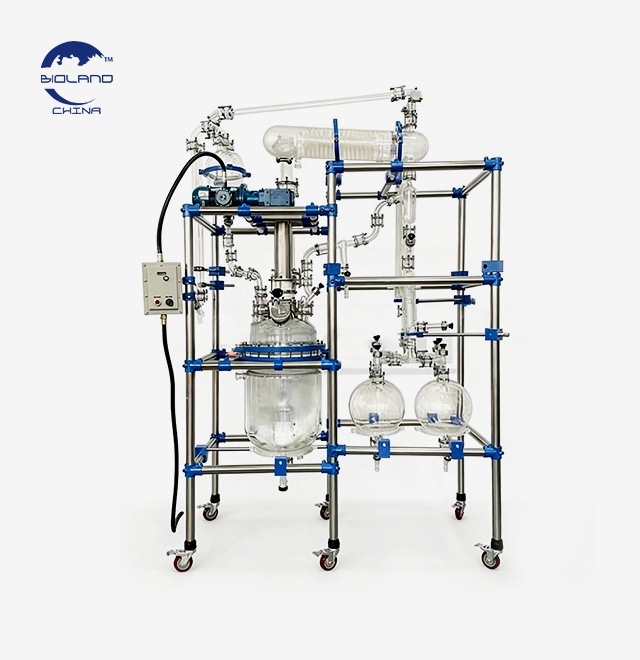
Choosing between glass and stainless steel is one of the first decisions any fine chemical or pharmaceutical buyer faces when specifying pilot-scale equipment, and for mid-volume production the 100 liter glass reactor has become the benchmark against which steel alternatives are measured. Xi'an Bioland Instrument's 100 liter glass reactor is built from GG17 borosilicate glass with a dual-jacket structure supporting -80°C to 300°C operation, PTFE double sealing, and full process visibility — advantages that let fine chemical, pharmaceutical, and extraction operators see exactly what a sealed steel vessel would hide. This guide compares material properties, heat transfer, pressure handling, and durability between the two reactor types, then walks through how to select the right system for your production line.
Material Properties and Corrosion Resistance Comparison Between Reactors
GG17 Borosilicate Glass Versus 304/316 Stainless Steel
A 100 liter glass reactor is built from GG17 borosilicate glass, a material chosen specifically because it resists strong acids, strong bases, and organic solvents without corroding or leaching metal ions into the reaction mass. Stainless steel, even in 316L grade, remains vulnerable to pitting and stress corrosion when exposed continuously to chloride-rich or strongly acidic media, which is the exact chemistry many fine chemical processes depend on.
Case Study: Corrosion-Free Production for Nitric Acid and Acidified Glycerin Lines
A chemical intermediates manufacturer running continuous nitric acid and acidified glycerin production needed vessels that would not pit or contaminate the batch over years of exposure. Bioland Instrument supplied customized glass reactor systems, including 100 liter glass reactor units, that have supported this client's nitric acid line, acidified glycerin process, and downstream intermediate production without the corrosion issues their previous steel equipment experienced.
Contamination Risk in Metal-Ion-Sensitive Synthesis
For pharmaceutical intermediates and biologically active compounds, even trace metal-ion contamination from a corroding steel wall can fail a purity specification. A 100 liter glass reactor eliminates this risk entirely because the only wetted surfaces are GG17 glass and PTFE, both chemically inert across the vast majority of fine chemical process chemistries.
Surface Finish and Cleaning Between Batches
Steel vessels rely on electropolishing to reduce surface roughness and prevent residue buildup, but welded seams and agitator penetrations still create micro-crevices over time. The smooth, non-porous wall of a 100 liter glass reactor has no welds in the wetted zone, which shortens cleaning validation between different fine chemical products and reduces cross-contamination risk in multi-product facilities. Operators moving several small campaigns through the same 100 liter glass reactor each month consistently report faster changeover than teams cleaning an equivalent welded steel vessel.
PTFE Sealing as a Chemical-Compatibility Extension
Beyond the glass vessel itself, every wetted seal on a 100 liter glass reactor uses PTFE, a material that resists nearly the same chemical range as the borosilicate glass body. This matters because a steel reactor's overall corrosion resistance is only as strong as its weakest gasket, and mismatched elastomer seals are a common source of contamination that a properly specified glass system avoids entirely.
Differences in Heat Transfer, Pressure Handling, and Durability
Dual-Jacket Temperature Control Range
The dual-jacket construction on a 100 liter glass reactor circulates oil or ethanol as a heat-transfer medium independently of the reaction mass, supporting a working range of -80°C to 300°C. Steel jacketed reactors can reach similarly wide ranges, but without direct visual confirmation, operators must rely entirely on sensor data to judge whether the reaction mass is actually tracking the jacket temperature.
Case Study: Precise Low-Temperature Extraction for a European Precious-Metals Client
A European precious-metals producer needed accurate low-temperature control for solvent extraction but found existing steel equipment offered only narrow, imprecise temperature bands. Bioland Instrument delivered four customized 200L explosion-proof double-layer glass reactors and nine 50L rotary evaporators rated to ExdIIBT4 standards, and the same dual-jacket engineering underpins every 100 liter glass reactor in Bioland's catalog, supporting -80°C to 200°C control for corrosive extraction work.
Vacuum and Pressure Handling Compared to Steel
A 100 liter glass reactor typically operates from full vacuum, reaching below -0.095 MPa with PTFE sealing, up through modest positive pressure suited to reflux and distillation. Steel reactors generally handle significantly higher positive pressure ratings, which makes steel the better choice for high-pressure hydrogenation or polymerization, while glass remains the stronger option for vacuum-driven distillation, solvent recovery, and low-pressure crystallization work. For most fine chemical operations that rely on reflux, evaporation, or controlled solvent recovery rather than sustained high pressure, this vacuum-optimized range covers the process window without any practical limitation.
Long-Term Durability and Thermal Shock Resistance
Programmed, gradual heating and cooling ramps protect a 100 liter glass reactor from thermal shock cracking, and GG17 glass's low thermal expansion coefficient makes it more resistant to stress fracture than ordinary glass. Steel reactors do not face this thermal shock limitation, but they carry a different long-term durability concern: gradual wall thinning from corrosion that is invisible until a leak or failure occurs. A spark-free variable-frequency motor, PTFE double sealing, and a lifting-and-rotating structural design on the 100 liter glass reactor further reduce the handling stress that causes chips or cracks, extending service life well beyond what manual glass systems typically achieve.
Advantages and Limitations of Glass and Steel Reactor Systems
Full Process Visibility as the Defining Glass Advantage
The best thing about a 100 liter glass reactor over a steel one is that it is completely transparent. This means that operators can see the color change, formation of precipitates, foaming, and phase separation happening in real time, instead of having to operate in a "black box" like they do with metal tanks that are shut. This makes it easier to repeat the process and lets process engineers make changes while the process is going on instead of having to wait for a sample result at the end of the batch.
Case Study: Real-Time Visual Control for Oxygen-Sensitive Fermentation
A biotech client in South America had trouble making oxidation-sensitive intermediates because the dissolved oxygen wasn't working well and the product quality wasn't always stable. Bioland changed the agitator on a 50L double-layer glass reactor, which increased the efficiency of dissolved oxygen by about 30%. For customers going from lab tests to pilot-scale fermentation-adjacent synthesis, the same visible tracking and PTFE double closing are integrated into Bioland's 100 liter glass reactor.
Where Steel Still Outperforms Glass
For high-pressure hydrogenation, large-scale chemical manufacturing, and processes using abrasive slurries that could scratch or stress glass walls, steel reactor systems are usually the best choice. They can handle higher operating pressures, greater mechanical impact resistance, and larger single-vessel volumes than glass.
Balancing Trade-Offs for Mid-Scale Fine Chemical Production
For most fine chemical, pharmaceutical intermediate, and precious metals extraction work at the pilot to early production scale, a 100 liter glass reactor strikes the practical balance: enough volume for meaningful batch sizes, complete visual and chemical compatibility advantages over steel, and a vacuum and moderate-pressure range that covers the vast majority of fine chemical unit operations without the need for the additional pressure headroom that steel provides.
How to Select the Right Reactor for Industrial Applications
Matching Volume to Your Production Stage
Since it provides enough batch volume for useful scale-up data while still being simple to handle, clean, and inspect visually between runs, buyers moving from lab-scale trials into pilot production frequently choose a 100 liter glass reactor as the step between a 10–50L development unit and a 200L+ production system. This mid-range volume also keeps a 100 liter glass reactor within reach of a single overhead crane or lifting frame, avoiding the heavier installation requirements that come with larger production-scale steel tanks.
Before selecting between glass and steel, buyers should map their full process chemistry against material resistance: strongly acidic, basic, or solvent-heavy processes favor a 100 liter glass reactor, while high-pressure hydrogenation, large-volume bulk manufacturing, or abrasive slurry handling typically favor steel construction instead. If you look at solvent compatibility charts and predicted changes in working pressure and temperature early on in the project, you can avoid having to make an expensive move between reactor types in the middle of the project.
Customization Options That Extend Glass Reactor Capability
Beyond standard configurations, Bioland can create a 100 liter glass reactor in a variety of sizes, shapes, materials, and structures based on customer needs and experimental or production requirements. Fully explosion-proof systems, PLC-controlled automation, integrated temperature control, lifting and rotating structures, filtration, crystallization, ultrasonic crystallization, tail-gas absorption, and rectification columns are all options that can be built to meet the exact process needs of the client.
Working With a Manufacturer That Supports the Full Project Lifecycle
Xi'an Bioland Instrument Co.,Ltd. is a professional company that designs, builds, and sells equipment for drying, heating, cooling, emulsification, mixing, and distillation. They have more than 15 years of experience supporting these processes with heating, cooling, and vacuum devices, and their products are CE and ISO certified and built in a way that is GMP and FDA-compliant. Choosing a provider with this amount of technical experience counts as much as choosing between glass and steel, since a 100 liter glass reactor is only as reliable as the maker standing behind its design, customization, and after-sales support.
Conclusion
Glass and steel reactors serve different priorities: steel supports high pressure and wear resistance, while a100 liter glass reactor offers unmatched clarity, chemical inertness, and precision temperature control for fine chemical, medicinal, and extraction work. Bioland Instrument's GG17 design, dual-jacket range, and full customization options make the 100 liter glass reactor the sensible choice for pilot-to-production buyers who need both process openness and reliable, corrosion-free performance batch after batch.
FAQ
Q1: Is a 100 liter glass reactor more corrosion-resistant than steel?
Yes, GG17 borosilicate glass resists strong acids, bases, and solvents without pitting or leaching metal ions, unlike even 316L stainless steel under continuous corrosive exposure.
Q2: Can a 100 liter glass reactor handle high pressure like steel?
No, glass systems are best suited to vacuum and moderate positive pressure; steel remains the stronger choice for high-pressure hydrogenation or large bulk processes.
Q3: What temperature range does Bioland's 100 liter glass reactor support?
The dual-jacket design supports -80°C to 300°C, covering low-temperature crystallization through high-temperature reflux in a single vessel.
Q4: Why is process visibility important when comparing glass to steel?
Transparent glass lets operators observe reaction progress directly, improving reproducibility and enabling faster in-process adjustments than sealed steel tanks allow.
Q5: Can the 100 liter glass reactor be customized for explosion-proof operation?
Yes, Bioland offers fully explosion-proof, PLC-automated configurations with integrated temperature control for hazardous solvent environments.
Talk to Bioland Instrument About Your Reactor Selection
If you are weighing glass against steel for your next pilot or production line, Bioland Instrument can help you make that decision with data, not guesswork. Our 100 liter glass reactor is built from GG17 borosilicate glass with dual-jacket temperature control, PTFE double sealing, and full customization for explosion-proof, PLC-automated, or specialty-configured systems, backed by more than 15 years of manufacturing experience, CE and ISO certification, and GMP/FDA compliance. Every order includes weekly production updates with photos or videos, a one-year quality warranty, lifetime maintenance support, and the option to schedule a Factory Acceptance Test before shipment.
Whether your process demands the visibility and chemical resistance of glass or the pressure tolerance of steel, our engineering team will help you specify the right configuration at a competitive price. Contact Bioland Instrument today at info@biolandequip.com to discuss whether a 100 liter glass reactor fits your fine chemical, pharmaceutical, or extraction process, and get a customized solution built for reliable, long-term operation.
References
1. Perry, R.H., and Green, D.W. (2019). Perry's Chemical Engineers' Handbook, 9th Edition. McGraw-Hill Education.
2. Levenspiel, O. (1999). Chemical Reaction Engineering, 3rd Edition. John Wiley & Sons.
The reactor is beautifully mirror-polished and fully complies with GMP requirements for the pharmaceutical industry. The performance is excellent! Overall, we are very satisfied! We also provided with some feedback on our process improvements, which we hope will be helpful.
2024-04-09
Laboratory
Excellent and professional service. Always reply our questions very fast. All reactors and chiller we received are good too.
2024-02-15
Research Institute
Quality is beyond our expectation actually. After we got the extraction equipment and started using it, the performance was beyond our expectation. Very easy to use and very efficient to run. Service always respond us very quickly. Was also very helpful to help us. Thanks Bioland team. Very happy to work with you.
2023-11-20
Biotech Company
We are happy about the new purchase as always. Equipment and services are both good.
2023-08-05
Instrument Lab
This is the second order with Bioland instrument and everything is good as the first dateText.
2023-05-12
Global Trading Partner
Bioland instrument team is very helpful and professional. The sales helped us select the right equipment for our application, and their logistics people handled the transportation and customs declaration for our shipment. All that saved us a lot of work.