Key Factors When Choosing a Solid Phase Synthesis Reactor
Jul 29, 2026
Choosing a solid phase synthesis reactor affects every run that comes after it, from the growth of the resin and the joining of amino acids to the final cleavage and recovery of the product. The solid phase synthesis reactor platform that Xi'an Bioland Instrument Co., Ltd. makes is based on three things that process engineers really need: a fully visible high-borosilicate glass vessel, explosion-proof safety across 20L to 100L volumes, and an integrated PTFE filtration base that gets rid of the transfer steps that most old setups still need. Our solid phase synthesis reactor is not just a tank; it is designed to be a full reaction-filtration-washing platform. This means that peptide, resin, and fine-chemical makers can run more cycles per shift with less physical work and a lower chance of cross-contamination. Before choosing a solid phase synthesis reactor provider, you should read this advice and think about the questions you should ask about construction, control, capacity, and economy.
Understanding Reactor Design and Material Requirements
Explosion-Proof Structure for High-Pressure Synthesis
Every solid phase synthesis reactor needs to start with safety that meets industrial standards. Our vessels are made with high-strength pressure-bearing frames and an approved explosion-proof control system. This lets a solid phase synthesis reactor handle tough synthesis conditions in 20L, 30L, 50L, and 100L sizes without putting user safety at risk. This confirmed performance is most important in solvent-heavy peptide and glue chemistry, where a single change in pressure can stop a whole production line. That's why we make sure that every unit we ship is rated to eliminate that risk right away.
High-Borosilicate Glass Body Construction
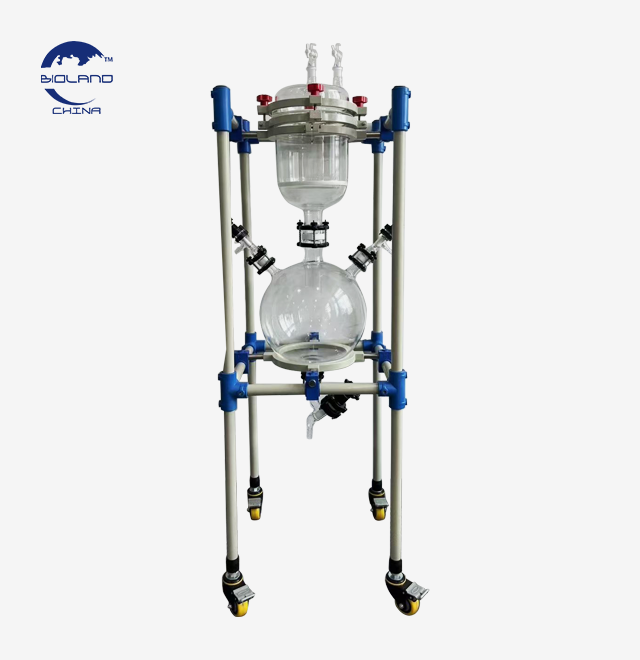
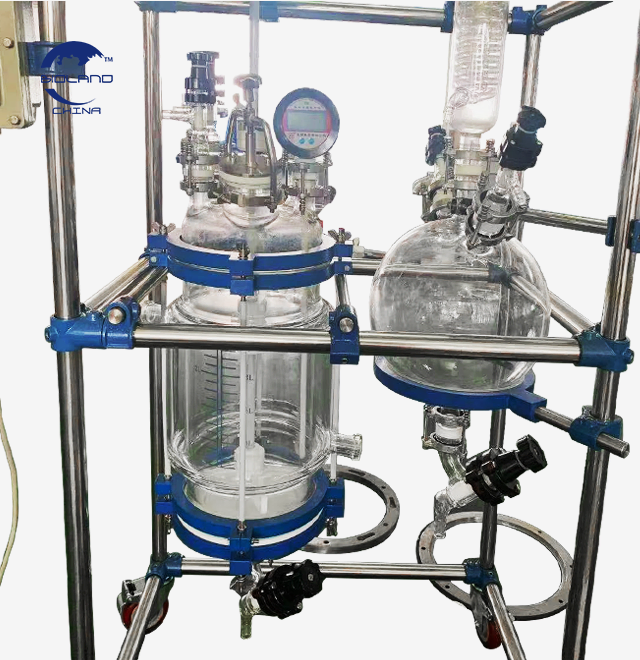
Technicians don't have to guess about progress from sensor data when they use a solid phase synthesis reactor made of high-borosilicate glass to see every step of the coupling, washing, and cleavage process. This helps make sure that the resin is growing evenly and that the color changes in the reaction are happening as planned. Because the glass body doesn't break down easily when exposed to acidic or basic chemicals, a jar made around Bioland Instrument's borosilicate shell can go through many deprotection and coupling cycles without getting pitted, etched, or contaminated with metal ions.
PTFE Filtration Base and Solid-Liquid Separation
This is the part of asolid phase synthesis reactor that does all the work. Our basic setup has a PTFE sand-core filter, but we can change the media to stainless steel or titanium if needed. Filter cloths and membranes come in a wide range of specs. This filter base lets the reactor remove used solvent from the resin bed right inside the vessel. It can then take in new wash solvent for the next cycle without moving the resin to a second unit, which greatly reduces resin loss and greatly cuts down on cycle time.
Modular Configuration and Standard-to-Custom Pathways
Bioland Instrument's solid phase synthesis reactor can be changed from a standard configuration to a fully customized build in terms of size, shape, material, and internal structure. This is because no two synthesis programs work the same way. A fully explosion-proof system, electric lifting, PLC-controlled full automation, an integrated temperature-control unit, and modules that combine filtration, crystallization, and ultrasonic distillation are some of the configuration options. Most of the time, customers don't have to choose between a ready-made unit and a custom-built one because our engineering team can set up either way around the goal chemistry.
Evaluating Mixing, Temperature, and Process Control
Programmable Agitation for Resin Suspension
To get consistent coupling efficiency, the resin suspension needs to be even. A solid phase synthesis reactor with programmable agitation makes sure that the solid phase is spread out evenly in the reaction solution. Controlling the speed of the stirring stops the resin from sticking, lowers concentration differences in certain areas, and makes it easier for the chemicals to reach all the active sites on the bead surface. The motion patterns can be changed by the operators between the coupling, washing, and cutting steps to match how sensitive the resin being handled is to mechanical forces.
Wide-Range Jacket Temperature Control
A solid phase synthesis reactor with a jacket that can handle temperatures from -20°C to 200°C gives scientists the flexibility they need for both cold-chain-sensitive coupling reactions and higher-temperature deprotection or cleavage steps. When combined with a stainless steel high-low temperature integrated unit, the working range of the same vessel is increased. This means that one vessel can support a wider synthesis workflow instead of needing separate temperature-controlled equipment for each stage.
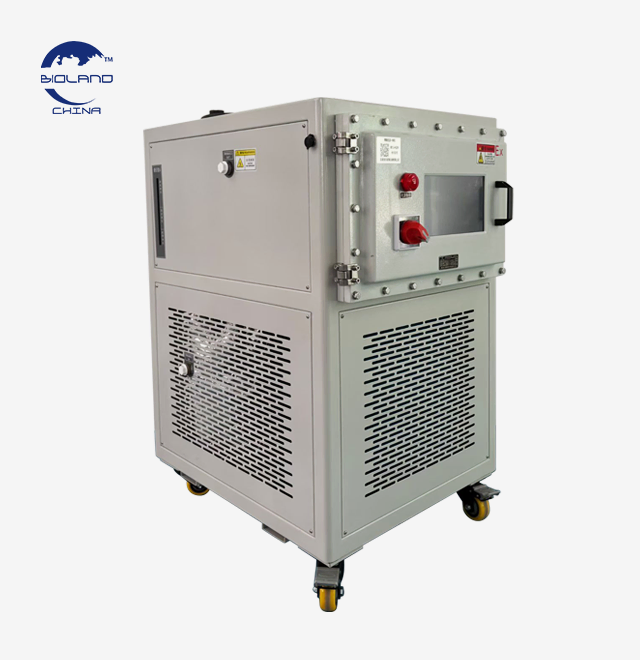
Heating and Cooling System Precision
Controlling the jacket temperature very precisely changes the solubility behavior, which controls both the reaction kinetics and any crystallization steps that happen later. When the system is properly tuned, the heating and cooling unit can gradually set ramp rates. This keeps sensitive intermediates safe from thermal shock and ensures that solvent losses are consistent over the course of the whole production run.
PLC Automation and Touchscreen Control
A solid phase synthesis reactor with PLC automation gets rid of the need to physically coordinate stirring, temperature, and filtering over dozens of coupling cycles. The pump and pipe network, the heating and cooling system, and the filter base are all controlled by a tablet interface. This lets workers save recipes, keep track of process data, and repeat exact steps from one batch to the next.
Selecting Reactor Capacity for Different Applications
Matching Vessel Volume to Peptide-Scale Requirements
A solid phase synthesis reactor with a volume of 20L or 30L is usually best for developing peptides on a small scale in the lab and doing early feasibility studies. On the other hand, 50L and 100L setups are better for pilot testing and early commercial-scale synthesis. By choosing the right reactor volume at the start, you can avoid both capacity that isn't being used and the extra solvent and labor costs that come with running a vessel that is too big before the order volumes justify it.
Case Study: Thymosin Peptide Pilot Scale-Up
While making thymosin peptide for pilot testing, a pharmaceutical research group ran into problems with coupling not working well, resin loss during solvent transfer, and batch quality that wasn't consistent between development runs on their original bench-scale equipment.
The group used a 50L Bioland Instrument solid phase synthesis reactor that had a PTFE filtration base and programmable stirring. Running amino acid coupling, deprotection, and washing all in the same clear vessel let the operators see each step of the reaction before moving on to the next one.
The tank kept the resin bed in place during filtration and washing. This meant that much less resin was lost during the multiple-step synthesis process than with their old transfer-based method, and there was much less difference in purity from batch to batch.
Case Study: Antimicrobial Peptide Screening Program
A biotech business looking for possible antimicrobial peptides needed to do a lot of small-batch reactions without affecting repeatability. However, their current setup needed to be cleaned for a long time before each new sequence could be started.
Bioland Instrument provided a 20L solid phase synthesis reactor with a quick-release PTFE filter plate. This made it easy to remove, clean, and reattach the filtration core in just a few minutes. The unit could safely handle both standard and more reactive coupling chemicals because it was made to work in a wide temperature range and not explode.
The screening team could do a lot more candidate sequences each month because the syntheses could be done faster, and the clear glass body let researchers see directly how the resin behaved for each new peptide chemistry they tested.
Scaling from Bench to Pilot Without Losing Data Continuity
One benefit of using the same solid phase synthesis reactorplatform at all sizes is that process settings that were found to work in 20L vessels can be used reliably in 50L or 100L vessels of the same design. Teams that move the process from the bench to the pilot spend less time re-optimizing and more time confirming because the churning shape, filter media, and temperature control logic stay the same. This speeds up the time it takes to get to commercial-scale production.
Improving Synthesis Efficiency Through Proper Selection
Reducing Cycle Time Through Integrated Operations
Usually, getting rid of transfer steps is the most efficient way to use a solid phase synthesis reactor that has been carefully chosen. By doing reaction, filtration, and washing all in one vessel, you avoid the time, resin loss, and contamination that come with moving materials between different units. Teams that switch to an integrated system usually say that the total cycle time is shorter and there are fewer failed batches because of transfer errors.
Solvent and Reagent Selection for Coupling Efficiency
When the right fluid and reagents are used with the right reactor design, the full value of the design is realized. When the solvent polarity, coupling reagent concentration, and resin swelling behavior are all right for the amino acid sequence or carrier-material chemistry that is being built, the equipment works best. If these factors are not right, diffusion into the resin bead is slowed down, no matter how well the vessel itself works.
Filter Maintenance and Long-Run Reliability
Regular filter cleaning is important for the sustained solid phase synthesis reactor to work well. Choosing the right filter cloth or membrane pore size, keeping an eye on the filtration pressure, and cleaning the PTFE core at set times all help keep flow rates steady over many rounds. One of the most common reasons a reactor slowly slows down or makes cake dryness uneven over time is that this upkeep isn't done.
Compliance, Certification, and After-Sales Support
Before buying a solid phase synthesis reactor for regulated pharmaceutical work, manufacturers should make sure that it has CE and ISO certification and follows GMP/FDA-approved production practices. Every solid phase synthesis reactor that Bioland Instrument sells comes with a one-year warranty, access to maintenance for life, weekly production tracking with photos or videos, and the option of a Factory Acceptance Test at our facility. This gives customers a clear, supported path from ordering to installation.
Conclusion
It's important to find asolid phase synthesis reactor that has the right safety features, including explosion-proof safety, clear borosilicate construction, accurate temperature and stirring control, and built-in PTFE filtering for the goal chemistry and batch size. The peptide-synthesis case studies show that using the right solid phase synthesis reactor cuts down on resin loss, speeds up the cycle time, and keeps purity stable between runs. Bioland Instrument backs up this engineering with certification, flexible customization, and hands-on support after the sale. This makes every solid phase synthesis reactor a long-term production partner instead of just a piece of equipment bought once.
FAQ
1. What capacities does a solid phase synthesis reactor come in?
Standard solid phase synthesis reactor volumes include 20L, 30L, 50L, and 100L, with custom sizes available for specific peptide or resin production needs.
2. Can the reactor handle both reaction and filtration without transferring material?
Yes. Each solid phase synthesis reactor integrates a PTFE filtration base, so reaction, washing, and solid-liquid separation happen inside one vessel.
3. What temperature range can the equipment support?
The standard solid phase synthesis reactor jacket runs from -20°C to 200°C, extendable with a paired high-low temperature circulation unit.
4. How long does a customized order typically take?
A customized solid phase synthesis reactor generally requires about 30 business days; non-customized units ship within 5-7 days.
5. Does Bioland Instrument offer OEM and ODM configurations?
Yes, we welcome OEM and ODM orders and can configure a solid phase synthesis reactor around specific capacity, automation, and process requirements.
Talk to Our Team About Your Solid Phase Synthesis Reactor Project
If resin loss, inconsistent purity, or slow cycle times are limiting your peptide or resin production, it may be time to reconsider your equipment. Xi'an Bioland Instrument Co., Ltd. brings more than 15 years of engineering experience, CE and ISO certification, and flexible OEM/ODM customization to every solid phase synthesis reactor we build, backed by weekly production updates, pre-shipment inspection, an optional Factory Acceptance Test, and a one-year warranty with lifetime maintenance support. Whether you need a standard bench-scale unit or a fully automated pilot system, our technical team is ready to review your process. Contact us at info@biolandequip.comto discuss your solid phase synthesis reactor requirements and request a quotation.
References
1. Journal of Peptide Science, "Reactor Design Considerations for Solid-Phase Peptide Synthesis at Preparative Scale."
2. Organic Process Research & Development, "Scale-Up Strategies for Solid-Phase Synthesis from Bench to Pilot Plant."
3. Chemical Engineering Research and Design, "Agitation and Mixing Performance in Stirred Filter Reactors for Solid-Phase Processes."
4. International Journal of Peptide Research and Therapeutics, "Filtration and Washing Efficiency in Automated Peptide Synthesis Equipment."
5. Industrial & Engineering Chemistry Research, "Material Selection for Corrosion Resistance in Batch Synthesis Reactors."
6. Separation and Purification Technology, "PTFE Filtration Media Performance in Solid-Liquid Separation for Fine Chemical Manufacturing."
The reactor is beautifully mirror-polished and fully complies with GMP requirements for the pharmaceutical industry. The performance is excellent! Overall, we are very satisfied! We also provided with some feedback on our process improvements, which we hope will be helpful.
2024-04-09
Laboratory
Excellent and professional service. Always reply our questions very fast. All reactors and chiller we received are good too.
2024-02-15
Research Institute
Quality is beyond our expectation actually. After we got the extraction equipment and started using it, the performance was beyond our expectation. Very easy to use and very efficient to run. Service always respond us very quickly. Was also very helpful to help us. Thanks Bioland team. Very happy to work with you.
2023-11-20
Biotech Company
We are happy about the new purchase as always. Equipment and services are both good.
2023-08-05
Instrument Lab
This is the second order with Bioland instrument and everything is good as the first dateText.
2023-05-12
Global Trading Partner
Bioland instrument team is very helpful and professional. The sales helped us select the right equipment for our application, and their logistics people handled the transportation and customs declaration for our shipment. All that saved us a lot of work.