How to Reduce Extraction Time With a Curcumin Extraction Machine
Sep 23, 2026
Turmeric processors worldwide share the same frustration: curcumin commands premium prices, yet conventional extraction locks factories into 4–8 hour hot reflux cycles that burn energy, degrade heat-sensitive curcuminoids, and cap daily output. The curcumin extraction machine from Xi'an Bioland Instrument Co., Ltd. was engineered to break that bottleneck. By combining ultrasonic cavitation with ethanol extraction and vacuum concentration in one closed system, this curcumin extraction machine completes a full cycle in just 24–40 minutes at a gentle 40–60°C, lifting extraction rates by 50–500% over traditional methods. Producers who invest in a curcumin extraction machine routinely convert slow, costly batches into a fast, repeatable process. This guide examines why conventional processes waste so much time, how cavitation compresses hours into minutes, which temperature and solvent settings accelerate processing, how to protect yield at higher speed, and how to scale rapid extraction into commercial production—backed by real customer cases and numbers.
What Causes Long Extraction Times in Conventional Processes?
Turmeric rhizomes are among the toughest botanical feedstocks in the industry. Curcuminoids sit inside dense, starch-rich cells protected by rigid cellulosic walls, and raw turmeric also contains 40–60% starch that swells into viscous barriers when wetted. Conventional soaking depends entirely on passive diffusion: solvent must migrate through these walls at its own pace, which is why maceration stretches into days and why curcumin trapped near particle cores never fully releases. Grinding helps, but even finely milled turmeric resists penetration without mechanical energy assistance. Facilities that replace soaking tanks with a curcumin extraction machine equipped with ultrasonic transducers attack this structural barrier physically rather than waiting it out—and that mechanistic difference is what finally breaks the cycle-time ceiling.
Hot Reflux Trades Curcumin Quality for Speed
When maceration proves too slow, factories turn to hot reflux—boiling turmeric in ethanol at 78–85°C for four to eight hours. This accelerates diffusion, but creates two expensive problems. First, curcumin begins degrading above 70°C, so prolonged reflux quietly destroys a measurable share of the very compound being extracted; thermal losses of 10–20% during extended heating are well documented. Second, boiling consumes enormous steam and cooling water, and the evaporator must then strip large solvent volumes at high temperature, compounding utility bills. Producers essentially pay twice—once in degraded product value, once in energy. A curcumin extraction machine operating at 40–60°C sidesteps this trade-off entirely, because ultrasonic energy replaces thermal energy as the driving force for mass transfer.
Case: An Indian Spice Exporter Kept Missing Shipment Windows
A turmeric processor in Kerala ran six reflux tanks, each needing six hours per batch, and orders kept outgrowing capacity while curcuminoid content fluctuated between 88% and 94%. Bioland's engineers audited the line, then installed a 300L curcumin extraction machine with ethanol recovery. Cycle time fell to 35 minutes, curcuminoids stabilized at 95%, daily output tripled within the first quarter, and the exporter finally met its EU delivery schedule.
The Real Bottleneck Is Mass Transfer, Not Chemistry
Understanding the bottleneck determines the fix. Curcumin dissolves readily in ethanol—the chemistry is easy. What is hard is moving solvent into cells and moving dissolved curcumin back out. Every conventional technique attacks this diffusion problem indirectly: heat thins the solvent, stirring refreshes the boundary layer, and time simply waits. But diffusion through intact cell walls stays slow regardless, which explains why adding more reflux tanks never proportionally increases output. A curcumin extraction machine attacks the bottleneck directly: cavitation physically ruptures cell walls, eliminating the diffusion barrier instead of working around it. That is why cycle times fall from hours to minutes rather than improving by incremental percentages, and why the speed gain persists batch after batch without additional energy input.
How Ultrasonic Cavitation Accelerates Curcumin Extraction
Collapsing Bubbles Do the Work That Hours of Heat Used to Do
Inside acurcumin extraction machine, ultrasonic transducers broadcast sound waves at 20–40 kHz through the solvent-turmeric slurry. Each wave cycle creates millions of microscopic vapor bubbles that grow and collapse violently within microseconds. Every collapse generates a localized shockwave, microscale pressures of hundreds of atmospheres, and microjets that strike particle surfaces at high velocity. These forces crack cell walls, peel away surface layers, and drive solvent deep into fresh material with each pulse. The practical outcome is dramatic: extraction rates rise 50–500% over conventional stirring, and peak yield arrives in 24–40 minutes. Because the curcumin extraction machine works mechanically rather than thermally, bulk temperature stays in the 40–60°C range curcumin tolerates comfortably, preserving both potency and color value.
Case: A Vietnamese Producer Retired Six Reflux Tanks
A Hanoi supplement factory relied on 8-hour reflux shifts and could not grow without buying more tanks, boilers, and floor space. Bioland instrument replaced the entire line with one 500L curcumin extraction machine running 38-minute ultrasonic cycles. Eight batches now finish daily instead of two, steam consumption dropped 60%, extract purity passed EU import testing, and the project reached full payback in eleven months, according to the client's finance team.
A Complete 40-Minute Cycle, Step by Step
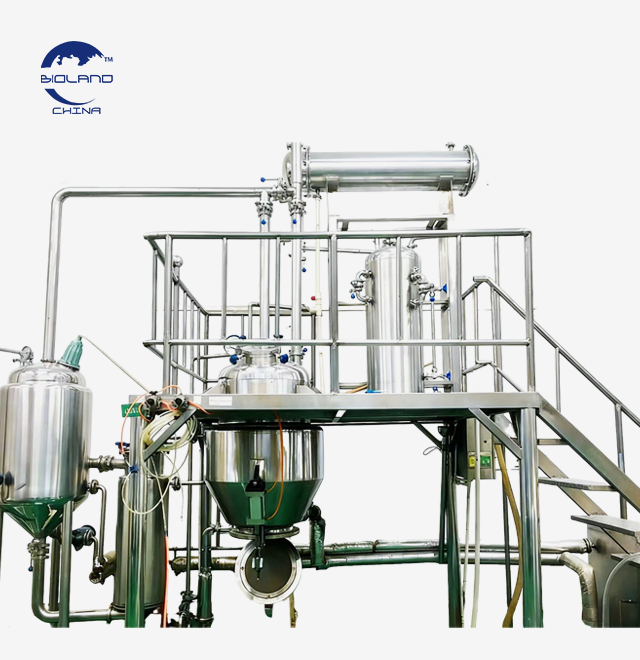
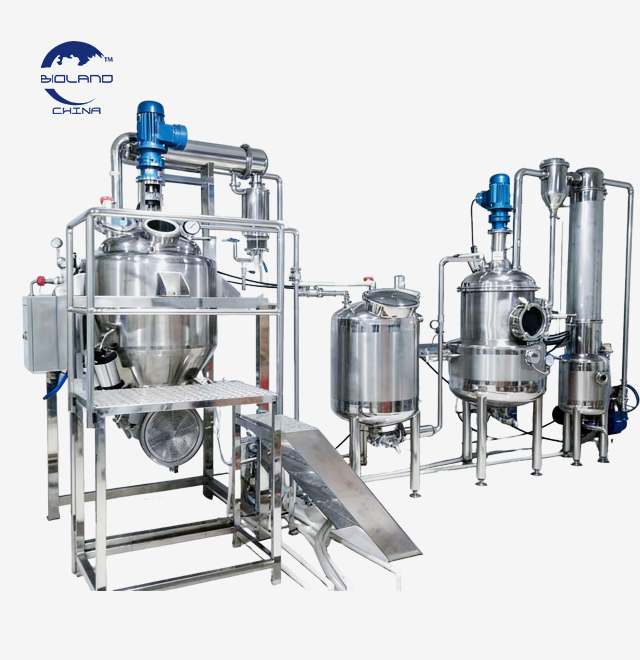
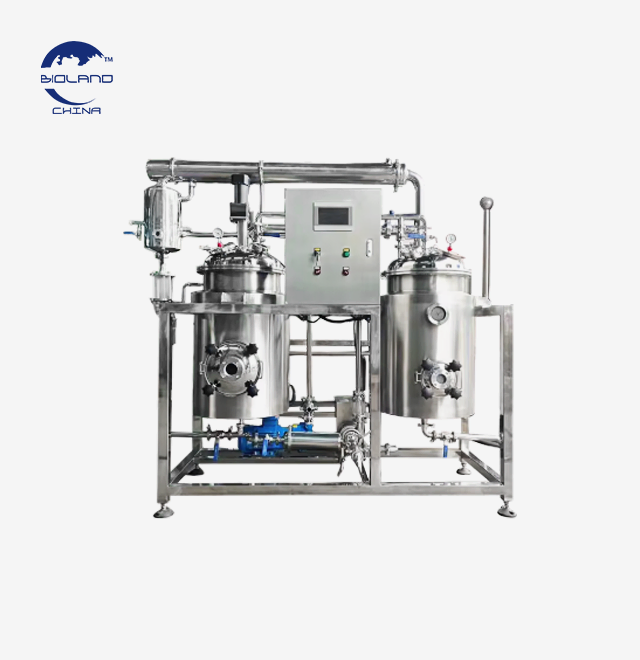
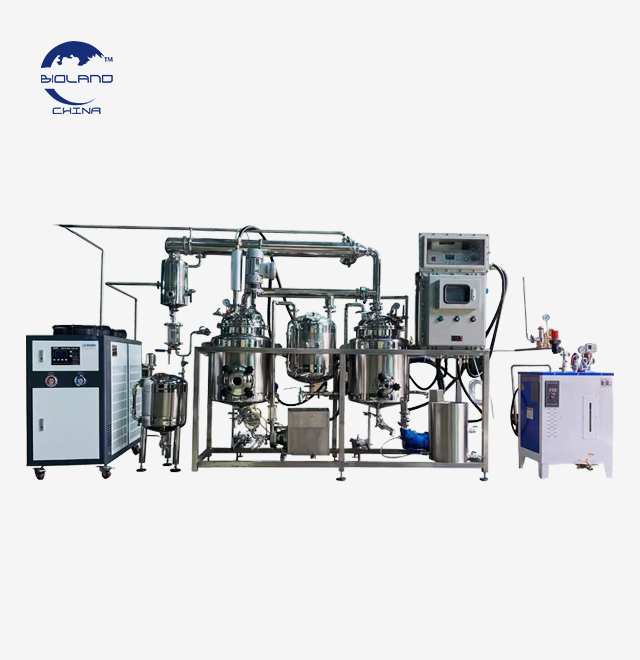
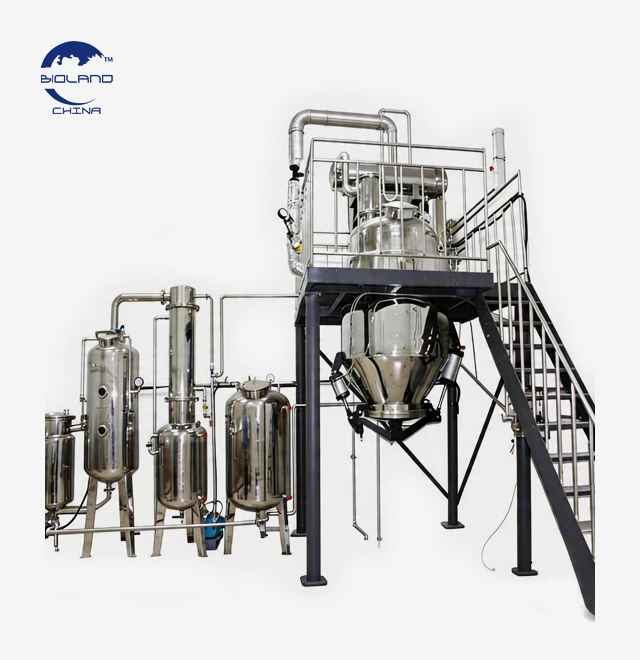
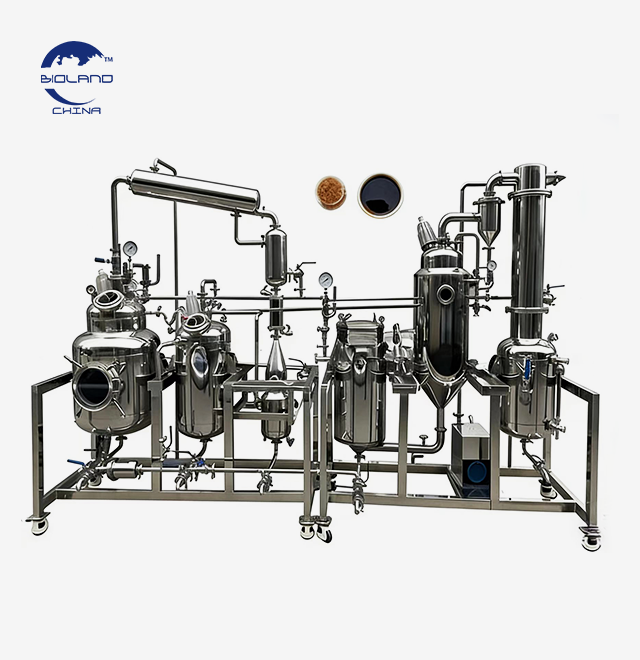
Speed without process discipline means nothing, so it helps to see where the minutes go inside a curcumin extraction machine cycle. Operators load milled turmeric (typically 30–60 mesh) into the extraction tank and dose ethanol at a preset 1:8 to 1:12 solid-liquid ratio from the metering tank. The jacket brings the slurry to 40–60°C while the ultrasonic system runs its programmed 24–40 minute profile. Valves then open in sequence, transferring the extract to the concentration tank, where vacuum holds −0.05 to −0.09 MPa so ethanol evaporates gently at low temperature. Secondary vapor passes through the condenser and cooler, returning to the extraction tank as fresh solvent that percolates downward through the turmeric bed until the liquid runs nearly colorless. Concentration continues to target density, and recovered solvent is reused next batch—extraction and concentration flow as one continuous process, not separate waiting periods.
The Same Ultrasonic Platform Serves a Dozen Other Botanicals
A curcumin extraction machine is not a single-crop asset, and that versatility matters for contract manufacturers. The identical ultrasonic platform already runs stevia extraction lines pulling steviol glycosides from leaves, tea extraction lines recovering polyphenols and aromatic oils, mushroom lines extracting reishi and shiitake polysaccharides, and propolis lines combining cavitation with ethanol for flavonoids. It also handles flavonoid extraction from ginkgo and chrysanthemum, ultrasound assisted extraction of quercetin from sophora buds, pigment extraction from orange peel and anthocyanin sources, chili oleoresin and capsaicin, goji berry actives, and essential oils from rose and mint. Because ultrasonic extraction is not limited by compound polarity or molecular weight, switching products means loading a new PLC recipe—not buying a new machine—an economic argument that often closes the investment case for multi-product facilities.
Optimizing Temperature and Solvent Ratio for Faster Processing
Why 40–60°C Is the Fast Lane for Curcumin
Counterintuitively, running cooler often means finishing sooner. At 40–60°C, ethanol viscosity drops enough for rapid penetration while curcumin remains chemically stable, so the ultrasonic system can run at full power without risking thermal damage—the true speed limiter in hot processes. Bioland instrument's curcumin extraction machine holds this window with jacketed heating and PID control accurate to ±1°C, keeping every liter of slurry inside the optimal band for the entire cycle. The low-temperature regime also shortens concentration, because solvent that never overheated carries fewer co-extracted waxes, so the evaporator reaches target density faster. Operators notice the schedule benefit immediately: a thermal process spends 30–45 minutes merely heating and cooling each batch—time the curcumin extraction machine spends actually extracting product.
Dialing In Ethanol Strength and Solid-Liquid Ratio
Solvent settings decide how much curcumin the fast cycle actually captures. Curcumin is lipophilic, so 80–95% ethanol extracts it most efficiently; food-grade producers typically standardize on 90–95% for oleoresin-grade product, while nutraceutical lines targeting 95% curcuminoids may run two-stage extraction. A solid-liquid ratio between 1:8 and 1:12 balances completeness against evaporation load—too little solvent saturates early, while too much burdens the concentrator and slows the whole line. Thecurcumin extraction machine's metering tank, dosing pump, and level-controlled vessels turn both variables into stored recipe parameters, eliminating batch-to-batch operator drift. Bioland's commissioning data shows that fixing ethanol strength and ratio precisely typically improves curcuminoid recovery by 8–12% while cutting evaporation energy nearly 20%—a double gain that compounds across hundreds of batches per year.
Closed-Loop Solvent Recovery Compresses the Whole Timeline
Extraction speed means little if concentration becomes the new bottleneck. The curcumin extraction machine solves this with integrated vacuum concentration: at −0.05 to −0.09 MPa system vacuum, ethanol boils gently at reduced temperature, protecting curcumin through the final stage. Vapor condensed through the condenser returns to the extraction tank as clean solvent, flowing top-down through the turmeric bed in a Soxhlet-style dynamic loop until extraction runs colorless. This closed circuit cuts net ethanol consumption by 30–40% per batch and removes the inter-stage transfers where conventional lines lose hours. Models BL-TN-C50L through C500L provide evaporation capacities from 20 to 200 kg/h, so solvent recovery always keeps pace with extraction—a sizing principle Bioland engineers confirm during project design rather than leaving customers to discover a mismatch after installation.
Case: An Indonesian Plant Halved Its Solvent Bill
A Java-based curcumin producer spent heavily on food-grade ethanol that open reflux evaporated into the air, and auditors flagged solvent vapor risks. After installing a 200L curcumin extraction machine with vacuum recovery, net ethanol use fell 42%, curcuminoid yield rose 15%, solvent purchasing dropped from weekly to monthly, and the plant passed its HACCP audit the following quarter with zero solvent-safety findings.
How to Balance Extraction Speed and Curcumin Yield
Faster Cycles Can Actually Mean Higher Recovery
Producers raised on conventional wisdom often assume speed sacrifices yield, but ultrasonic extraction inverts that relationship. Because cavitation ruptures cell walls mechanically, a 24–40 minute cycle in a curcumin extraction machine releases curcuminoids that hours of soaking never reach—client benchmarks consistently show 15–40% higher recovery than the reflux lines they replace. Shorter contact time also means fewer impurities: starch and waxes dissolve more slowly than curcumin, so a fast cycle leaves much of the impurity load behind in the residue. The crude extract arrives at concentration cleaner, simplifying downstream purification to 95% curcuminoid specification and reducing the crystallization and washing steps that consume both time and yield in conventional high-purity production.
Online Monitoring Finds the True Endpoint, Not a Clock Time
The most reliable way to balance speed and yield is to stop guessing. A curcumin extraction machine equipped with online concentration monitoring tracks extract density in real time, so operators end each batch when the reading plateaus—the moment the turmeric has genuinely surrendered its curcumin—rather than at an arbitrary clock time. Some feedstock lots release their curcuminoids in 25 minutes; denser, older rhizomes may need 38. The PLC records the curve for every batch, building a data history that quality managers use to tighten specifications. Automatic discharge at target density and automatic CIP cleaning between batches keep the line moving without manual intervention, which is how Bioland clients running the curcumin extraction machine sustain six to eight batches daily while holding curcuminoid variation within ±2% across shifts.
Case: A Chinese Nutraceutical Plant Locked In Its 95% Spec
A Shaanxi facility failed two customer audits because curcuminoid content swung ±8% between batches, putting a major contract at risk. Bioland supplied a curcumin extraction machine with stored PLC recipes and endpoint concentration monitoring. Batch variation narrowed to ±1.5%, the plant passed its next GMP audit on the first attempt, and it signed a two-year supply contract with a US supplement brand.
Scaling Up Faster Extraction for Commercial Production
From 50L Pilot to 500L Production Without Losing the Recipe
Scale-up fails when pilot recipes behave differently in production vessels. Bioland's BL-TN-C series—50L, 100L, 200L, 300L, and 500L—is engineered for linear transfer: ultrasonic power density, jacket pressure (0.09–0.3 MPa), system vacuum (−0.085 MPa), compressed air (0.5–0.6 MPa), and evaporation temperature (60–100°C) hold constant across the range, while evaporation capacity scales from 20 to 200 kg/h to match vessel volume. A recipe validated on the curcumin extraction machine at pilot scale therefore reproduces at production scale without re-development, compressing scale-up timelines from months to weeks. Xi'an Bioland Instrument Co., Ltd. brings more than 15 years of extraction, distillation, concentration, and reaction equipment experience, with CE and ISO certification and GMP/FDA-compliant design—engineering depth customers lean on when a pilot project becomes a factory decision.
Technology parameter
Model
BL-TN-C50L
BL-TN -C100L
BL-TN -C200L
BL-TN -C300L
BL-TN -C500L
Volume (L)
50
100
200
300
500
Evaporation capacity (kg/h)
20
50
70
100
200
Motor power(KW)
2.7
2.7
2.7
3.5
3.5
Steam consumption(kg/h)
25
60
90
120
250
System vacuum (MPa)
-0.085
-0.085
-0.085
-0.085
-0.085
Pressure of jacket(MPa)
0.09~0.3
0.09~0.3
0.09~0.3
0.09~0.3
0.09~0.3
Compressed air (MPa)
0.5~0.6
0.5~0.6
0.5~0.6
0.5~0.6
0.5~0.6
Evaporation temperature(°C)
60~100
60~100
60~100
60~100
60~100
GMP-Ready Construction for Export-Grade Curcumin
Commercial curcumin sells into regulated markets, and the curcumin extraction machine is built accordingly: all product-contact surfaces are SUS304 or 316L stainless steel, the full circuit carries CIP online cleaning with spray coverage, three-layer insulation stabilizes temperature, and defoaming devices protect vapor outlets on both the extraction tank and evaporator. The system operates under negative, atmospheric, or positive pressure and supports hot reflux, percolation, water or alcohol precipitation, and solvent recovery, meeting pharmaceutical GMP and food HACCP requirements in one skid. Where steam is unavailable, a thermal-oil heating system integrates seamlessly. This compliance-ready architecture explains why the same platform runs certified stevia, tea polyphenol, mushroom polysaccharide, capsaicin, propolis, and natural pigment lines across Europe and Southeast Asia—each documented, auditable, and export-ready from day one.
Support That Continues Long After Commissioning
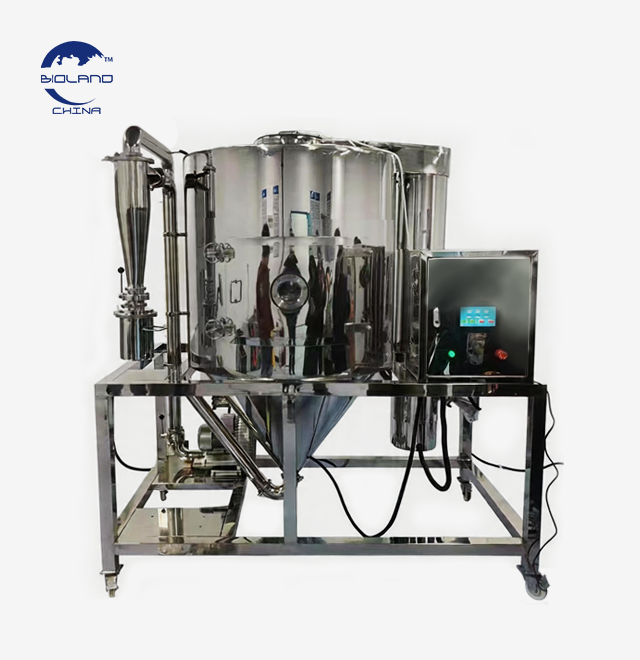
Equipment speed only creates value when the line keeps running, and Bioland structures its service accordingly. Customized curcumin extraction machine lines ship in about 30 business days and standard models in 5–7 days, by sea, rail, or air. During manufacturing, a dedicated specialist sends weekly photo and video progress updates; on completion, detailed inspection footage is provided, and clients may attend a Factory Acceptance Test at the facility before shipment approval. A one-year quality warranty and lifetime maintenance back every unit, with OEM and ODM engineering available for integration with crystallizers, filter reactors, spray dryers, or freeze dryers downstream. The technical team also assists with process validation, operator training, and recipe transfer—customers buy a production capability, not a crate of stainless steel.
Case: A Thai Exporter Tripled Daily Capacity
A Chiang Mai exporter kept turning away contracts because its aging line produced only two batches daily. Bioland instrument delivered a 500L curcumin extraction machine, completed Factory Acceptance Testing with the client's engineers, and commissioned the line within three weeks of arrival. Daily output rose to eight batches, solvent costs fell 35%, and the exporter signed its first German buyer within a single quarter.
Conclusion
Reducing extraction time is not about rushing—it is about removing the physical barriers that make conventional turmeric processing slow. A curcumin extraction machine replaces hours of heat-driven diffusion with 24–40 minutes of ultrasonic cavitation at 40–60°C, protecting heat-sensitive curcuminoids while raising extraction efficiency by 50–500%. Precise solvent ratios, vacuum concentration with closed-loop ethanol recovery, and PLC-controlled endpoints turn speed into a repeatable, auditable process from 50L pilot to 500L production. The customer cases above share one lesson: producers who treat cycle time as an engineering variable rather than a fixed constraint win capacity, quality, and contracts simultaneously. If slow batches limit your growth, the fastest investment you can make is a curcumin extraction machine sized to your feedstock and specification.
FAQ
Q1: How long does a curcumin extraction machine take per batch?
A: Ultrasonic cycles reach peak yield in 24–40 minutes—over two-thirds shorter than conventional reflux.
Q2: What extraction rate improvement is realistic?
A: Clients report 50–500% higher extraction efficiency versus traditional soaking or hot reflux methods.
Q3: Does faster extraction damage curcumin?
A: No. Processing at 40–60°C protects heat-sensitive curcuminoids far better than prolonged boiling reflux.
Q4: What capacities are available?
A: Models range from 50L to 500L, with 20–200 kg/h evaporation capacity for pilot through commercial lines.
Q5: Can one curcumin extraction machine process other botanicals?
Ready to Cut Your Extraction Time? Talk to Bioland Instrument Today
Every extra hour of reflux costs you energy, solvent, and saleable curcumin. Xi'an Bioland Instrument Co., Ltd. delivers complete curcumin extraction machine solutions—from 50L R&D units to 500L GMP production lines—with CE and ISO certification, factory-direct pricing, OEM/ODM customization, and over 15 years of process engineering experience. We keep you informed at every step: weekly photo and video production updates, Factory Acceptance Testing before shipment, a one-year warranty, and lifetime maintenance. Customized lines ship in about 30 business days; standard models in 5–7 days. Whether you need to shorten cycles, stabilize 95% curcuminoid specifications, or scale into export markets, a Bioland Instrument curcumin extraction machine is engineered around your feedstock. Send your requirements to info@biolandequip.com for a free consultation and tailored quotation.
References
1. Priyadarsini, K. I. "The Chemistry of Curcumin: From Extraction to Therapeutic Agent." Molecules, 2014.
2. Shirsath, S. R., Sable, S. S., Gaikwad, S. G., Sonawane, S. H., Saini, D. R., & Gogate, P. R. "Intensification of Extraction of Curcumin From Curcuma Amada Using Ultrasound Assisted Approach: A Case Study." Chemical Engineering and Processing: Process Intensification, 2017.
3. Wakte, P. S., Sachin, B. S., Patil, A. A., Mohato, D. M., Band, T. H., & Shinde, D. B. "Optimization of Microwave, Ultra-Sonic and Supercritical Carbon Dioxide Assisted Extraction Techniques for Curcumin From Curcuma Longa." Separation and Purification Technology, 2011.
4. Braga, M. E. M., Leal, P. F., Carvalho, J. E., & Meireles, M. A. A. "Comparison of Yield, Composition, and Antioxidant Activity of Turmeric (Curcuma longa L.) Extracts Obtained Using Various Techniques." Journal of Agricultural and Food Chemistry, 2003.
5. Chemat, F., Rombaut, N., Sicaire, A.-G., Meullemiestre, A., Fabiano-Tixier, A.-S., & Abert-Vian, M. "Ultrasound Assisted Extraction of Food and Natural Products: Mechanisms, Techniques, Combinations, Protocols and Applications." Ultrasonics Sonochemistry, 2017.
6. Kotha, R. R., & Luthria, D. L. "Curcumin: Biological, Pharmaceutical, Nutraceutical, and Analytical Aspects." Molecules, 2019.
The reactor is beautifully mirror-polished and fully complies with GMP requirements for the pharmaceutical industry. The performance is excellent! Overall, we are very satisfied! We also provided with some feedback on our process improvements, which we hope will be helpful.
2024-04-09
Laboratory
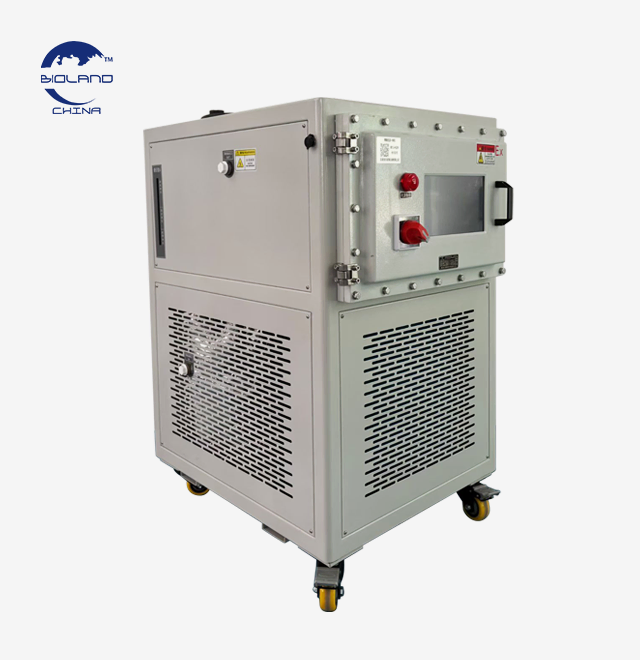
Excellent and professional service. Always reply our questions very fast. All reactors and chiller we received are good too.
2024-02-15
Research Institute
Quality is beyond our expectation actually. After we got the extraction equipment and started using it, the performance was beyond our expectation. Very easy to use and very efficient to run. Service always respond us very quickly. Was also very helpful to help us. Thanks Bioland team. Very happy to work with you.
2023-11-20
Biotech Company
We are happy about the new purchase as always. Equipment and services are both good.
2023-08-05
Instrument Lab
This is the second order with Bioland instrument and everything is good as the first dateText.
2023-05-12
Global Trading Partner
Bioland instrument team is very helpful and professional. The sales helped us select the right equipment for our application, and their logistics people handled the transportation and customs declaration for our shipment. All that saved us a lot of work.