How Ultrasonic Extraction Equipment Improves Yield Without Extra Heat
Oct 23, 2026
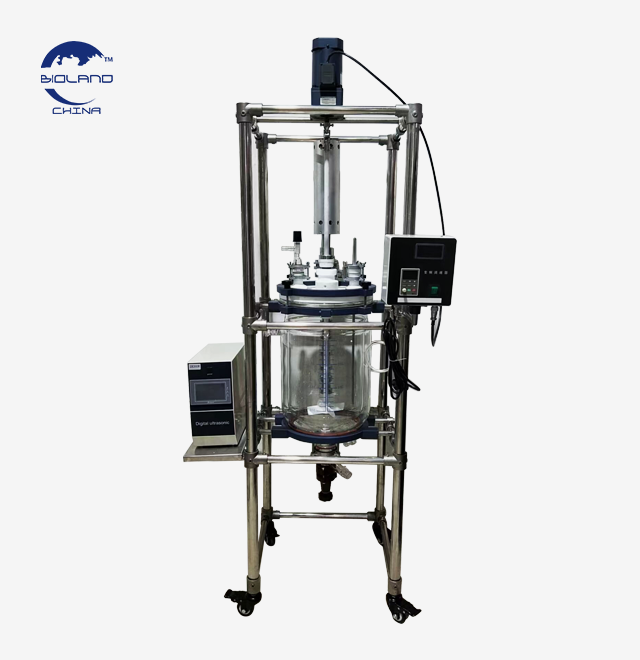
How ultrasonic extraction increases yield without using more heat depends on how well the mechanical action works to replace the long thermal treatment. The ultrasonic extraction equipment made by Bioland instrument uses controlled cavitation to break up plant or fungal cells, speed up the entry of solvents, and release target chemicals at normal bulk temperatures. Without using more forceful heating, manufacturers can get higher recovery, faster extraction processes, less energy use, and better safety for products that are sensitive to heat.
The ultrasonic extraction equipment usually works at temperatures between 40°C and 60°C. In the right situations, comparisons from the manufacturer show that the extraction rate can be increased by 50% to 500%, and the optimised ultrasonic stage may only need 24 to 40 minutes. So Bioland instrument customises the process parameters for each customer's product instead of using the same setting for all materials. This is because the results depend on the material, particle size, solvent ratio, temperature, and operating recipe.
The Xi'an Bioland Instrument Co., Ltd. has been working with technologies for more than 15 years, including technologies for drying, separating, distilling, and extracting. Testing the material, designing the process, choosing the right tank, filtering, vacuum concentration, solvent recovery, automation, and cleaning are all parts of an ultrasonic extraction equipment project. This all-in-one method gives customers the confidence to move from testing in the lab to pilot or commercial production.
Enhancing Yield Through Efficient Cell Disruption
Turning Cell Walls into Accessible Extraction Pathways
A lot of people who process plants lose useful chemicals because solvents can't get through tough cell walls. Instead of making the soaking time longer, ultrasonic extraction equipment changes the pressure in the liquid very quickly. These forces change or break up the structures of plants and fungi, which makes it easier for water, ethanol, or another acceptable liquid to get to parts inside cells.
Mass movement between the solid and liquid is stronger because there is more contact area. Before the solids that have been used up are released, more soluble material can be released. This is especially helpful for expensive plants like herbs, mushrooms, medical plants, and functional food items, where leftover active chemicals in used material directly hurt profits.
Using Cavitation Instead of Additional Bulk Heating
Tiny bubbles appear, grow, and disappear in the liquid inside Bioland instrument's ultrasonic extraction equipment. This cavitation creates shear, turbulence, and micro-streaming around the bits of material. The physical action makes it easier for the solvent to move through the raw material, and it doesn't need the whole extraction tank to get very hot like long boiling or reflux processes do.
When ultrasonic extraction equipment is properly matched to the batch size and material density, cavitation spreads through the working zone while the bulk liquid stays at a steady temperature. A validated recipe lets operators change the amount of ultrasonic input, the duration of the extraction, the solvent ratio, and the mixing. Temperature monitors and extra cooling keep heat from building up during long periods of activity.
Solving Low Recovery in Mushroom Polysaccharide Production
A company that made mushroom extracts was losing soluble polysaccharides in used Ganoderma and shiitake solids, and the tanks were full of hot water extraction for long periods of time. Bioland instrument customised ultrasonic extraction equipment based on the customer's particle size, water ratio, batch volume needs, and filtration conditions. Controlled turbulence made it easier for water to reach the thick fungus tissue.
It was aimed at the 24–40-minute ultrasonic optimisation window at 40–60°C that had been reported. The customer got a faster release, less time for the tank to fill up, and an easier-to-handle liquid for concentration and filtering. The same method can be used to remove polysaccharide-rich materials from mushrooms like Ganoderma, shiitake, enoki, Tremella, and others using ultrasound.
Selecting Parameters Around the Feedstock
Instead of just looking at the tank amount, the right ultrasonic extraction equipment should be chosen based on the raw material. Engineers have to think about things like particle size, solids loading, viscosity, solvent compatibility, target compound, and downstream filtration. When working with hard Ganoderma pieces, soft mushrooms or sweet potato pieces need a different approach.
Bioland instrument's set-up ultrasonic extraction equipment can have parts that come into contact with products made of SUS304 or SUS316L, as well as sanitary connections, three layers of insulation, and CIP cleaning. The technical team decides on the ultrasonic power, tank shape, pumps, filters, controls, and concentration capacity after deciding on the extraction goal. This keeps systems from being too small and stops capital spending that isn't needed.
Protecting Active Compounds During Extraction
Separating Extraction Force from Thermal Stress
To make up for slow diffusion, conventional extraction often uses more heat. The liquid-solid system is directly injected with mechanical energy by ultrasonic extraction equipment, in contrast. While cavitation speeds up solvent entry, moderate bulk temperatures of 40–60°C can be kept. This helps protect chemicals that are easily broken down by water, oxygen, scent loss, or heat damage.
"Without extra heat" does not mean that the process has no temperature. Ultrasound can focus energy in one place, and controlled warming is still needed in some situations. The benefit is that increasing yield doesn't depend on slowly heating the whole batch to a higher temperature or keeping it there for a long time.
Protecting Tea Polyphenols and Natural Pigments
During long hot extraction, a tea maker had to deal with changing levels of polyphenols and loss of flavour. Bioland instrument made ultrasonic extraction equipment that had different recipes for time, temperature, solvent ratio, and concentration. Moderate extraction conditions made mass transfer better, and vacuum concentration cut down on the need for harsh atmospheric boiling.
When a natural-pigment customer extracted anthocyanins and orange-peel pigments, the colours changed. Bioland instrument used controlled ultrasound, enclosed liquid transfer, filtration, and vacuum concentration all at the same time. The new process cut down on heat that wasn't needed and made it easier to use again and again for anthocyanins, betalains, carotenoids, chlorophyll, and other plant colours.
Preserving Quality Through Sanitary Construction
Protecting products also depends on how the equipment is built. Bioland instrument can make ultrasonic extraction equipment out of SUS304 or SUS316L stainless steel. It comes with shielded tanks, sterilised pipes, demisters, filters, and CIP cleaning. These features lower the chance of contamination and make it easier to get rid of residue when switching materials or production recipes.
Systems can be made to meet the needs of pharmaceutical GMP and food HACCP standards, with safety features based on CE standards and production controls backed by ISO. Nutraceuticals, biopharmaceuticals, food, drinks, skincare, plant proteins, essential oils, and medical products can all be made in the right way. Verification of cleaning should always follow the customer's quality and risk assessment processes for the product.
Maintaining Safe Low-Temperature Operation
Operators should check the electrical connections, cooling water, vacuum parts, safety interlocks, seals, valves, pumps, transducers and transducers before turning on ultrasonic extraction equipment. Solvents must be allowed for the system that has been set up. For example, ethanol and other flammable substances might need air flow, grounding, solvent-compatible seals, and explosion safety measures that are designed for that specific use.
Without unneeded temperature drift, preventative maintenance keeps ultrasonic extraction equipment running consistently. It is important to clean filters on a regular basis, inspect pumps and seals, and make sure that ultrasonic parts have stable output. Bioland instrument protects long-term production performance with operating instructions, help with maintenance, a quality warranty for one year, and maintenance for life.
Improving Recovery Rates with Ultrasonic Technology
Connecting Extraction with Solvent Circulation
The extraction tank is filled with raw materials before the right amount of water, ethanol, or another acceptable liquid is added. After the temperature, time, mixing, and ultrasonic recipe are chosen, theultrasonic extraction equipmentstarts to work. The liquid goes through the necessary valves, pumps, and filtration stage after extraction before going into the concentration vessel.
During vacuum concentration, secondary vapour goes through a cooler and condenser to turn into condensate that can be used again. The liquid that was recovered can go back to the extraction tank, move down through the material layer, and break down any chemicals that are still soluble. This cycle will keep going until the desired limit of extraction and concentrate concentrations are reached.
Recovering More Value from Goji and Ganoderma
It was hard for a goji grinder to work with fruit that had different levels of wetness, thick liquid, and uneven polysaccharide recovery. Bioland instrument put together ultrasonic extraction equipment that could control the mixing, filtration, moving of liquids, and vacuum concentration. The process gave the customer a steady feed for focus while lowering the need for repeated cooking steps and operator judgement.
For dense Ganoderma material, the ultrasonic extraction equipment was set up so that water would enter slowly and stay in the tank for a long time. Preparing the material, adding the solids, the temperature of extraction, and the length of the ultrasonic wave were all looked at together. Better breaking up of cells led to faster release and better use of valuable raw materials before the spent solids were thrown away.
Adapting the Process for Propolis and Quercetin
A company that makes propolis had to separate flavonoids and phenolic acids from a sticky, variable feedstock while also keeping an eye on how much ethanol was being used. Bioland instrument changed ultrasonic extraction equipment so that it could be used for ethanol extraction with ultrasonic help, filter, liquid recovery, and vacuum concentration. Instead of separate machines with inconsistent transfer steps, the customer got a coordinated process.
The tool can also help remove quercetin or its predecessors, such as rutin and quercitrin, using ultrasound. Materials that could be used are larch, celery, mulberry leaves, Vaccinium leaves, Sophora buds, and medicinal plants that are right for the job. For each target and raw material source, the concentration of the solvent, the temperature, and the ultrasonic conditions must be checked and confirmed.
Preparing a Cleaner Stream for Purification
When ultrasonic extraction equipment is used correctly, it can improve target release without needlessly prolonging treatment until too many unwanted solids enter the liquid. It might be easier to filter and get the product ready for filtering, concentration, precipitation, separation, or crystallisation. This is important because a high oil yield doesn't add much value if there are too many loses further down the line.
Bioland instrument can mix ultrasound with different processes like percolation, water and alcohol precipitation, dynamic extraction, and reduced-pressure concentration. So, customers can choose a full recovery route based on the needs of the end product instead of buying a separate extraction tank and then fixing problems further down the line.
Reducing Thermal Impact on Sensitive Ingredients
Understanding What “Without Extra Heat” Means
It's not higher bulk temperatures that ultrasonic extraction equipment is meant to raise, but rather cavitation and mass transfer that raise grain yield. At the point where the liquid and solid meet, ultrasound provides physical extraction energy. Then, temperature control keeps the bulk liquid within the approved range. This keeps materials safe that are sensitive to long-term warmth.
When analysing methods, this difference is important. A traditional method might help recovery by raising the temperature or making the reflux last longer. The same goal can be reached with an ultrasonic process that makes it easier for solvents to get to cells and breaks them up. Any heat that is made while the equipment is working is controlled by cooling, insulation, temperature tracking, and automatic limits.
Combining Moderate Extraction with Vacuum Concentration
Bioland instrumentultrasonic extraction equipment usually works between 40°C and 60°C, but this can change based on application attempts. After filtering, concentration can work in a vacuum range of about -0.05 to -0.09 MPa. The BL-TN-C range has a specified system vacuum of -0.085 MPa, which lets the liquid evaporate in more controlled conditions than when it's in the open air.
The ultrasonic extraction equipment is placed between the evaporation stage and the moderate-temperature extraction stage. The concentration system's absorption temperatures range from 60°C to 100°C, based on the pressure, the product, and the output that is needed. Condensers turn secondary vapour back into a liquid, which allows the solvent to be used again and again while cutting down on waste, emissions, and energy over and over again.
Retaining Value in Aromatic and Sensitive Products
A company that makes rose and peppermint products lost aromas during long, hot extraction processes. Bioland instrument set up ultrasonic extraction equipment that could control the temperature, move the material safely, separate the oil, condense it, and collect it. More value was kept in the extract before it reached concentration or downstream separation thanks to shorter extraction contact and better vapour control.
The same process logic can be used for volatile plant oils, valerian fragrance components, polyphenols, flavonoids, heat-sensitive botanical actives, and aromatic oils from tea. Because flammable oils, sugars, proteins, alkaloids, and colours react differently to temperature, fluid, and ultrasonic strength, they need their own recipes.
Reducing Heating Time and Utility Demand
Based on application data from the manufacturer, ultrasound-enhanced extraction may reach an optimal healing point in 24 to 40 minutes, which is more than two-thirds faster than some other methods. So, ultrasonic extraction equipment might make it possible to use fewer tanks, heat them for shorter periods of time, cool them down faster, and require less work per production batch.
How much energy is saved depends on the whole process, such as the amount of solvent used, the starting temperature, the insulation, the duty of evaporation, the cooling conditions, and the schedule for production. Bioland instrument looks at these things when choosing a process. The goal is not just to add ultrasound, but also to change the way things are done so that extraction, filter, recovery, and focus all work well together.
Optimizing Extraction Processes for Better Output
Matching Capacity to Commercial Production
Bioland instrument sells ultrasonic extraction equipment in five different sizes: BL-TN-C50L, 100L, 200L, 300L, and 500L. They say that they can evaporate 20, 50, 70, 100, or 200 kg/h. These options let customers do lab testing, pilot production, and medium-scale production without having to buy a single machine that is too big for their needs.
Technology parameter
Model
BL-TN-C50L
BL-TN -C100L
BL-TN -C200L
BL-TN -C300L
BL-TN -C500L
Volume (L)
50
100
200
300
500
Evaporation capacity (kg/h)
20
50
70
100
200
Motor power(KW)
2.7
2.7
2.7
3.5
3.5
Steam consumption(kg/h)
25
60
90
120
250
System vacuum (MPa)
-0.085
-0.085
-0.085
-0.085
-0.085
Pressure of jacket(MPa)
0.09~0.3
0.09~0.3
0.09~0.3
0.09~0.3
0.09~0.3
Compressed air (MPa)
0.5~0.6
0.5~0.6
0.5~0.6
0.5~0.6
0.5~0.6
Evaporation temperature(°C)
60~100
60~100
60~100
60~100
60~100
For the 50L, 100L, and 200L types, the motor has 2.7 kW of power. For the bigger units, it has 3.5 kW. The ultrasonic extraction equipment uses 0.5 to 0.6 MPa of compressed air and a jacket pressure range of 0.09 to 0.3 MPa. The amount of steam that is listed ranges from 25 kg/h to 250 kg/h. If steam isn't available, thermal oil can be used instead.
Automating Recipes and Cleaning Procedures
Time, temperature, pumps, hoover, discharge, and cleaning sequences can all be controlled by PLC-controlled ultrasonic extraction equipment. Online concentration monitoring, automatic discharge, continuous feeding, continuous output, and CIP cleaning are all options that can be added to make adjustments easier. When working with materials that have different densities or levels of moisture, it's easier to repeat production when recipes are saved.
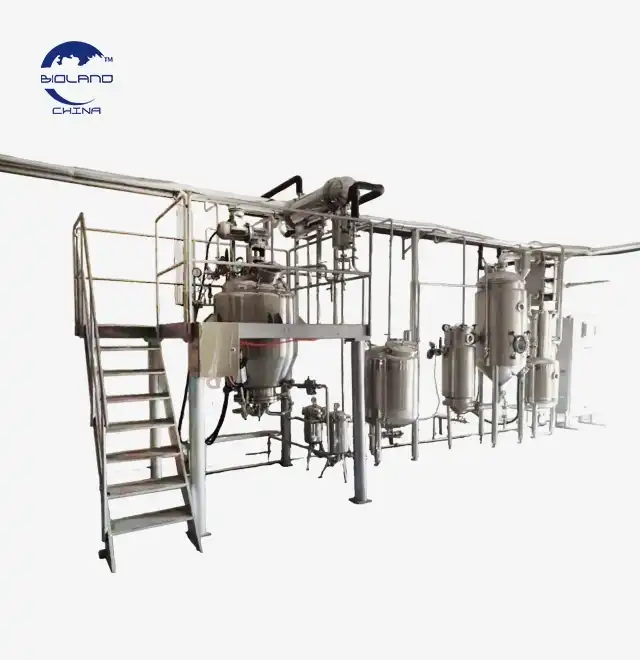
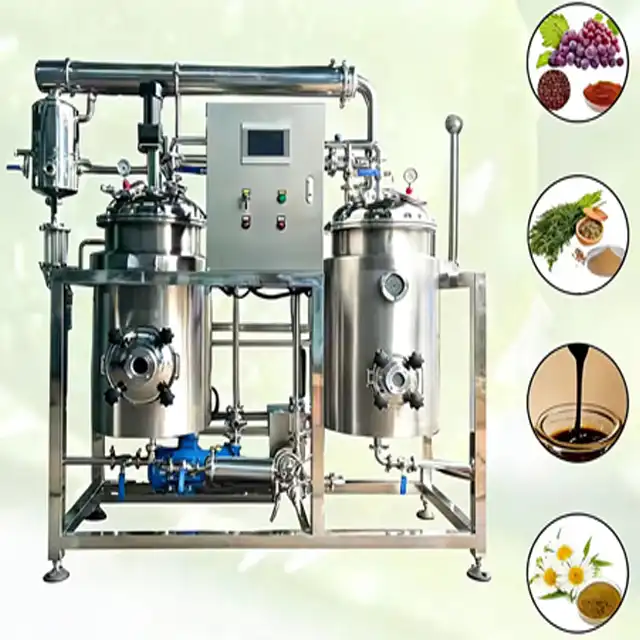
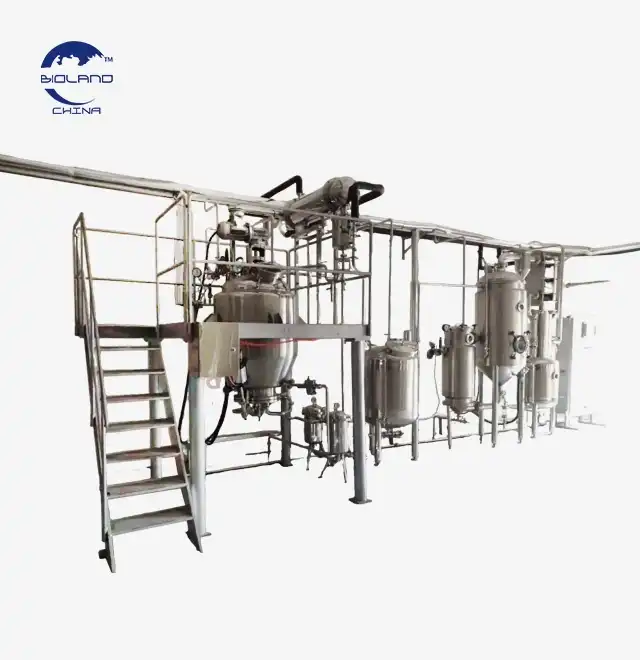
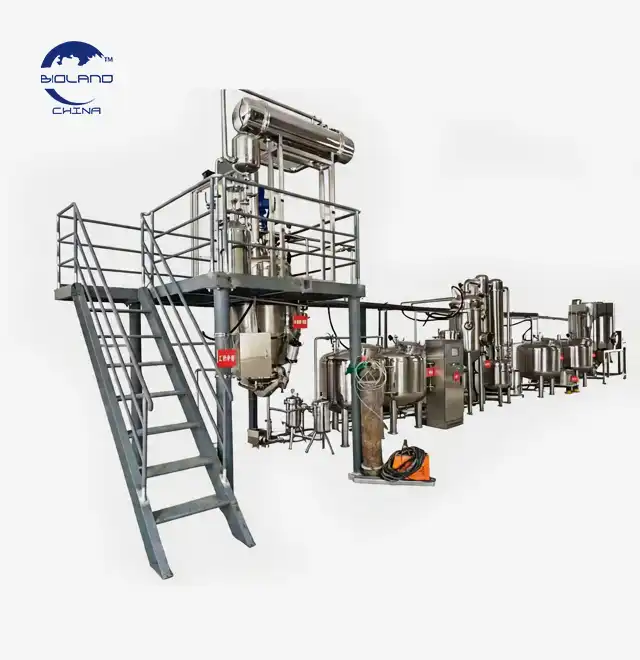
The whole setup might have an ultrasonic system, an extraction tank, a tube heater, an evaporator, a condenser, an oil separator, an oil receiver, a liquid pump, a measuring tank, a storage vessel, a filter, a vacuum pump and an electrical cabinet. At vapour exits, demisters help keep liquids from mixing in while concentration and solvent recovery are going on.
Solving Different Problems with Separate Recipes
A company that makes stevia needs the steviol glycosides to come out of the leaves, stems, and roots more quickly. Bioland instrument modified ultrasonic extraction equipment that managed the touch with the liquid and did the filter, concentration, and automatic transfer. The built-in stevia extraction machine cut down on transfer times and let the producer control extraction by using written parameters instead of making adjustments by hand over and over.
During the production of capsaicin and chilli oleoresin, a chilli grinder had to deal with solvents for a long time. Bioland instrument built a Chilli Oleoresin Extraction Plant with ultrasonic help, parts that work with different solvents, reflux, recovery, and concentration. The user got a smaller process that gave them more control over the time it takes to remove, the flow of liquid, and the regularity between batches.
Moving from Process Review to Factory Acceptance
Before choosing ultrasonic extraction equipment, Bioland instrument's engineers look at the feedstock, target compound, daily throughput, solvent, utilities, filtration needs, and factory layout. OEM and ODM services include size of the vessel, automation, heating methods, solvent recovery, design of clean rooms, and production lines that work together. Customised projects usually take about 30 business days, while standard tools are usually ready in 5–7 days.
During creation, a specialised professional sends pictures or movies every week. Customers can set up a Factory Acceptance Test at Bioland instrument's facility and get detailed inspection records before the goods are shipped. The risk of buying and putting something in place is further reduced by having CE and ISO certifications, GMP/FDA-focused building, factory-direct prices, global freight choices, and exports to Europe and Southeast Asia.
Conclusion
A higher temperature doesn't always mean a higher extraction yield. Theultrasonic extraction equipmentfrom Bioland instrument uses cavitation, controlled solvent contact, moderate-temperature processing, and vacuum concentration to get more valuable material out while reducing the time it spends in heat. Its benefits go beyond the extraction tank: PLC recipes, filtration, solvent circulation, condensation, CIP cleaning, and clean construction all work together to make a streamlined production system. There are different ways to process mushroom polysaccharides, goji actives, tea polyphenols, steviol glycosides, propolis flavonoids, capsaicin, natural pigments, and aromatic ingredients. Bioland helps customers turn tough extraction problems into scalable and repeatable production workflows by offering OEM/ODM engineering, FAT inspection, and lifetime maintenance.
FAQ
1. Does ultrasound eliminate heat completely?
No. Ultrasonic extraction equipment reduces reliance on prolonged high-temperature treatment, while controlled heating may still maintain 40–60°C.
2. Which solvents can be used?
Water, ethanol, and other process-approved solvents can be considered with suitable seals, controls, and safety configurations.
3. What capacities are available?
Bioland offers 50L, 100L, 200L, 300L, and 500L models.
4. Can it process mushrooms?
Yes. The system supports Ganoderma, shiitake, enoki, Tremella, and other polysaccharide-rich materials.
5. Is customization available?
Yes. Ultrasonic extraction equipment can be customized through OEM/ODM engineering, process design, PLC control, and FAT verification.
Turn Better Recovery into a Scalable Production Advantage
Are low yield, long extraction cycles, heat damage, or inconsistent concentration limiting your production? Bioland Instrument can configure ultrasonic extraction equipment around your material, target compound, solvent, daily capacity, utilities, and quality requirements. You receive an integrated solution covering extraction, filtration, concentration, solvent recovery, automation, cleaning, and operating support—not simply a processing tank. With over 15 years of engineering experience, factory-direct pricing, CE and ISO credentials, OEM/ODM capability, weekly production updates, FAT support, a one-year warranty, and lifetime maintenance, Bioland Instrument helps reduce technical and purchasing risk. Send your raw-material information, current bottleneck, and required output to info@biolandequip.com. The team will recommend a practical ultrasonic extraction equipment configuration and process route for your project.
References
1. Chemat, F., Rombaut, N., Sicaire, A. G., et al. “Ultrasound Assisted Extraction of Food and Natural Products: Mechanisms, Techniques, Combinations, Protocols and Applications.” Ultrasonics Sonochemistry, 2017.
2. Chemat, F., Zill-e-Huma, and Khan, M. K. “Applications of Ultrasound in Food Technology: Processing, Preservation and Extraction.” Ultrasonics Sonochemistry, 2011.
3. Vinatoru, M. “An Overview of the Ultrasonically Assisted Extraction of Bioactive Principles from Herbs.” Ultrasonics Sonochemistry, 2001.
4. Vilkhu, K., Mawson, R., Simons, L., and Bates, D. “Applications and Opportunities for Ultrasound Assisted Extraction in the Food Industry—A Review.” Innovative Food Science & Emerging Technologies, 2008.
5. Tiwari, B. K. “Ultrasound: A Clean, Green Extraction Technology.” TrAC Trends in Analytical Chemistry, 2015.
6. Azmir, J., Zaidul, I. S. M., Rahman, M. M., et al. “Techniques for Extraction of Bioactive Compounds from Plant Materials: A Review.” Journal of Food Engineering, 2013.
The reactor is beautifully mirror-polished and fully complies with GMP requirements for the pharmaceutical industry. The performance is excellent! Overall, we are very satisfied! We also provided with some feedback on our process improvements, which we hope will be helpful.
2024-04-09
Laboratory
Excellent and professional service. Always reply our questions very fast. All reactors and chiller we received are good too.
2024-02-15
Research Institute
Quality is beyond our expectation actually. After we got the extraction equipment and started using it, the performance was beyond our expectation. Very easy to use and very efficient to run. Service always respond us very quickly. Was also very helpful to help us. Thanks Bioland team. Very happy to work with you.
2023-11-20
Biotech Company
We are happy about the new purchase as always. Equipment and services are both good.
2023-08-05
Instrument Lab
This is the second order with Bioland instrument and everything is good as the first dateText.
2023-05-12
Global Trading Partner
Bioland instrument team is very helpful and professional. The sales helped us select the right equipment for our application, and their logistics people handled the transportation and customs declaration for our shipment. All that saved us a lot of work.