How Ultrasonic Assisted Extraction Equipment Boosts Quercetin Yield
Oct 28, 2026
It's not hard for people who make quercetin to find the raw materials; it's hard for them to get more of the compound out of them. A lot of flavonoids get stuck inside the plant matrix when it is soaked in hot water for a long time or when it refluxes. This uses up extra energy and damages molecules that are sensitive to heat. This guide shows howultrasound assisted extraction of quercetin alters that image and how Xi'an Bioland Instrument Co.,Ltd. transforms the technique into a controlled, production-ready process. Our ultrasound assisted extraction of quercetin equipment increases extraction rates by 50–500% compared to conventional methods, achieves the highest yield in 24–40 minutes at 40–60 °C, and is constructed of SUS304/316L stainless steel with PLC control, CIP cleaning, and a GMP-compliant design. Ultrasound assisted extraction of quercetin becomes a practical upgrade rather than a risky experiment thanks to CE and ISO certification, OEM/ODM support, and factory-direct pricing.
How Ultrasonic Cavitation Improves Quercetin Release
Why Quercetin Stays Trapped Inside Plant Tissue
Some of the building blocks of quercetin are rutin, quercitrin, and sugars. They are found inside plant cells and are held in place by cellulose and pectin walls. Soaking or heating depends on the compound slowly diffusing through these walls. To make up for this, processors use long processes and high temperatures, and some of the compound still stays in the leftovers. The main technical hole that ultrasound assisted extraction of quercetin is meant to fill is this one. It does this by directly breaking down the barrier instead of waiting for the liquid to make its way through it.
How Ultrasound Assisted Extraction of Quercetin Works Inside the Tank
Tiny bubbles form and pop within microseconds as ultrasonic waves move through the solvent. Micro-jets and shock waves are made when the particles fall apart. These break or deform the cell walls, shorten the diffusion path, and keep new solvent moving across the particle surfaces. The ultrasound system and a jacketed vessel work together in our extraction tanks, allowing for ultrasound assisted extraction of quercetin to take place at temperatures between 40 and 60 degrees Celsius rather than almost boiling. That lower temperature saves flavonols that are easily oxidized or broken down by water. The resulting liquor also has fewer impurities, which makes it easier to separate and clean later.
A Sophora Japonica Bud Processor Breaks Through Its Yield Ceiling
A flavonoid plant in eastern China used hot reflux for three hours to extract rutin and quercetin from Sophora japonica buds. The yield had stopped growing, the energy bills kept going up, and the extract got darker from being heated for too long. The shop owner wanted a faster way to get to work without having to redesign the whole place.
We set up a BL-TN-C200L unit and used 70% ethanol for ultrasound assisted extraction of quercetin precursors at 55 °C. It took only 35 minutes instead of three hours to extract the flavonoids, and the amount of steam used was about a third less. The client now does four batches with an extract that is lighter in color each shift.
One Ultrasonic Platform for Many Botanical Lines
Cavitation can happen with more than one compound. Different types of machines in the same family can be used to get different kinds of chemicals. For example, stevia machines can get steviol glycosides, tea machines and coffee machines can get polyphenols and caffeine, chili oleoresin machines can get capsaicin, tincture machines can work with propolis, plants can get pigments, and mushrooms can get polysaccharides through ultrasonic extraction. Because of this adaptability, a company that purchases ultrasound assisted extraction of quercetin equipment can later add new product lines without having to replace the main hardware.
A tea producer in Southeast Asia only used its tank during the spring harvest, which meant that expensive machinery sat there for months. We demonstrated to the team that the same BL-TN-C200L could handle the fall ultrasound assisted extraction of quercetin from mulberry leaves. Payback dropped to less than 14 months, and use went from about 40% to 75%.
Not every plant gives you the same place to start. Buds from Sophora japonica, celery, mulberry leaves, Ganhuangcao, Vaccinium leaves, onion skins, and larch all have different amounts and types of quercetin or flavonoids that are related to it. We advise drying the material to a stable moisture level, removing any foreign matter, and milling to a consistent particle size before performing ultrasound assisted extraction of quercetin. Too big of particles can hide the compound in whole tissue, and too small of powder can pack tightly and slow down filtration. The best mesh range is one that has a balance of sizes.
Liquid-to-Solid Ratio, Temperature and Mass Transfer
How much quercetin gets into the liquor depends on three things: the amount of liquid to solid, the temperature, and the strength of the touch. A large fluid ratio makes the concentration gradient steeper, but it also makes the later evaporation load higher, so after a few small tests, most makers decide on a middling ratio. Our ultrasound assisted extraction of quercetin equipment maintains a temperature of 40 to 60 °C through the jacket, and cavitation keeps the slurry moving so that the solvent is constantly meeting new surfaces. The same reasoning works for rutin, quercitrin, and other related flavonoids because ultrasonic extraction is not limited by the polarity or molecular weight of the components.
Mulberry Leaf Batches That Refused to Match
A company that sells plant extracts made a quercetin-rich powder from mulberry leaves, but the results of the tests were very different. The operators estimated the extraction time by looking at the leaves. The size of the particles changed with each milling shift, and customers complained that the content wasn't always the same.
We made the milling mesh the same, set the ethanol ratio, and switched production to a BL-TN-C100L unit that stores PLC recipes. Because ultrasound assisted extraction of quercetin now operates within predetermined limits, batch-to-batch variation decreased from about 11% to less than 3%, and complaint returns almost completely vanished.
Why Repeatability Is Part of Yield
Yield is not only about the best single run; it is about getting the same result every day. Our systems combine intelligent PLC control, online concentration monitoring, automatic discharge and online cleaning, so ultrasound assisted extraction of quercetin can be repeated with minimal operator judgment. Continuous feeding and discharge, together with CIP cleaning, also reduce cross-contamination between botanical batches. This matters when one workshop switches between quercetin, tea polyphenols and other flavonoid products during the year.
Solvent Selection for Higher Quercetin Recovery
Why Ethanol Concentration Makes or Breaks Recovery
Quercetin aglycone doesn't dissolve well in water but does dissolve easily in watery ethanol. Other glycosides, like rutin, like mixes that are a bit more neutral. That's why blends of ethanol and water, usually between 60 and 80%, are so common. Small pilot tests can be used to make them even better. Cavitation enhances solvent entry in ultrasound assisted extraction of quercetin, allowing processors to frequently achieve strong recovery without using the most ethanol. This cuts down on solvent costs and makes the recovery step easier later on.
Matching Solvent to Your Target Market
Based on the needs of the process, our tools can work with water, ethanol, methanol, acetone, and other liquids. Because they are legal, ethanol and water are usually the best choices for food, supplements, and cosmetics. However, research labs do test other solvents for analytical work from time to time. Customers can choose the method that best suits their product specifications by using a single platform for ultrasound assisted extraction of quercetin, which can also be used for water decoction, wet maceration, hot reflux, percolation, and alcohol precipitation.
Onion Skin Waste Becomes a Sellable Flavonoid Extract
Someone who recycles food waste got onion skins and sold them as cheap feed. The company wanted an extract that was high in quercetin, but its small stirred tank took four hours to work and used too much ethanol, so the profit margins stayed low.
We gave you a BL-TN-C50L test machine that can recover solvents. At 50 °C, ultrasound helped extract quercetin in 30 minutes. The ethanol that was recovered during vacuum concentration was used again, and the cost of buying solvents went down by about 35%. The recycler turned a low-value waste product into an extract that could be sold.
Solvent Recovery Built Into the Same Line
One of the biggest hidden costs is often the solvent. In our design for extraction and concentration, the vapor that is made during vacuum concentration goes through the cooler and condenser, comes back as condensate, and can be used as fresh solvent in the extraction tank. This type of recovery, called reflux, improves extraction and lowers consumption. The clear liquid that is left in the tank can be used in the next batch. This loop makes solvent management a built-in function for ultrasound assisted extraction of quercetin, as opposed to a separate project.
Optimizing Extraction Time and Ultrasonic Power
Finding the 24–40 Minute Sweet Spot
Most plant materials produce the most flavonoids in 24 to 40 minutes when they are exposed to ultrasound, which is more than two-thirds faster than the old way of doing things. Running longer doesn't usually add much yield, and it may expose the extract to too much heat. For each new raw material, we usually suggest a time-gradient test that lasts 20, 30, 40, and 50 minutes. The best point is then locked into the PLC recipe. With this method, ultrasound assisted extraction of quercetin can produce the highest return for every hour of work.
Matching Ultrasonic Power to the Material
It's not always better to have more power. Low power may leave some thick tissue alone, but high power can raise the temperature in the area and mess up flavonoids that are sensitive to it. Dense things, like larch chips, can handle being treated more harshly than soft things, like mulberry or celery leaves. Our engineers try different power levels with your raw material during setup, and the data they collect helps them decide how to set up the ultrasound assisted extraction of quercetin system so that the power, temperature, and time all work together in a balanced manner.
Ganhuangcao Line Cuts Cycle Time by 70%
A company that processed Ganhuangcao plant extracts used two-hour reflux extraction, and each shift only made one batch. Costs of labor were going up and deliveries were being late, so the owner had to find a faster route.
We set up a BL-TN-C300L system that has PLC control, ethanol extraction, and vacuum concentration. With ultrasound help, flavonoids containing quercetin were extracted in 36 minutes at 55 °C, which cut the cycle time by about 70%. The amount of work done each day went from one batch to three, and the extract needed less cleaning.
Letting the PLC Hold the Process Window
Once the best time and power are known, the control system protects them. Operators select a stored recipe, the PLC manages temperature, ultrasonic operation and discharge, and the system can run under negative, normal or positive pressure for water, alcohol or solvent extraction. This keeps ultrasound assisted extraction of quercetin consistent across shifts and supports the documentation needs of GMP and HACCP-oriented customers.
Scaling Up Ultrasonic Quercetin Extraction for Production
Scale-Up Rules for Ultrasound Assisted Extraction of Quercetin
Scale-up is easier when you start with the right size. The BL-TN-C50L offers 50 L volume and 20 kg/h evaporation capacity for laboratory and pilot work, the C100L and C200L reach 50 and 70 kg/h, and the C300L and C500L deliver 100 and 200 kg/h. Motor power is 2.7–3.5 kW, system vacuum is -0.085 MPa, jacket pressure is 0.09–0.3 MPa, compressed air is 0.5–0.6 MPa and evaporation temperature is 60–100 °C. At every scale, ultrasound assisted extraction of quercetin follows the same logic, so laboratory results transfer predictably.
Inside the Equipment: Structure, Principle and Safe Operation
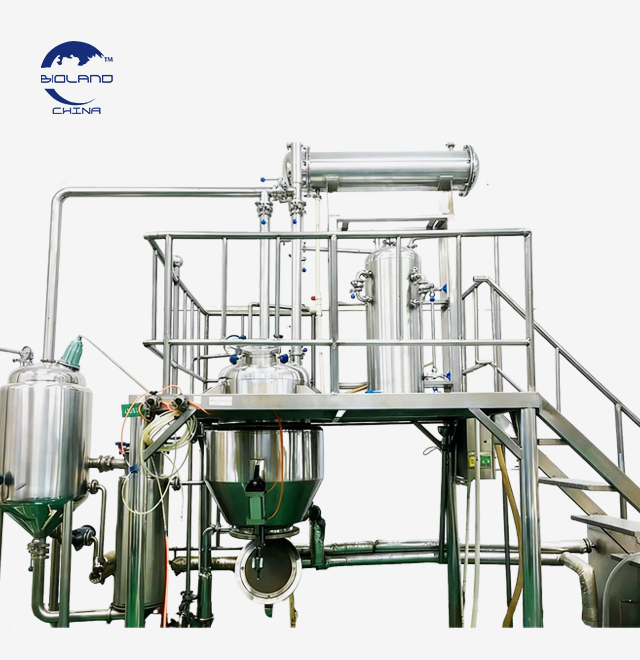
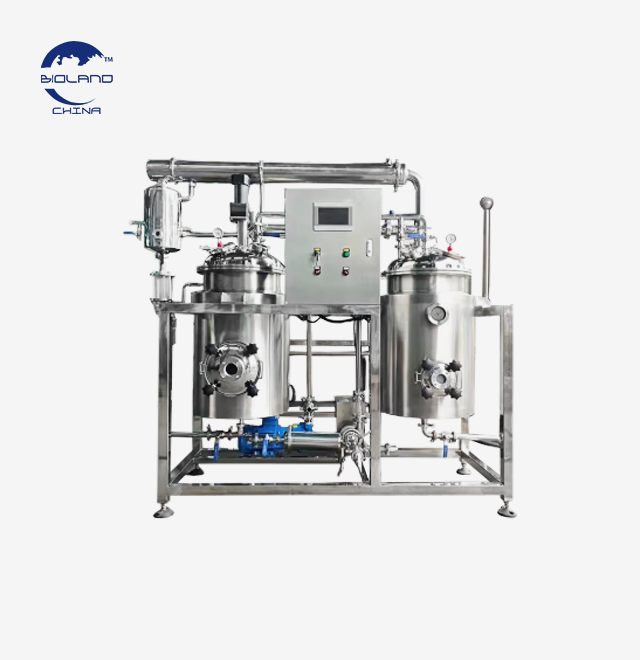
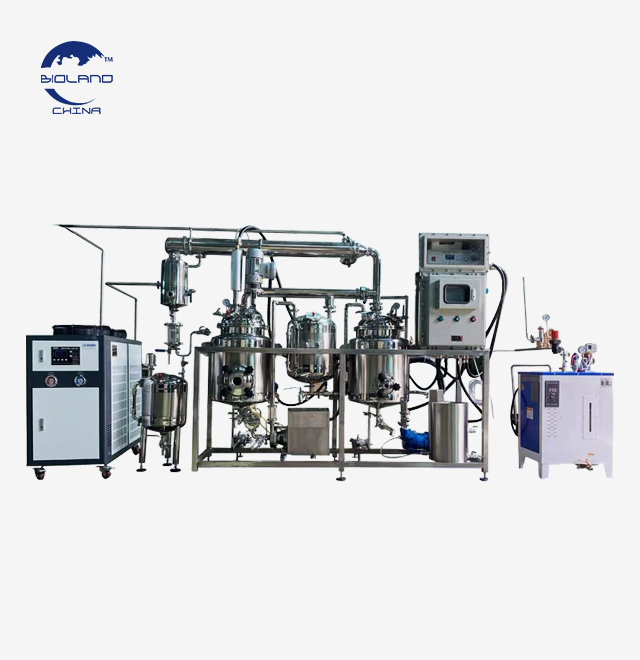
A complete unit includes the ultrasonic system, extraction tank, tubular heater, evaporator, condenser, oil separator, oil collector, liquid pump, metering tank, storage tank, filter, vacuum pump and electrical cabinet, with demisters on the steam outlets of the tank and evaporator. Where steam is unavailable, a thermal-oil heating system can be added. Material and solvent are loaded, extraction runs at the set temperature, the liquor is drawn into the concentrator under -0.05 to -0.09 MPa vacuum, and condensate returns as fresh solvent. Operators should check vacuum, jacket pressure and air supply before each run and use CIP afterward. These steps keep ultrasound assisted extraction of quercetin safe, clean and efficient.
A University Spin-Off Moves From Beaker to Production
A university spin-off had proven a quercetin recovery process in the laboratory but could not reproduce the results in a larger tank. Investors wanted a pilot line with GMP-oriented design and reliable data before funding production.
We built a BL-TN-C100L line with SUS304/316L contact parts, CIP and PLC recipes, and sent weekly photos during manufacturing. Ultrasound assisted extraction of quercetin precursors from Sophora japonica buds then achieved pilot recovery within 5% of laboratory data, helping the team secure its first commercial order.
One Supplier, One Process Partner
Xi'an Bioland Instrument Co.,Ltd. is a professional manufacturer and solution provider for distillation, concentration, reaction, extraction, separation, filtration, purification, crystallization, emulsification, mixing and drying equipment, with more than 15 years in the field. Our range includes ultrasonic plant extraction machines, ethanol and CO2 extraction machines, jacketed glass reactors, vacuum spray dryers and freeze dryers, exported to Europe and Southeast Asia. Customized lines are ready in about 30 business days and standard units in 5–7 days, backed by CE and ISO certification, GMP/FDA-compliant design, a one-year warranty and lifetime maintenance. A dedicated specialist sends weekly photos or videos during production, and clients may approve shipment after inspection or schedule a Factory Acceptance Test. That is why ultrasound assisted extraction of quercetin from Bioland arrives as a full solution, not just a machine.
Conclusion
Higher quercetin yield comes from a chain of well-controlled decisions: preparing the raw material, using cavitation to release the compound, choosing an efficient solvent, holding time and power in the best window, and scaling up with production-grade equipment. Ultrasound assisted extraction of quercetin from Bioland Instrument supports each link, delivering 50–500% higher extraction rates, 24–40 minute cycles and gentle 40–60 °C operation. The cases show the practical results: shorter batches, steadier assays, lower solvent use and faster payback. With CE and ISO certification, GMP-oriented design, OEM/ODM flexibility and lifetime maintenance, ultrasound assisted extraction of quercetin becomes a reliable foundation for laboratories, pilot plants and growing factories.
FAQ
Q1: How does ultrasound assisted extraction of quercetin raise yield?
A: Cavitation breaks plant cell walls, releasing quercetin faster and raising extraction rates by 50–500%.
Q2: What time and temperature are typical?
A: Most materials reach best yield in 24–40 minutes at 40–60 °C.
Q3: Which plants can the equipment process?
A: Sophora japonica buds, celery, mulberry leaves, Ganhuangcao and onion skins, plus stevia, tea and propolis.
Q4: Which solvents and models are available?
A: Water, ethanol, methanol or acetone; models range from 50 L to 500 L.
Q5: Is ultrasound assisted extraction of quercetin equipment certified?
A: Yes. It carries CE and ISO certification, GMP/FDA-compliant design, a one-year warranty and lifetime maintenance.
Ready to Upgrade Your Ultrasound Assisted Extraction of Quercetin Process? Talk to Bioland Instrument
Low yield, long cycles and unstable assays are process problems, and process problems have solutions. At Bioland Instrument, we do more than sell equipment for ultrasound assisted extraction of quercetin; we help you choose the solvent, model and layout that fit your raw material and output. With 15+ years of experience, CE and ISO certification, GMP/FDA-compliant construction, competitive factory pricing, OEM/ODM customization, weekly progress photos or videos, optional FAT and a one-year warranty with lifetime maintenance, you can move forward with confidence. Tell us your plant material, target quercetin content and daily capacity, and our engineers will recommend a tailored ultrasound assisted extraction of quercetin solution. Customized lines ship in about 30 business days, standard units in 5–7 days. Email info@biolandequip.comfor a quotation or pilot-test plan today.
References
1. Chemat, F., Rombaut, N., Sicaire, A.-G., Meullemiestre, A., Fabiano-Tixier, A.-S., & Abert-Vian, M. (2017). Ultrasound assisted extraction of food and natural products. Mechanisms, techniques, combinations, protocols and applications. A review. Ultrasonics Sonochemistry, 34, 540–560.
2. Vinatoru, M. (2001). An overview of the ultrasonically assisted extraction of bioactive principles from herbs. Ultrasonics Sonochemistry, 8(3), 303–313.
3. Jin, E. Y., Lim, S., Kim, S. O., Park, Y.-S., Jang, J. K., Chung, M.-S., Park, H., Shim, K.-S., & Choi, Y. J. (2011). Optimization of various extraction methods for quercetin from onion skin using response surface methodology. Food Science and Biotechnology, 20(6), 1727–1733.
4. Lakhanpal, P., & Rai, D. K. (2007). Quercetin: A versatile flavonoid. Internet Journal of Medical Update, 2(2), 22–37.
5. Hertog, M. G. L., Hollman, P. C. H., & Katan, M. B. (1992). Content of potentially anticarcinogenic flavonoids of 28 vegetables and 9 fruits commonly consumed in the Netherlands. Journal of Agricultural and Food Chemistry, 40(12), 2379–2383.
6. Wang, L., & Weller, C. L. (2006). Recent advances in extraction of nutraceuticals from plants. Trends in Food Science & Technology, 17(6), 300–312.
The reactor is beautifully mirror-polished and fully complies with GMP requirements for the pharmaceutical industry. The performance is excellent! Overall, we are very satisfied! We also provided with some feedback on our process improvements, which we hope will be helpful.
2024-04-09
Laboratory
Excellent and professional service. Always reply our questions very fast. All reactors and chiller we received are good too.
2024-02-15
Research Institute
Quality is beyond our expectation actually. After we got the extraction equipment and started using it, the performance was beyond our expectation. Very easy to use and very efficient to run. Service always respond us very quickly. Was also very helpful to help us. Thanks Bioland team. Very happy to work with you.
2023-11-20
Biotech Company
We are happy about the new purchase as always. Equipment and services are both good.
2023-08-05
Instrument Lab
This is the second order with Bioland instrument and everything is good as the first dateText.
2023-05-12
Global Trading Partner
Bioland instrument team is very helpful and professional. The sales helped us select the right equipment for our application, and their logistics people handled the transportation and customs declaration for our shipment. All that saved us a lot of work.