Why Choose Borosilicate Glass Reactors for Chemical Processing?
Aug 27, 2026
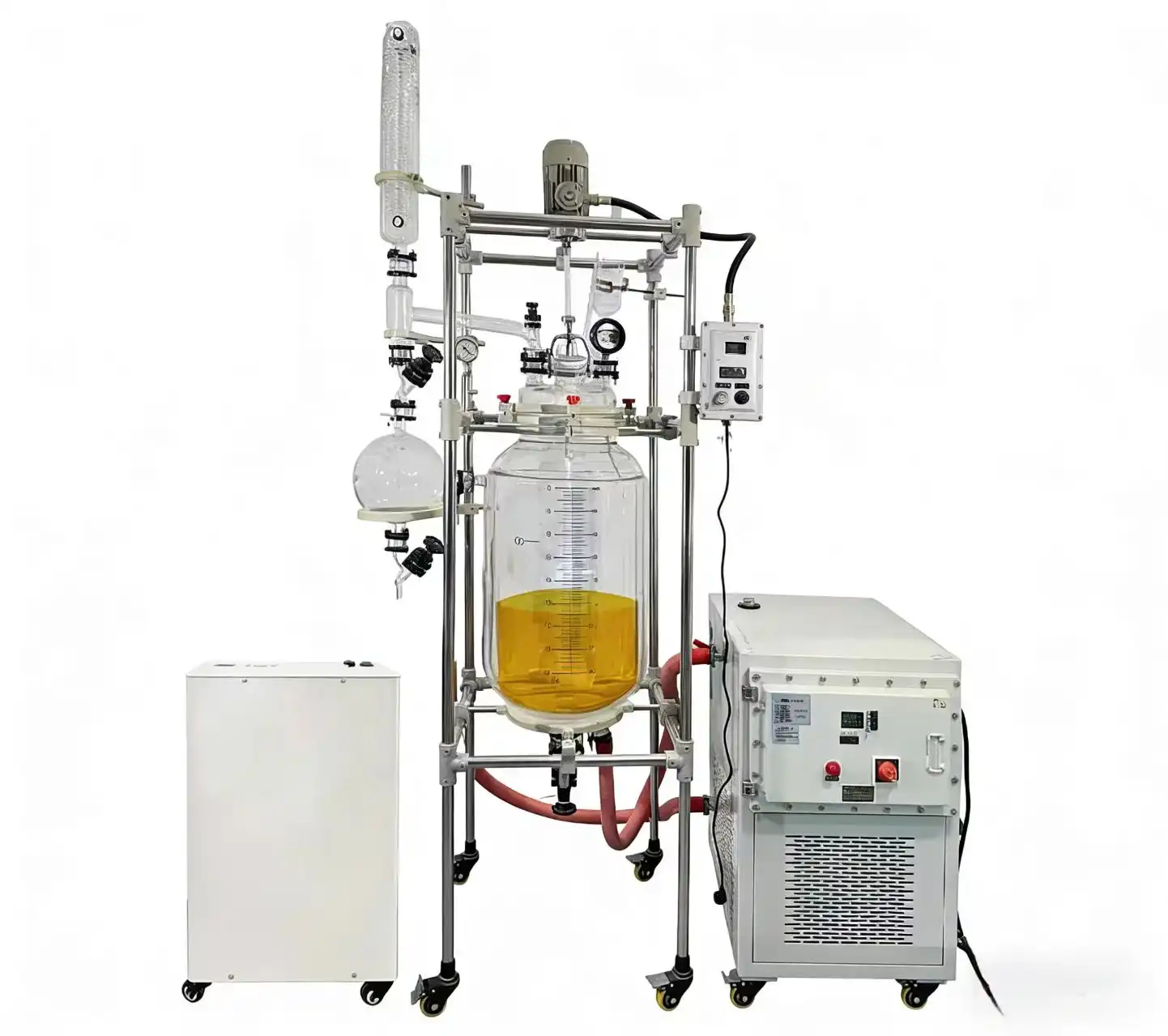
Why should people who work with chemicals pick a borosilicate glass reactor over a regular metal vessel? Process visibility, chemical compatibility, purity protection, and flexible integration are the keys to the answer. The temperature, stirring, feeding, condensation, and pressure conditions can be controlled while the workers can see colour changes, precipitation, foaming, phase separation, and crystallisation through clear glass.
The borosilicate glass reactor from Bioland Instrument is not just a container; it is meant to be a base for both lab work and trial processing. It can handle reaction, extraction, distillation, reflux, concentration, filtration, and crystallisation with its GG17 high-borosilicate tank, jacketed temperature control, flexible ports, variable-speed agitation, and adaptable supporting equipment. Price cuts from the factory and OEM/ODM engineering make the project even more valuable.
Key Properties of Borosilicate Glass That Support Chemical Processing Applications
Product purity, equipment life, and batch consistency are all directly affected by how well materials work. A borosilicate glass reactor is very clear, doesn't expand or contract much when heated, and works well with many common chemical media. Because of these qualities, it is especially useful when workers need to understand how a process works without using only outside tools. Bioland can also match the glass vessel with the right frames, drives, condensers, temperature controllers, and seals.
Transparent Processing That Supports Faster Decisions
An dark vessel can hide things like catalyst dispersion, localised foaming, partial dissolving, or a phase border that wasn't expected. With a borosilicate glass reactor, workers can keep an eye on these changes and see how they match up with records of temperature, pressure, and motion. This clear proof helps process engineers find endpoints, improve standard operating procedures, and find risks related to scaling up before they commit expensive materials to larger production batches.
It is helpful to be able to see during crystallisation and dissolution because the shape of particles can change quickly. Engineers can watch nucleation, slurry movement, wall adhesion, and crystal setting without having to open the system over and over again. This feature, along with sampling and analytical testing, helps teams understand the process better and come up with more consistent ways to charge, cool, seed, and discharge.
GG17 Glass for Corrosion Resistance and Product Purity
The main tank at Bioland is made of GG17 high-borosilicate glass. A borosilicate glass reactor can handle a lot of different acids, organic solvents, and chemical mixtures. This makes it a good choice for pharmaceutical intermediates and highly pure compounds. Glass doesn't usually let metal ions into the system like metal surfaces do. These ions could change the activity of catalysts, the colour of products, their biological function, or the quality further down the line.
Still, concentration, temperature, residence time, and cleaning agents must be checked to make sure they are compatible. Extra care needs to be taken with hydrofluoric acid and some very alkaline conditions. Before suggesting the vessel, PTFE parts, mechanical seals, gaskets, valves, pipes, and other equipment, Bioland's engineers look over the process media. This review of the whole system is more accurate than just choosing the material for the reactor.
Low Thermal Expansion and Jacketed Heat Transfer
When compared to regular glass, borosilicate glass has a low rate of thermal expansion. This means that it can stay in use even when process temperatures change as long as the right steps are taken. In a jacketed borosilicate glass reactor, heat is transferred through the vessel wall by moving fluid. This lets the temperature be controlled for heating, cooling, condensation, reflux, or crystallisation without having to put a heater inside the product itself.
Different Bioland configurations can be designed to work with processes ranging from -80°C cooling to 300°C heating. These numbers rely on the thermal fluid, pump, seals, fittings, and the conditions under which they are to be used. Controlled ramp rates are still very important. Always pay more attention to the allowed working range written on the final equipment paperwork than to a general product description.
Modular Connections for Multiple Unit Operations
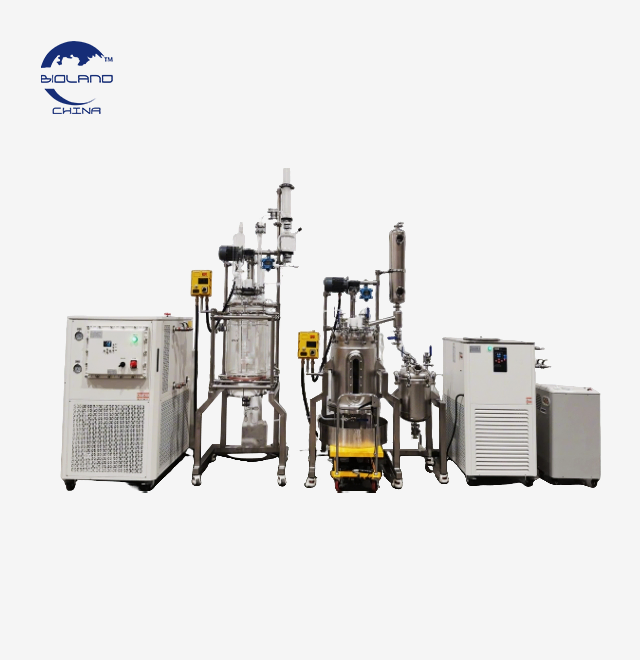
Standard flange ports, including optional multi-neck covers, can accommodate a condenser, dropping funnel, temperature probe, feed pipe, pressure instrument, vacuum line, distillation column, or tail-gas connection. This modular structure allows one borosilicate glass reactor to support several process stages without transferring material repeatedly between unrelated vessels.
Reducing transfers can limit product loss, contamination exposure, and operator workload. Depending on the application, Bioland can add lifting and rotating mechanisms, filtration modules, ultrasonic crystallization, purification equipment, receivers, condensers, and automated dosing. The result is a process platform developed around the customer’s actual material flow.
How Borosilicate Glass Reactors Improve Chemical Reaction Performance and Safety
Reaction performance depends on the interaction between mixing, heat transfer, feed control, pressure, and residence time. A properly configured borosilicate glass reactor makes these variables easier to observe and adjust. Safety is strengthened through suitable sealing, verified vacuum operation, controlled temperature ramps, compatible accessories, and optional automation. For hazardous locations, Bioland can engineer explosion-protected systems based on the applicable site requirements.
Connecting Visual Evidence with Process Parameters
Color change, gas evolution, precipitation, reflux rate, and phase separation can indicate whether a reaction is progressing as expected. A borosilicate glass reactor lets operators connect these visible events with recorded temperature, stirring speed, dosing rate, and vacuum data. This combined information is valuable during recipe development because it helps distinguish raw-material variation from mixing or temperature-control problems.
Variable-frequency agitation provides adjustable mixing for low-viscosity solutions, suspensions, emulsions, and crystallizing media. Impeller geometry should be selected according to viscosity, solid loading, vessel dimensions, and the desired flow pattern. Bioland can customize the shaft, blade type, motor power, and speed range instead of applying one agitation design to every process.
From Raw-Material Charging to Product Recovery
A typical workflow begins with compatibility review, seal inspection, utility checks, and an empty-system vacuum test. Raw materials are then charged according to the approved sequence, after which agitation starts at low speed. The borosilicate glass reactor supports controlled dosing while the jacket maintains the target temperature and the condenser manages vapors or reflux.
After the reaction hold, the same borosilicate glass reactorcan support vacuum concentration, solvent recovery, extraction, crystallization, or discharge to a filtration unit. Integrating these operations can reduce waiting time and material handling. PLC control may be added for recipe management, timed dosing, temperature sequences, alarms, data recording, and repeatable pilot validation.
Safety Engineering Beyond the Glass Vessel
Safe processing requires more than chemical-resistant glass. A borosilicate glass reactor should be supported by a stable frame, compatible seals, guarded rotating parts, suitable vacuum components, and correctly sized temperature-control equipment. PTFE sealing combined with an application-specific mechanical seal can improve containment, while a lifting or rotating structure can simplify charging, discharge, inspection, and cleaning.
Operators should inspect the glass for damage, avoid sudden temperature changes, apply vacuum gradually, and never exceed the documented limits. Solvent processes may require explosion-proof motors, electrical controls, grounding, ventilation, interlocks, and tail-gas absorption. Bioland can integrate these features into a fully explosion-protected system after reviewing the hazardous-area classification.
Solving an Acidified Glycerol Processing Problem
A customer using nitric acid in an acidified glycerol production line needed corrosion resistance and better supervision of color development, heat release, and reaction endpoints. An opaque processing arrangement made it difficult to evaluate changes without frequent sampling.
Bioland developed a customized glass reaction solution with controlled feeding, visible mixing, temperature monitoring, compatible sealing, and connections for supporting treatment equipment. The borosilicate glass reactor concept gave operators a clearer view of the process while reducing dependence on exposed metal surfaces. Appropriate risk assessment and site-specific safeguards remained central to the final configuration.
Advantages of High Chemical Resistance and Thermal Stability in Reactor Systems
Chemical resistance protects both equipment and product quality, while thermal stability helps maintain predictable reaction conditions. A borosilicate glass reactor combines these advantages with a jacketed design that separates the process material from the circulating thermal fluid. For high-value batches, this combination can reduce contamination concerns, simplify visual inspection, and support accurate control during synthesis, reflux, solvent removal, and cooling crystallization.
Reliable Compatibility for Demanding Formulations
Pharmaceutical chemicals, pesticides, biological compounds, precious-metal solutions, and specialty materials may contain aggressive solvents or corrosive reagents. A borosilicate glass reactor provides broad chemical compatibility without requiring a metal coating in contact with the product. This is especially helpful when trace contamination could change purity, color, catalyst selectivity, or final analytical results.
Bioland reviews the complete wetted path rather than focusing only on the vessel. Feed tubes, bottom valves, seals, probes, filter media, receivers, and transfer lines must be compatible with the process. This approach prevents a resistant vessel from being paired with an unsuitable accessory that becomes the weakest point in the system.
Precise Heating, Cooling, Reflux, and Vacuum Control
The double-layer design allows thermal fluid to circulate around the vessel for controlled energy transfer. When paired with a correctly sized circulator, a borosilicate glass reactorcan maintain reaction temperature, remove exothermic heat, create a programmed cooling curve, or support low-temperature condensation. The transparent wall also lets operators identify uneven circulation or material buildup.
Selected systems may achieve vacuum levels down to approximately -0.095 MPa, subject to the complete configuration and local atmospheric conditions. Under vacuum, a borosilicate glass reactor can promote evaporation or solvent recovery at reduced boiling temperatures. Condenser area, receiver volume, vacuum-pump capacity, vapor load, and seal performance must be calculated as one system.
Stable Sealing with Practical Maintenance Access
Mechanical seals, PTFE components, and carefully aligned agitation shafts support containment during vacuum processing and inert-gas operation. The borosilicate glass reactor can also be equipped with a lifting assembly or a rotating vessel structure, making the interior easier to inspect and clean. Better access can shorten changeover time when a pilot facility handles several formulations.
Preventive maintenance should include seal inspection, fastener checks, hose assessment, drive alignment, condenser cleaning, and vacuum leak testing. Bioland provides a one-year quality warranty and lifetime maintenance support. Clear operating documentation and spare-parts planning help customers keep the complete line available instead of treating maintenance as an emergency response.
A 30% Improvement for a Biopharmaceutical Customer
A South American biopharmaceutical company faced insufficient oxygen-transfer efficiency, long fermentation cycles, inconsistent parameter control, and purity concerns. The process also required a sealed environment for oxidation-sensitive pharmaceutical intermediates.
Bioland customized a 50L double-layer system and optimized the agitation blade, improving oxygen-transfer efficiency by 30% and shortening the fermentation cycle. The borosilicate glass reactor configuration combined process visibility, accurate temperature control, and sealed operation. The resulting data also gave the customer a stronger basis for subsequent pilot-scale evaluation.
Applications of Borosilicate Glass Reactors Across Different Chemical Industries
The value of a borosilicate glass reactor extends beyond conventional synthesis. Its visible vessel and modular connections can serve drug development, chemical intermediate production, food processing, cosmetics, biotechnology, petroleum research, metallurgy, pesticides, fuels, precious metals, and new materials. The configuration changes by industry, but the core objective remains consistent: control the process while protecting product quality and operator awareness.
Pharmaceutical Synthesis and Pilot Validation
Pharmaceutical teams must observe reaction endpoints, protect sensitive compounds, and maintain repeatable process records. A borosilicate glass reactor can support intermediate synthesis, catalyst evaluation, controlled precipitation, solvent recovery, and active-compound development. Its non-metallic product-contact surface is useful where unwanted metal ions could compromise a high-purity formulation.
For pilot validation, the borosilicate glass reactor can include inert-gas protection, recipe-controlled PLC automation, sampling connections, temperature recording, and vacuum control. Bioland develops systems for GMP-oriented pilot requirements and can provide project documentation according to the agreed scope. Customers should define qualification, traceability, and documentation expectations before manufacturing begins.
Precious-Metal Extraction and Refining
A European precious-metal processor struggled with low throughput, inefficient solvent separation, and equipment that could not support a new hazardous production line. The company required a coordinated solution rather than individual machines from several suppliers.
Bioland delivered four 200L explosion-proof double-layer reactors and nine 50L explosion-proof rotary evaporators compliant with the specified ExdⅡBT4 requirement. The borosilicate glass reactorsystems provided visible monitoring for corrosive mixtures and integrated temperature control. Modular manufacturing shortened delivery by 40%, enabled production 15 days early, and increased annual capacity by 30%.
The completed line operated for more than 1,000 hours without a reported failure. The project demonstrates how reactor selection, solvent recovery, explosion protection, and production scheduling can be solved as one engineering package.
Food, Biotechnology, and Cosmetics Processing
Food and biotechnology applications require controlled heating, blending, extraction, concentration, and fermentation monitoring. A borosilicate glass reactor gives developers a clear view of dissolution, foaming, emulsification, and phase behavior. It can support flavor extraction, ingredient trials, fermentation studies, formulation optimization, and controlled dehydration when equipped with suitable vacuum and condensation components.
Cosmetic developers can use the platform for botanical extraction, emulsion trials, active-ingredient mixing, and temperature-sensitive formulations. Bioland can combine the reactor with a high-shear homogenizer, filtration unit, concentration system, or drying equipment, creating a connected process rather than a collection of isolated machines.
Petroleum, Metallurgy, and New-Material Research
Petroleum research may involve catalyst testing, polymer synthesis, solvent treatment, and chemical analysis. Metallurgical applications include ore leaching, precious-metal refining, and the evaluation of corrosive process solutions. A borosilicate glass reactor helps researchers observe phase interfaces, catalyst movement, dissolution progress, and precipitate formation during these operations.
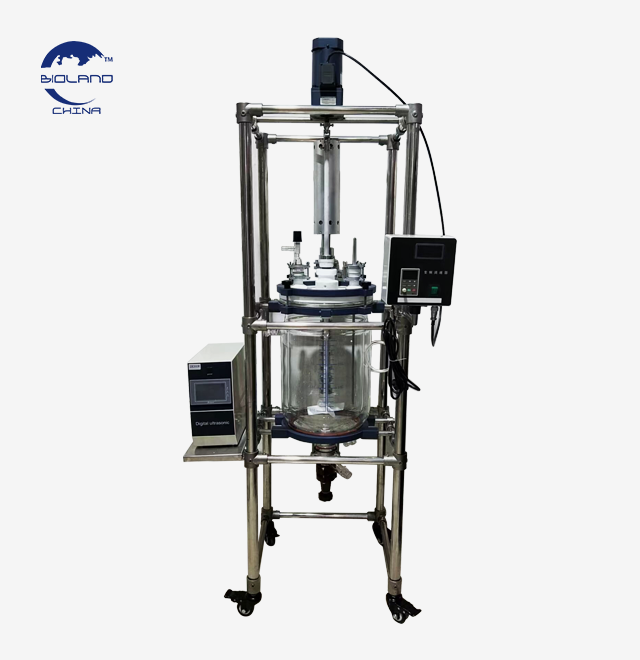
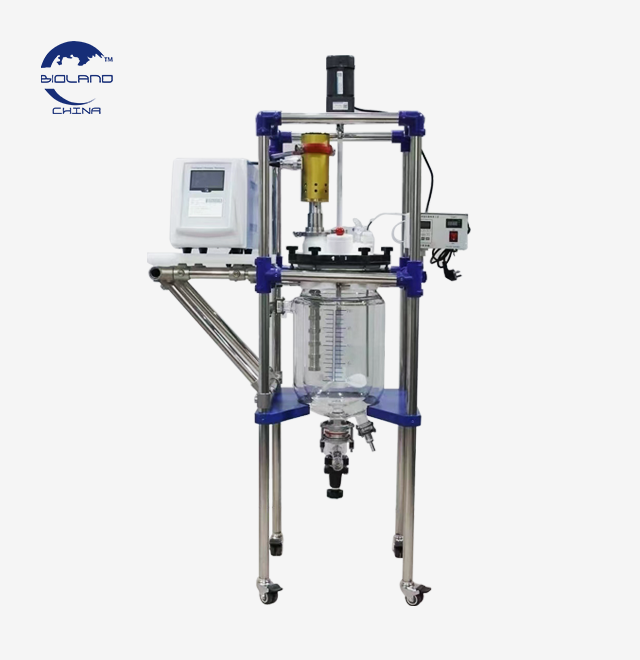
New-material laboratories can configure the system for nanoparticle synthesis, resin development, coating formulations, crystallization, or controlled polymerization. Condensers, fractional columns, feed tanks, ultrasound modules, and tail-gas systems can be added according to the process. This flexibility allows the same platform to evolve as research moves toward pilot production.
Factors to Consider When Selecting Borosilicate Glass Reactors for Processing Needs
Correct selection begins with process information, not nominal vessel capacity. A borosilicate glass reactor must be matched to working volume, chemistry, viscosity, solids content, thermal duty, vapor generation, vacuum requirements, agitation, and downstream operations. Available ceiling height, floor area, utilities, hazardous-area classification, cleaning procedures, and future production goals should also influence the final engineering proposal.
Define the Process Before Choosing Capacity
Customers should provide material safety data, batch composition, minimum and maximum working volumes, temperature profile, feed sequence, viscosity, reaction time, and expected annual output. A borosilicate glass reactor normally requires free headspace for foaming, gas evolution, reflux, and effective mixing, so nominal capacity should not be treated as usable capacity.
Scale-up should consider mixing power, impeller tip speed, heat-transfer area, condenser duty, feed time, and filtration load. Bioland’s technical team evaluates these variables before recommending a vessel. This prevents customers from purchasing a larger reactor that lacks appropriate thermal, agitation, or downstream capacity.
Select Components as an Integrated Process Line
After the process review, engineers define the jacket, motor, impeller, seal, ports, condenser, vacuum pump, receiver, temperature circulator, and control method. A borosilicate glass reactor may also need a fractional column, filter reactor, Nutsche filter, crystallizer, homogenizer, tail-gas absorber, or purification module.
OEM/ODM support allows Bioland to modify dimensions, vessel shape, frame structure, glass configuration, automation, and material-contact components. Options include full explosion protection, PLC automation, integrated temperature control, lifting and rotating designs, filtration, ultrasonic crystallization, concentration, and solvent recovery. Customers therefore purchase a coordinated solution built around the process bottleneck.
Confirm Safety, Documentation, and Factory Testing
Before shipment, the borosilicate glass reactor should be checked against the approved drawings, instrument list, electrical requirements, operating limits, and control philosophy. Bioland can support a Factory Acceptance Test at its facility, allowing customers to inspect fabrication, controls, accessories, rotation, lifting functions, and agreed test procedures.
A dedicated specialist follows customized production and supplies weekly photographs or videos. Detailed inspection media are provided when manufacturing is complete, and shipment is arranged after customer approval. This transparent workflow helps identify questions before equipment reaches the site and supports more predictable installation and commissioning.
Compare Price with Lifecycle Value
Xi’an Bioland Instrument Co., Ltd. has more than 15 years of experience in reaction, extraction, distillation, concentration, separation, filtration, crystallization, mixing, and drying equipment. Its borosilicate glass reactor solutions are supported by in-house engineering, CE and ISO quality systems, factory-direct pricing, OEM/ODM services, and exports to Europe, Southeast Asia, and other markets.
Non-customized equipment is generally available in 5–7 business days, while customized projects typically require around 30 business days. Sea, rail, and air freight are supported. Buyers should compare not only purchase price but also engineering support, supplied documentation, spare parts, warranty coverage, maintenance access, automation, and future expansion capability.
Conclusion
A borosilicate glass reactor is a strong choice when chemical processing demands corrosion resistance, visible reaction monitoring, purity protection, and precise thermal control. Its modular design can connect reaction, condensation, vacuum concentration, distillation, extraction, filtration, and crystallization in one coordinated platform. Bioland Instrument strengthens these material advantages through customized agitation, PLC automation, explosion-protected options, GMP-oriented pilot solutions, and complete ancillary equipment. Successful selection still depends on working volume, chemical compatibility, heat-transfer duty, vacuum load, and site safety requirements. By reviewing the whole process rather than selling an isolated vessel, Bioland helps laboratories and manufacturers solve scale-up bottlenecks, improve batch repeatability, and prepare more confidently for future production.
FAQ
What is a borosilicate glass reactor used for?
It supports synthesis, extraction, reflux, distillation, concentration, crystallization, mixing, and pilot-scale process development.
Can it process corrosive materials?
Yes, GG17 glass resists many acids and solvents, but application-specific compatibility must be confirmed.
Can the system operate under vacuum?
Selected configurations can reach approximately -0.095 MPa when correctly equipped and operated.
Can a borosilicate glass reactor be automated?
Yes. PLC recipes, dosing, temperature sequences, alarms, data logging, and interlocks are available.
Turn Your Processing Challenge into a Bioland Engineered Solution
Your project needs more than a standard vessel. Bioland Instrument starts with your material properties, batch target, temperature curve, solvent load, viscosity, vacuum requirement, safety classification, and downstream operations. Our engineers can develop a borosilicate glass reactor with customized dimensions, agitation, jacket design, PLC automation, explosion-protected components, lifting and rotating mechanisms, filtration, ultrasonic crystallization, fractional distillation, purification, concentration, or tail-gas treatment.
With over 15 years of equipment and process experience, Bioland Instrument combines factory-direct price advantages with CE and ISO quality assurance, OEM/ODM flexibility, GMP-oriented pilot configurations, and responsive technical support. Standard products are generally ready within 5–7 business days, while customized solutions typically require around 30 business days.
Every custom borosilicate glass reactor project receives monitored production, weekly photo or video updates, final inspection media, optional FAT, a one-year quality warranty, and lifetime maintenance support. Whether your challenge involves pharmaceutical intermediates, corrosive chemical synthesis, food extraction, precious-metal refining, or new-material scale-up, Bioland Instrument is ready to develop the complete process solution. Send your requirements to info@biolandequip.com and begin your technical evaluation.
References
1. International Organization for Standardization. ISO 3585:1998, Borosilicate Glass 3.3—Properties.
2. ASTM International. ASTM E438, Standard Specification for Glasses in Laboratory Apparatus.
3. Green, Don W., and Marylee Z. Southard, editors. Perry’s Chemical Engineers’ Handbook. Ninth Edition, McGraw-Hill Education, 2019.
4. Fogler, H. Scott. Elements of Chemical Reaction Engineering. Sixth Edition, Pearson, 2020.
5. Towler, Gavin, and Ray Sinnott. Chemical Engineering Design: Principles, Practice and Economics of Plant and Process Design. Third Edition, Elsevier, 2021.
The reactor is beautifully mirror-polished and fully complies with GMP requirements for the pharmaceutical industry. The performance is excellent! Overall, we are very satisfied! We also provided with some feedback on our process improvements, which we hope will be helpful.
2024-04-09
Laboratory
Excellent and professional service. Always reply our questions very fast. All reactors and chiller we received are good too.
2024-02-15
Research Institute
Quality is beyond our expectation actually. After we got the extraction equipment and started using it, the performance was beyond our expectation. Very easy to use and very efficient to run. Service always respond us very quickly. Was also very helpful to help us. Thanks Bioland team. Very happy to work with you.
2023-11-20
Biotech Company
We are happy about the new purchase as always. Equipment and services are both good.
2023-08-05
Instrument Lab
This is the second order with Bioland instrument and everything is good as the first dateText.
2023-05-12
Global Trading Partner
Bioland instrument team is very helpful and professional. The sales helped us select the right equipment for our application, and their logistics people handled the transportation and customs declaration for our shipment. All that saved us a lot of work.