Jacketed Glass Filter Reactor vs Standard Models Comparison
Sep 1, 2026
Strip a glass filter reactor down to its flask, filter plate, and stirrer, and you have the standard model: honest, capable, and blind to temperature. Wrap that same vessel in a second glass wall through which heating and cooling fluid circulates, and you have a jacketed filter glass reactor—a machine that no longer merely separates solids but commands the solubility curve that created them. That single structural layer is the entire subject of this comparison. Xi'an Bioland Instrument Co., Ltd. has manufactured both variants for more than 15 years, and our jacketed filter glass reactor platform pairs GG17 borosilicate transparency with a sintered-PTFE filter assembly, a −20 °C to 200 °C working envelope, programmable stirring, electric lifting, and optional explosion-proof construction with PLC automation—CE- and ISO-certified, GMP/FDA-compliant, and shipped at factory-direct prices with full OEM/ODM support across Europe and Southeast Asia. By the end of this guide, you will know precisely when the jacket earns its keep, and when the standard model is the smarter buy.
Key Structural Differences Between Jacketed and Standard Glass Filter Reactors
The Second Wall: What a Jacket Actually Is
Structurally, the difference is elegant. A standard filter reactor has one borosilicate wall between chemistry and laboratory air; a jacketed filter glass reactor has two, with a sealed annular channel between them where thermal fluid circulates. That channel covers the entire wetted surface, so every litre of batch sits millimetres from a heating or cooling stream. Standard models must borrow temperature control from the outside—immersion baths, heating mantles, or simply the room—approaches that act slowly, unevenly, and always after the fact. The jacket moves thermal control inside the vessel boundary, where it belongs.
Shared Foundations: The Filter Assembly Both Models Carry
It is worth stating clearly what does not change between the two models. Both carry the high-performance PTFE filtration assembly that defines this equipment class: a sintered-PTFE core as standard, stainless steel or titanium plates as options, and filter cloths and membranes in various specifications for different crystal sizes and solvent systems. Both offer the same large-diameter, high-throughput filtration geometry. What the jacket changes is everything the filter depends on upstream—because a jacketed filter glass reactor can dissolve, crystallize, and filter in one body, while a standard model receives whatever slurry it is handed.
Ports, Seals, and Frames: A Common Skeleton at Different Duty Stations
Above the flask, the two models share their skeleton: multi-port flange lids accepting condensers, dropping funnels, and probes; dual PTFE-plus-mechanical sealing for vacuum and inert-gas work; electric lifting-rotation frames that make charging, discharging, and cleaning safe and brief. The 20 L, 30 L, 50 L, and 100 L volume family stays consistent across both variants, as do certified explosion-proof builds for hazardous synthesis. The difference is duty: on ajacketed filter glass reactor, those shared components operate inside a programmed thermal process rather than alongside an improvised one.
A Thirty-Second Visual Test to Tell the Two Apart
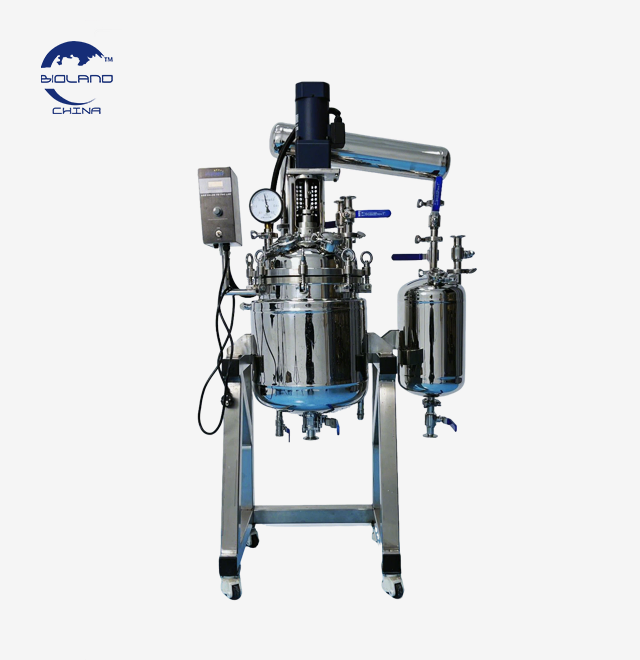
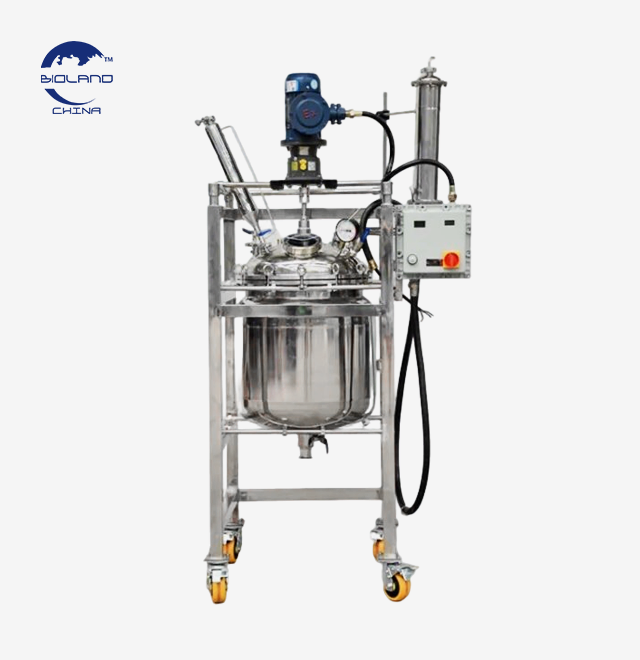
For buyers inspecting quotations or photographs, the tell is simple: look at the lower flange. A jacketed filter glass reactor carries two circulation nozzles—supply and return—feeding the annular space, usually with insulated hoses running to a stainless steel heating–cooling unit. A standard model shows a single wall and none of the plumbing. It takes thirty seconds, and it tells you whether the vessel can run a cooling curve or only a filtration.
Comparing Temperature Control, Filtration Efficiency, and Process Stability
The Thermal Envelope: −20 °C to 200 °C on Command
Here the comparison stops being fair. Paired with its integrated circulator, the jacketed filter glass reactor holds any setpoint from −20 °C to 200 °C and—far more importantly—moves between them along programmable ramps, the gentle 1–2 °C per hour descents that let crystals grow slowly and reject impurity. Standard models approximate this with ice baths and patience, and every operator runs the curve slightly differently. The result is the classic signature of unjacketed crystallization: batches that nominally match and analytically don't. Commanded temperature is the jacketed platform's first and largest advantage.
Filtration Itself Is Thermal: Viscosity, Solubility, and Cake Behavior
Filtration efficiency, supposedly the standard model's home turf, is also quietly thermal. Mother liquor viscosity falls as temperature rises, so a warm filter pass runs faster and blinds less; a slurry held just above saturation avoids premature crystallization in the cake; a chilled hold locks in a completed crystallization before the valve opens. Because a jacketed filter glass reactor controls all three situations from the same vessel, its large-diameter PTFE plate consistently delivers the throughput it was designed for. The standard model's plate is identical—it simply never enjoys controlled conditions around it.
Stability You Can Log: Recipes, PLC, and the Friday-Night Batch
Process stability, the third axis, is where the two philosophies diverge permanently. A jacketed filter glass reactor specified with PLC control and touchscreen operation runs stored recipes: temperature ramps, stirring profiles, and filtration sequences executed identically by every operator, on every shift, with every parameter logged for GMP/FDA-aligned batch records. The standard model's stability lives in the skill of whoever is holding the ice bucket. For pilot validation, regulatory filings, or simply defending data six months later, that difference is not cosmetic—it is the difference between an anecdote and a record.
Case in point—a chiral intermediate that needed a cooling curve: A European biopharmaceutical developer of a chiral API intermediate was losing on two fronts at once: reaction completeness could not be confirmed mid-batch, and crystallization delivered purity and yield that declined together. Corrosive acid/base systems and frequent vessel transfers compounded the damage.
Bioland engineered the answer as a custom 100 L jacketed filter glass reactor. Under nitrogen at 0–5 °C, the catalytic step proceeded while operators tracked the color change through the wall—completeness confirmed in real time, not inferred afterward.
Then the jacket did its defining work: −20 °C coolant drove a measured 1–2 °C per hour descent, growing uniform crystals while excluding impurity from the lattice. Filtration followed in the same vessel through the PTFE assembly, mother liquor recycled to the next batch.
The measured outcome—purity above 99.5%, yield lifted 15%, and material transfers eliminated along with their contamination risk—was, in the client's own words, the cooling curve made visible.
How Reactor Design Affects Chemical Processing Performance and Reliability
Where Chemistry Meets Glass: Material Decisions Both Models Get Right
Performance begins at the wetted surface, and here both variants start equal: GG17 high-borosilicate glass resists strong acids, strong alkalis, and organic solvents while contributing zero metal-ion contamination, which is precisely why pharmaceutical intermediates and biologically active compounds standardize on glass. What elevates the jacketed filter glass reactor is the engineered union of vessel and stainless steel heating–cooling unit—a modular combination specified as one system, so the glass that protects the chemistry and the thermal engine that drives it arrive matched, commissioned, and mutually accountable.
Thermal Uniformity and the Crystal Size Distribution It Produces
Deeper design consequences show up in the product. A jacket heats and cools the entire wetted wall uniformly, so supersaturation develops evenly throughout the batch and crystals grow on the same schedule everywhere; unjacketed vessels develop local hot and cold zones, and zones breed encrustation, secondary nucleation, and widened crystal-size distributions. Those defects then attack reliability itself, because encrusted walls and erratic cakes make every subsequent filtration slower and every cleaning longer. In a well-designed jacketed filter glass reactor, the thermal layer is not a comfort feature—it is what keeps the vessel young.
Reliability Engineering: Seals, Stirring, and a Frame That Protects the Glass
Mechanical reliability follows the same integrated logic. The spark-free variable-frequency stirrer sweeps gently and quietly across its full speed range; dual PTFE-plus-mechanical sealing holds vacuum and inert atmospheres through thousands of cycles; and the electric lifting-rotation frame removes the manual glass-handling episodes that shorten ordinary equipment's life. Because thejacketed filter glass reactor reaches temperature internally, operators stop hauling baths, clamps, and hoses around a fragile vessel—the quiet daily accidents simply leave the workflow, and service life extends accordingly.
Case in point—catalyst recovery above 90% in Poland: A Polish chemical company developing palladium and platinum catalysts faced a punishing ledger: low precious-metal recovery, corrosive media degrading equipment, high-temperature solid-phase reactions deactivating catalyst, sluggish separation, and cleaning costs climbing batch by batch.
Bioland delivered a custom 50 L jacketed filter glass reactor from the same platform. Solid-phase synthesis ran at 150 °C—borosilicate tolerating the excursion comfortably while transparency confirmed ligand reaction visually.
The quick-release PTFE assembly then split catalyst from mother liquor directly, with dissolved precious metal routed to recovery rather than drain. Reuse from the mother liquor exceeded 90%, and cleaning between batches fell to minutes. The client's corrosion line item—the original complaint—stopped appearing in the maintenance log entirely. One closed loop: react hot, filter clean, recover value.
Cost, Maintenance, and Application Considerations for Both Reactor Types
Purchase Price Versus Price per Acceptable Batch
On the invoice, the standard model wins; in the ledger, the question flips quickly. At Bioland's factory-direct pricing the jacket premium is modest, and one prevented re-run—crystals grown properly rather than quenched—typically repays it within a campaign. Ownership math then favors the jacketed unit further: a one-year quality warranty, lifetime maintenance, and lead times of roughly 30 business days for customized builds or 5–7 days for standard products, with sea, rail, and air freight to any destination. Buyers should compare cost per acceptable batch, the only unit that reaches the P&L.
Two Maintenance Calendars, Honestly Compared
Fairness requires admitting the jacket adds items: circulation fluid condition, hose integrity, and insulation checks join the weekly routine. But they replace a larger burden—the bath refills, spills, and repositioning that standard models impose—while the quick-release filter design keeps media inspection and exchange tool-light. A jacketed filter glass reactor therefore usually costs less to maintain than the clutter of equipment it replaces, a fact experienced plant managers verify within the first quarter.
When the Standard Model Is Still the Right Answer
Credible guidance includes the honest cases: ambient-temperature solid–liquid separations, teaching laboratories, simple workups where no step depends on a thermal program, and budgets that genuinely cannot stretch. If your process never asks the vessel for a cooling curve or a warm filter pass, the standard model filters just as well as its jacketed sibling through the identical PTFE plate. Our applications engineers say exactly this to inquirers—and that honesty is why those same inquirers return when their process matures and a jacketed filter glass reactor becomes the requirement.
Utilities, Footprint, and the Operator's Morning
The practical fit questions close the comparison. The jacketed configuration needs a circulator, cooling fluid, modest floor area, and operators comfortable with a touchscreen; in exchange it deletes the morning ritual of positioning baths and hoses that standard setups demand. For peptide programs running dozens of coupled cycles, or antibiotic crystallizations run to specification, that daily convenience is not luxury—it is throughput.
Selecting the Right Glass Filter Reactor for Different Industrial Requirements
A Four-Question Audit Before Any Purchase Order
Selection compresses into four questions our engineers ask every client. Does any step in your process depend on temperature—dissolution, crystallization, viscosity control? Do your specifications name polymorph or particle-size targets? Does the chemistry's hazard classification call for explosion-proof construction? And what will your documentation demand in six months? Three or four "yes" answers point squarely at ajacketed filter glass reactor; a clean sheet of "no" answers earns the standard model with our blessing.
Sizing Within the Family: 20 L to 100 L of Consistent Geometry
Volume selection rides on consistent geometry across the 20 L, 30 L, 50 L, and 100 L family, so protocols transfer upward without relearning. Peptide solid-phase synthesis—thymosin preparation, antibacterial peptide screening, peptide carrier material synthesis—typically finds its rhythm in the mid volumes where cycle count dominates; antibiotic intermediates and fine-chemical campaigns graduate to the 100 L jacketed filter glass reactor where documentation and throughput lead. The vessel should match the campaign, and the family lets it grow without starting over.
Customization as Strategy, Not Luxury
Because no two processes are identical, the platform customizes as a matter of course: certified explosion-proof systems, electric lifting, PLC-controlled full automation, integrated temperature management, ultrasonic crystallization, and rectification combination vessels, all engineered to order under our OEM/ODM program. During the build, a dedicated specialist sends weekly photos or videos of your jacketed filter glass reactor taking shape; finished goods are documented for approval before shipment, and a Factory Acceptance Test can be scheduled at our facility. GMP pilot validation is served, not merely tolerated.
The Supplier Question: Why the Manufacturer Behind the Glass Matters
The final selection factor is the signature on the quotation. A jacketed filter glass reactor couples two systems—vessel and thermal unit—so the manufacturer must engineer both, service both, and stand behind the integration. Fifteen-plus years of building reaction, filtration, crystallization, and thermal equipment, an in-house R&D team of senior engineers, exports across Europe and Southeast Asia, and CE/ISO certification are not decorations; they are the difference between a supplier and a partner when the cooling curve matters.
Conclusion
The jacket is one glass wall, and it separates two philosophies. Standard models separate solids competently and economically when temperature is a spectator; a jacketed filter glass reactor makes temperature a controlled reagent, commanding −20 °C to 200 °C, shaping crystal growth, accelerating filtration, and logging every parameter for GMP-grade records. The European chiral program—99.5% purity, 15% higher yield—and the Polish catalyst recovery above 90% show what commanded thermodynamics returns. Selection is a four-question audit, and the honest answers, backed by Bioland's engineering, certification, and lifetime support, make themselves plain.
FAQ
Q1: What temperature range does the jacketed filter glass reactor cover?
A: −20 °C to 200 °C via the jacket and integrated heating–cooling unit.
Q2: Can it be used as a plain filter, like a standard model?
A: Yes—simply idle the jacket; the PTFE filtration assembly works identically.
Q3: Which filter media are available?
A: Sintered PTFE standard; stainless steel or titanium plates, plus various cloths and membranes.
Q4: What volumes and safety options exist?
A: 20 L, 30 L, 50 L, and 100 L, with certified explosion-proof builds available.
Q5: Lead time and warranty?
A: ~30 business days customized, 5–7 days standard; one-year warranty with lifetime maintenance.
Let the Cooling Curve Decide — Ask Bioland Instrument
Your crystallization deserves better than an ice bucket and hope. Bioland Instrument builds everyjacketed filter glass reactor to industrial standards—transparent GG17 glass, programmable thermal control from −20 °C to 200 °C, high-flow PTFE filtration, explosion-proof and PLC-automated options—backed by 15+ years of engineering, CE and ISO certification, GMP/FDA compliance, and factory-direct pricing. Weekly build updates with photos and videos, Factory Acceptance Testing, a one-year warranty, and lifetime maintenance keep you informed and protected from order to operation. Tell us your process; we will answer with the right vessel, standard or jacketed. Write toinfo@biolandequip.com today—OEM and ODM inquiries warmly welcomed.
References
1. Mullin, J. W. Crystallization, 4th Edition. Butterworth-Heinemann, 2001.
2. Myerson, A. S., ed. Handbook of Industrial Crystallization, 2nd Edition. Butterworth-Heinemann, 2002.
3. Tung, H.-H., Paul, E. L., Midler, M., and McCauley, J. A. Crystallization of Organic Compounds: An Industrial Perspective. John Wiley & Sons, 2009.
4. Svarovsky, L. Solid-Liquid Separation, 4th Edition. Butterworth-Heinemann, 2000.
5. Kern, D. Q. Process Heat Transfer. McGraw-Hill, 1950.
6. Green, D. W., and Perry, R. H. Perry's Chemical Engineers' Handbook, 9th Edition. McGraw-Hill Education, 2018.
The reactor is beautifully mirror-polished and fully complies with GMP requirements for the pharmaceutical industry. The performance is excellent! Overall, we are very satisfied! We also provided with some feedback on our process improvements, which we hope will be helpful.
2024-04-09
Laboratory
Excellent and professional service. Always reply our questions very fast. All reactors and chiller we received are good too.
2024-02-15
Research Institute
Quality is beyond our expectation actually. After we got the extraction equipment and started using it, the performance was beyond our expectation. Very easy to use and very efficient to run. Service always respond us very quickly. Was also very helpful to help us. Thanks Bioland team. Very happy to work with you.
2023-11-20
Biotech Company
We are happy about the new purchase as always. Equipment and services are both good.
2023-08-05
Instrument Lab
This is the second order with Bioland instrument and everything is good as the first dateText.
2023-05-12
Global Trading Partner
Bioland instrument team is very helpful and professional. The sales helped us select the right equipment for our application, and their logistics people handled the transportation and customs declaration for our shipment. All that saved us a lot of work.