How to Choose a Crystallization Filter Reactor for High Purity
Aug 11, 2026
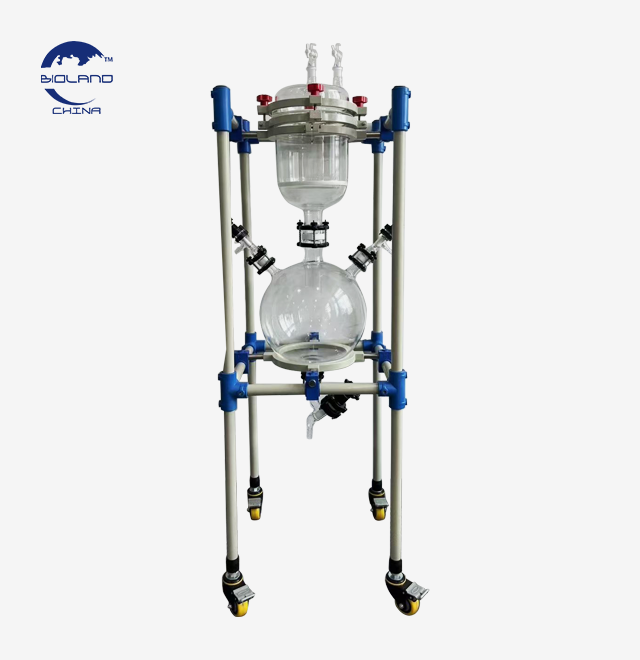
If your final product purity keeps landing at 97 % when the specification says 99.5 %, the problem is rarely your chemistry — it is usually what happens between crystallization and isolation. Every material transfer, every open filtration, every uncontrolled cooling ramp is a chance for impurity inclusion, mother-liquor entrainment and contamination. ACrystallization Filter Reactor from Xi'an Bioland Instrument Co., Ltd. removes those chances by performing reaction, crystallization, filtration and washing inside one sealed, fully transparent vessel. Built from high-borosilicate GG17 glass with a jacketed body covering -80 °C to 200 °C, a large-diameter PTFE sintered filter plate as standard (stainless steel, titanium, filter cloth and membrane options available), vacuum to -0.095 MPa, programmable stirring and optional explosion-proof PLC automation, each Crystallization Filter Reactor is a complete purification platform. With CE and ISO certification, GMP/FDA compliance, 15+ years of manufacturing, factory-direct pricing, OEM/ODM customization, a one-year warranty and lifetime maintenance, Bioland delivers the Crystallization Filter Reactor as a solution to your purity problem — not just a vessel on a frame.
Before comparing specifications, define what is actually costing you purity. Is it slow, uncontrolled cooling that traps impurities inside growing crystals? Is it a wet cake carrying mother liquor into the dryer? Is it contamination introduced when slurry is scooped from a reactor into a separate Nutsche filter? A Crystallization Filter Reactor attacks all three at once by integrating the steps. Bioland engineers begin every enquiry by asking for your solvent system, cooling profile, expected crystal size and target purity, then configure the Crystallization Filter Reactor around those numbers rather than around a fixed model list.
Volume, Working Capacity and Filter Area Balance
Standard Bioland units are offered at 10 L, 20 L, 30 L, 50 L and 100 L, with larger custom builds available. Two numbers matter together: usable batch volume, normally 60–75 % of nominal, and filter plate diameter. A large slurry volume sitting on an undersized plate produces a thick cake, slow filtration and poor washing. That is why every Bioland Crystallization Filter Reactor uses a large-diameter filtration design, delivering high throughput and thin, uniformly washable cakes. Matching capacity to filter area is the first real engineering decision in selection.
Material Compatibility and Contamination Control
For APIs, peptides, chiral intermediates and precious-metal compounds, the wetted path must contribute nothing to the product. Borosilicate glass and PTFE introduce no metal ions, resist strong acids, strong alkalis and aggressive organic solvents, and will not pit or corrode. This is why a glass Crystallization Filter Reactor outperforms stainless steel in high-purity work. Where mechanical duty demands it, Bioland can supply stainless steel or titanium filter elements, plus a full range of filter cloths and membranes matched to your particle size distribution.
Certification, Documentation and Pilot Validation Needs
Regulated customers need equipment that survives an audit. Every Crystallization Filter Reactor can be supplied with material certificates, calibration records and IQ/OQ support documentation aligned to GMP/FDA expectations, making it suitable for pilot validation batches feeding a registration file. CE and ISO certification cover safety and manufacturing quality. Because Bioland builds directly in its own factory, pricing stays competitive and lead time short — standard units in 5–7 days, customized systems typically 30 business days.
Evaluating Purity Control and Separation Performance
The physical principle is simple: solubility falls as the jacket cools or as antisolvent is added, crystals form, and a porous barrier retains solids while liquid passes through under vacuum or pressure. What makes a Crystallization Filter Reactor powerful is that all of this happens in one closed vessel. No slurry transfer, no exposure to air, no product left on transfer lines. Yield rises simply because nothing is lost in handling, and impurity levels fall because there is no opportunity for external contamination between steps.
Case Study: Chiral API Intermediate Purification, Europe
A European biopharma developing a chiral API intermediate could not confirm reaction completion, suffered low crystallization purity and yield, corroded equipment in strong acid/base systems, and faced cross-contamination from repeated transfers.
Bioland customized a 100 L Crystallization Filter Reactor for a single-vessel workflow. Reaction ran at 0–5 °C under nitrogen, with the transparent body allowing real-time observation of colour change to confirm completion.
Crystallization followed by circulating -20 °C coolant through the jacket at a controlled 1–2 °C per hour ramp, producing uniform crystals without impurity occlusion. Filtration switched to the integrated PTFE plate for direct solid–liquid separation. Mother liquor was recycled, product purity exceeded 99.5 %, and yield improved by 15 %.
Wash Efficiency, Cake Uniformity and Residual Solvent
Purity is frequently won or lost during washing rather than crystallization. A thin, level, crack-free cake allows displacement washing to work; a channelled cake lets wash solvent bypass the solids entirely. Inside a Crystallization Filter Reactor, the agitator can be lowered to re-slurry and smooth the cake between washes, and the transparent wall lets operators see whether the wash front is moving evenly. This visual feedback typically reduces the number of wash cycles required and cuts residual solvent to specification faster.
Measuring What Good Separation Looks Like
Judge a Crystallization Filter Reactor on measurable outcomes: filtration time per batch, cake moisture percentage, crystal size distribution span, residual solvent by GC, purity by HPLC, and overall isolated yield. Record these across several batches before and after installation. Bioland customers routinely report tighter particle size distribution, shorter filtration cycles and purity gains of one to two percentage points, simply because temperature ramping, agitation and filtration are now controlled parameters in one integrated recipe rather than three separate manual operations.
Important Design Features for High Purity Processing
The PTFE Filtration Assembly and Interchangeable Media
The filter is the heart of the system. Bioland's standard configuration is a PTFE sintered plate, chemically inert to virtually everything you will run, with a large diameter that maximizes flux. Optional stainless steel and titanium elements suit high-temperature or high-differential-pressure duty, and a full selection of filter cloths and membranes allows fine adjustment to particle size. Critically, the assembly on every Crystallization Filter Reactor uses a quick-release design so it can be removed, inspected, cleaned or changed between batches without residue carryover.
Jacketed Temperature Control From -80 °C to 200 °C
Crystal habit is dictated by cooling rate. Too fast, and you get fines, impurity inclusion and a cake that will not filter; too slow, and cycle time collapses your throughput. The jacketed body of a Crystallization Filter Reactor connects to a stainless-steel high-low temperature circulator, giving a stable window from -80 °C to 200 °C with programmable ramp profiles. Standard glass solid-phase versions operate comfortably from -20 °C to 200 °C. Immersed PT100 sensing holds the batch typically within ±0.5 °C throughout nucleation and growth.
Case Study: Precious Metal Catalyst Synthesis and Recovery, Poland
A Polish chemical producer developing palladium and platinum catalysts faced low metal recovery, corrosion from aggressive media, catalyst deactivation during high-temperature solid-phase reaction, slow solid–liquid separation and heavy cleaning costs.
Bioland supplied a customized 50 L Crystallization Filter Reactor creating a closed solid-phase reaction and filtration loop. The borosilicate body withstood short-duration 150 °C reaction between metal precursor and organic ligand without deactivating the catalyst.
After reaction, the integrated PTFE filter separated solid catalyst directly in-vessel. Residual precious metal in the mother liquor was recovered at over 90 %, cutting raw material cost significantly.
Double-layer glass gave precise -80 °C to 200 °C control, and the quick-release filter simplified cleaning, eliminating batch-to-batch residue.
Agitation, Electric Lifting and Programmable Control
Stirring in a crystallizer must suspend solids without shattering crystals. Bioland fits variable-frequency, spark-free, low-noise motors with smooth low-speed regulation and impellers selected for your slurry density. Electric lifting raises the agitator clear for filtration, discharge and cleaning, reducing operator effort and wear. A PLC and touchscreen package adds recipe storage, programmable cooling ramps, stirring profiles, vacuum sequencing, alarm logging and data export — turning a manual procedure into a validated, repeatable process on every Crystallization Filter Reactor.
Explosion-Proof and Modular Expansion Options
Flammable solvent service demands more than glass. A fully explosion-proof Crystallization Filter Reactor with Ex-rated motor, control cabinet, wiring and earthing is available across the range, engineered with high-strength pressure-bearing structure for safe batch synthesis at 20 L, 30 L, 50 L and 100 L. Standard multi-neck lids accept condensers, addition funnels, thermowells, vacuum lines, rectification columns and ultrasonic crystallization probes, so one platform covers reaction, distillation, extraction, crystallization, filtration and purification.
Optimizing Reactor Selection for Consistent Product Quality
Locking a Repeatable Crystallization Recipe
Consistency comes from turning judgement into parameters. Fix solvent ratio, saturation temperature, seeding point, cooling rate, agitation speed, hold time, vacuum level and wash volume, then store them in the controller. Because a Crystallization Filter Reactor performs every step in one vessel, the entire recipe executes without manual intervention, and the transparent body allows operators to verify nucleation onset visually against the programmed setpoint. Batch-to-batch variation in particle size and purity drops sharply once the recipe is locked.
Case Study: Peptide Solid-Phase Synthesis and Isolation
A peptide developer working on antimicrobial peptide screening struggled with slow resin washing, incomplete drainage and inconsistent cleavage recovery across parallel batches. Bioland configured a jacketed glass Crystallization Filter Reactor with a large-diameter PTFE plate sized for resin retention, gentle programmable agitation and nitrogen blanketing.
Wash and drain cycles accelerated markedly because filtration happened in-situ, and the visible bed let chemists confirm complete solvent displacement before each coupling step. Recovery became consistent across runs, and the same unit later handled thymosin preparation and peptide carrier material synthesis without reconfiguration.
Non-Standard Customization That Protects Your Investment
Few high-purity processes fit a catalogue exactly. Bioland's in-house R&D team routinely modifies vessel shape, volume, port arrangement, filter media, discharge valve size, sealing system and jacket geometry, and integrates temperature-control units, ultrasonic crystallization, rectification columns, tail-gas absorption and concentration modules. This means the Crystallization Filter Reactor you buy for one product can be adapted for the next. OEM and ODM orders are welcome, and complete production lines can be engineered around your workflow.
Operating Discipline and Long-Term Maintenance
A Crystallization Filter Reactor rewards good practice. Select the solvent that gives the widest solubility gap, avoid thermal shock by limiting wall-to-fluid ΔT, never exceed roughly 75 % fill, monitor filtration rate and differential pressure so you catch blinding early, and clean the filter element on a defined schedule. Bioland supports this with weekly production photos or video during manufacture, optional Factory Acceptance Testing, sea/rail/air shipping, a one-year warranty, lifetime maintenance and readily available spare glass parts, PTFE seals and filter media.
Conclusion
Choosing a Crystallization Filter Reactor for high purity means matching four things to your chemistry: usable volume against filter area, wetted materials that contribute no contamination, a jacket and controller capable of precise cooling ramps, and an integrated filtration assembly that eliminates slurry transfer. Bioland Instrument delivers all four in transparent GG17 glass with PTFE filtration, -80 °C to 200 °C control, vacuum to -0.095 MPa, explosion-proof and PLC options, CE/ISO certification and genuine non-standard customization. Proven at 99.5 % API purity, 15 % yield gain and 90 % precious-metal recovery, a Bioland Crystallization Filter Reactor converts purification uncertainty into consistent, auditable quality.
FAQ
1. What sizes are available?
Standard 10 L, 20 L, 30 L, 50 L and 100 L crystallization filter reactors, with larger custom volumes built to order.
2. What filter media can I choose?
PTFE sintered plate as standard; stainless steel, titanium, and various filter cloths or membranes available to match particle size.
3. What temperature range does it cover?
-80 °C to 200 °C using a paired high-low temperature circulator, with programmable ramps and ±0.5 °C batch stability.
4. Can reaction, crystallization and filtration run in one vessel?
Yes. That single-vessel workflow is the core benefit — no transfers, less contamination, higher yield.
5. Is an explosion-proof version offered?
Yes, with Ex-rated motor, cabinet and wiring, plus electric lifting and full PLC automation.
Solve Your Purity Problem With Bioland Instrument
Xi'an Bioland Instrument Co., Ltd. has built reaction, extraction, distillation, concentration, filtration, crystallization, purification, drying and mixing equipment for over 15 years, exporting to Europe, Southeast Asia and beyond. We are CE and ISO certified, GMP/FDA compliant, and our in-house R&D engineers welcome OEM and ODM projects — customizing every Crystallization Filter Reactor in size, material, filter media, automation and explosion-proof rating. Enjoy factory-direct pricing, 5–7 day dispatch on standard units, 30 business days on custom builds, weekly production photos or video, optional Factory Acceptance Testing, flexible sea/rail/air freight, a one-year warranty and lifetime maintenance. Send us your solvent system, target purity and batch size, and Bioland Instrument will return a complete purification solution. Contact us at info@biolandequip.com.
References
1. Mullin, J. W. Crystallization, 4th Edition. Butterworth-Heinemann.
2. Myerson, A. S., Erdemir, D., Lee, A. Y. Handbook of Industrial Crystallization, 3rd Edition. Cambridge University Press.
3. Wakeman, R. J., Tarleton, E. S. Solid/Liquid Separation: Principles of Industrial Filtration. Elsevier.
4. Beckmann, W. Crystallization: Basic Concepts and Industrial Applications. Wiley-VCH.
5. Am Ende, D. J. Chemical Engineering in the Pharmaceutical Industry: R&D to Manufacturing. Wiley.
6. Perry, R. H., Green, D. W. Perry's Chemical Engineers' Handbook, 8th Edition. McGraw-Hill.
The reactor is beautifully mirror-polished and fully complies with GMP requirements for the pharmaceutical industry. The performance is excellent! Overall, we are very satisfied! We also provided with some feedback on our process improvements, which we hope will be helpful.
2024-04-09
Laboratory
Excellent and professional service. Always reply our questions very fast. All reactors and chiller we received are good too.
2024-02-15
Research Institute
Quality is beyond our expectation actually. After we got the extraction equipment and started using it, the performance was beyond our expectation. Very easy to use and very efficient to run. Service always respond us very quickly. Was also very helpful to help us. Thanks Bioland team. Very happy to work with you.
2023-11-20
Biotech Company
We are happy about the new purchase as always. Equipment and services are both good.
2023-08-05
Instrument Lab
This is the second order with Bioland instrument and everything is good as the first dateText.
2023-05-12
Global Trading Partner
Bioland instrument team is very helpful and professional. The sales helped us select the right equipment for our application, and their logistics people handled the transportation and customs declaration for our shipment. All that saved us a lot of work.