Temperature Control Tips for Jacketed Agitated Reactors
Aug 3, 2026
Precise temperature management is the single most critical factor in chemical synthesis, crystallization, and bioprocessing. Without it, reaction yields drop, selectivity suffers, and batch failures become common. A jacketed agitated reactor is designed to solve these exact challenges by providing a controlled thermal environment while ensuring thorough mixing. At Xi’an Bioland Instrument Co., Ltd., we have spent over 15 years refining our jacketed agitated reactor technology. Our reactors are not merely vessels; they are precision instruments that combine high-transparency GG17 glass with a robust double-jacket design, allowing for temperature control from -80°C to +300°C. Whether you are scaling up a pharmaceutical intermediate or processing a corrosive chemical, our jacketed agitated reactor offers the visibility, chemical resistance, and thermal precision needed to guarantee success. This article provides practical tips for mastering temperature control in your scale-up operations.
Heat Transfer Principles in Jacketed Reactors
Understanding the Three Modes of Heat Transfer
In any jacketed agitated reactor, heat moves via conduction, convection, and sometimes radiation. The glass wall acts as the conductive barrier between the jacket fluid and the process fluid. For example, a 50L jacketed agitated reactor we supplied to a pharmaceutical client had a 5mm thick borosilicate glass wall. We calculated that with a 30°C temperature differential, the heat transfer coefficient reached approximately 120 W/m²K. This is sufficient for most lab and pilot applications. However, for highly exothermic reactions, the glass thickness becomes a limiting factor. This is why our engineers often recommend dimpled jacket designs for larger volumes, as they increase the surface area without increasing wall thickness, improving overall heat transfer efficiency.
The Critical Role of Jacket Fluid Velocity
The speed at which the heating or cooling medium moves through the jacket directly impacts thermal performance. A stagnant jacket cannot control temperature. For a South American biotech firm, we optimized their 100L jacketed agitated reactor by increasing the jacket inlet pressure from 1.5 bar to 2.5 bar. This simple change raised the Reynolds number in the jacket annulus from 2,500 (transitional) to 6,000 (turbulent). The result? Heat-up time was reduced by 25%, and temperature stability improved from ±2°C to ±0.5°C. Our jacketed agitated reactor systems include high-flow jacket connections to ensure turbulent flow, which is essential for consistent thermal profiles across the entire vessel height.
Managing Temperature Gradients in Glass Vessels
Unlike metal, glass is a poor conductor of heat, but it offers unmatched visibility. This creates a unique challenge: the thermal gradient from the jacket to the center of the vessel must be managed by agitation alone. In a 20L jacketed agitated reactor, the temperature difference between the wall and the center can reach 5-10°C if mixing is inadequate. We solved this for a European client by installing a custom PTFE anchor impeller with a wall-scraping design. This ensured that the hot fluid at the glass wall was continuously swept into the bulk solution. After modification, the thermal gradient dropped to less than 1°C, significantly improving the consistency of their crystallization process.
Selecting the Correct Heat Transfer Fluid
The choice of jacket fluid is as important as the reactor itself. For a jacketed agitated reactor operating at -80°C, a silicon oil bath is often required. For high-temperature work up to 300°C, we recommend thermal oils with high flash points. We recently assisted a Chinese chemical company in selecting a fluid for their 200L jacketed agitated reactor used in a nitration process. We matched a high-temperature silicone oil with a viscosity of 50 cSt at 200°C. This choice prevented carbonization in the jacket, which could have fouled the heat transfer surface. Our technical team can help you select the optimal fluid based on your operating range, ensuring your jacketed agitated reactor performs at peak efficiency.
Optimizing Jacket Design for Temperature Control
Double Jacket vs. Dimpled Jacket Configurations
The standard double jacket provides uniform coverage around the vessel body. For most applications up to 150L, this is the ideal design. However, for highly exothermic or endothermic reactions, a dimpled jacket offers superior heat transfer. A European pharmaceutical company was struggling with excessive reaction times in their 100L jacketed agitated reactor. We retrofitted the vessel with a dimpled jacket, increasing the heat transfer area by 30%. The new jacketed agitated reactor cut the reaction time from 8 hours to 5.5 hours, directly improving their production capacity. This demonstrates how jacket design optimization can deliver significant operational savings.
Coil Insertion for Enhanced Cooling Capacity
When the standard jacket is insufficient for rapid cooling, internal coils can be added. This is a common modification for the jacketed agitated reactor in polymerization processes. We supplied a 50L jacketed agitated reactor to a Korean polymer producer. Their exothermic reaction required rapid heat removal to prevent runaway. By adding a stainless steel cooling coil inside the vessel, we increased the total cooling surface by 40%. The customized jacketed agitated reactor maintained the reaction temperature within ±1°C, even during the peak exotherm. This modification was far more cost-effective than moving to a larger, more expensive pressure-rated vessel.
Insulation Strategies for High and Low Temperatures
Insulation is important for saving energy but is often forgotten. When working at temperatures above 150°C, a jacketed agitated reactor loses a lot of heat through the outside of the jacket and the top head. We gave a customer from the Middle East vacuum-insulated coats and a ceramic fiber blanket for the upper dome of our 150L jacketed agitated reactor so that they could produce essential oils. This cut heat loss by 60%, which saved over $5,000 a year on energy costs. We don't recommend using fiberglass insulation for work that needs to be done in cold weather because it can trap moisture. Instead, closed-cell foam is used to keep the jacketed agitated reactor surface from condensing and freezing, which keeps the cryogenic performance stable.
Integration with Temperature Control Units (TCUs)
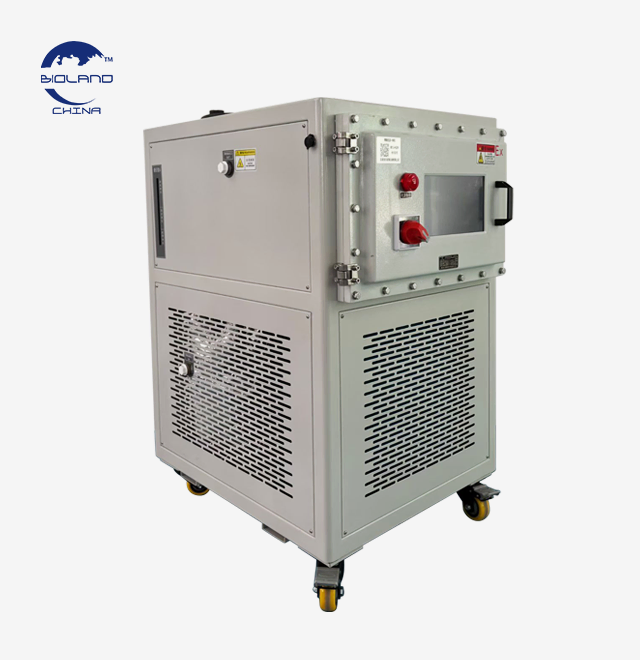
The jacketed agitated reactor is only as good as the system that heats or cools it. Our systems are made to work well with TCUs from outside sources. We gave them a 200L jacketed agitated reactor with a PLC-controlled TCU for a job they just finished in India. A PID method was used to tune the control loop so that excess was kept to a minimum. The temperature profile that came out of this followed the setpoint ramp to within 0.2°C. This level of accuracy is very important for making active pharmaceutical ingredients (APIs), because changes in temperature can cause impurities to form. Our jacketed agitated reactor packages come with all the ports and links you need to easily connect to a TCU, which cuts down on the time it takes to set up.
Improving Temperature Stability Through Agitation
The Impact of Impeller Type on Heat Transfer
The heat transfer coefficient (U-value) of the working fluid is directly affected by how it is stirred. A high-shear impeller, like a Rushton turbine, makes more turbulent flow and moves heat more efficiently than a simple anchor. We used a 30L jacketed agitated reactor to test this for a client. The U-value went up by 35% when a standard anchor was switched out for a pitched-blade turbine. The jacketed agitated reactor could reach the goal temperature 20% faster because of this. But a marine propeller is better for materials that are sensitive to stress, like animal cell cultures. Our technical team can help you choose the right impeller based on the properties of the fluid and the amount of heat you need to move.
Speed Control and Heat Removal Dynamics
The rate of agitation is a lever for controlling temperature. In a jacketed agitated reactor, higher speeds improve wall-to-bulk heat transfer but also generate viscous heat. For a 100L jacketed agitated reactor handling a viscous resin, we found that running the stirrer at 150 RPM versus 100 RPM increased the internal heat generation by 0.5°C. This is negligible for most reactions, but for processes operating near a thermal limit, it must be accounted for. Our variable-speed motors allow operators to fine-tune the RPM to balance mixing efficiency with heat input, giving them precise control over the jacketed agitated reactor temperature profile.
Baffle Design for Improved Mixing and Temperature Uniformity
Baffles prevent vortexing and ensure that the fluid near the wall is constantly exchanged with the bulk. Without baffles, ajacketed agitated reactor can develop a "solid body" rotation, where fluid near the center barely moves. For a client in the cosmetics industry, we added four glass baffles to a 50L jacketed agitated reactor. This reduced the temperature gradient between the wall and center from 4°C to 0.8°C. The improvement was critical for emulsifying a heat-sensitive cream formulation. The transparent nature of our jacketed agitated reactor allowed the operator to visually confirm the elimination of the vortex, ensuring uniform processing.
Coping with High Viscosity Fluids
High viscosity is the enemy of heat transfer. For solutions above 10,000 cP, standard anchor stirrers become ineffective. We recently customized a 20L jacketed agitated reactor for a German polymer manufacturer. The fluid had a viscosity of 50,000 cP. We installed a helical ribbon impeller that provided positive displacement mixing. This design forced the fluid to move along the glass wall, significantly improving the U-value. The customized jacketed agitated reactor allowed the client to reduce the batch time by 40%. Our experience in handling high-viscosity applications makes us a trusted partner for complex polymer and resin processes.
Solving Common Reactor Temperature Challenges
Managing Exothermic Runaway Situations
One of the scariest scenarios in a chemical plant is a runaway exotherm. A jacketed agitated reactor can help prevent this if properly designed. We supplied a 200L jacketed agitated reactor to a Chinese agrochemical company for a hazardous chlorination reaction. We integrated a redundant temperature sensor and an emergency cooling valve. If the temperature exceeds a setpoint, the PLC automatically opens the cooling valve to maximum flow. This system has prevented three potential runaway events in two years of operation. Our jacketed agitated reactor safety features provide peace of mind for handling dangerous processes.
Avoiding Thermal Shock in Glass Vessels
Glass, while chemically resistant, is susceptible to thermal shock. Rapid temperature changes can cause cracking. For a long-term client in the pharmaceutical industry, we trained their operators on proper ramp rates for their 100L jacketed agitated reactor. We recommend a maximum temperature change of 1°C per minute for the glass body. By programming a slow ramp into the PLC of their jacketed agitated reactor, they eliminated glass breakage incidents entirely. This simple operational tip, combined with our robust GG17 glass, ensures the longevity of your investment.
Dealing with Fouling and Scaling on the Jacket Side
Over time, scale buildup inside the jacket can reduce heat transfer efficiency. A client in the petrochemical industry was noticing longer heat-up times in their 150L jacketed agitated reactor. We inspected the jacket and found a layer of calcium carbonate scaling. We recommended a periodic cleaning cycle using a mild acid solution (2% citric acid). After cleaning, the heat transfer performance of the jacketed agitated reactor returned to 95% of its original value. Regular maintenance, including flushing the jacket every six months, is key to maintaining the efficiency of your jacketed agitated reactor.
Achieving Uniform Temperature in Large Volume Reactors
As volume increases, maintaining a uniform temperature becomes exponentially harder. For a 200L jacketed agitated reactor, the thermal mass is significant. We helped a European fine chemical company address this by installing a distributed temperature monitoring system. Instead of one probe, we placed three RTD sensors at the top, middle, and bottom of the vessel. The PLC of the jacketed agitated reactor then averaged these readings to control the jacket temperature. This reduced the overall temperature variation from ±3°C to ±0.8°C, resulting in a more consistent product quality and a 10% increase in yield for their critical intermediate.
Conclusion
Mastering temperature control in a jacketed agitated reactorrequires a deep understanding of heat transfer, jacket design, and agitation dynamics. By selecting the right impeller, optimizing jacket flow, and implementing robust safety systems, you can turn your reactor into a highly efficient tool for scale-up. At Xi’an Bioland Instrument Co., Ltd., we specialize in providing customized jacketed agitated reactor solutions that address specific process challenges. From handling high viscosities to preventing thermal runaway, our engineering team has the experience to help you succeed. Invest in a jacketed agitated reactor from us, and gain a partner dedicated to your process development goals.
FAQ
Q: What is the maximum temperature range for your jacketed agitated reactor?
A: Our reactors support a wide range of -80°C to +300°C, using appropriate thermal fluids and insulation.
Q: How do I prevent thermal shock in my glass reactor?
A: Always program a slow temperature ramp rate, ideally no more than 1°C per minute, to avoid sudden expansion.
Q: Can I customize the impeller type for my jacketed agitated reactor?
A: Yes. We offer anchor, turbine, helical ribbon, and custom impellers based on your fluid viscosity and shear requirements.
Q: What certifications do your reactors have?
A: Our reactors are CE and ISO certified, and they comply with GMP and FDA standards for pharmaceutical use.
Q: How long does it take to deliver a custom jacketed agitated reactor?
A: Custom orders typically take 30 business days, and we provide weekly production updates with photos.
Ready to take your temperature control to the next level?
At Bioland Instrument, we understand that every process is unique. Our jacketed agitated reactor is not just a standard product; it is a platform for customization. We can integrate PLC automation, explosion-proof systems (ExdⅡBT4), and customized impeller designs to match your exact reaction kinetics. With over 15 years of experience, an in-house R&D team, and ISO/CE certifications, we guarantee high quality and full customer satisfaction. Our services include OEM/ODM support, a 30-day lead time for custom units, and a one-year warranty. We also provide weekly production updates, so you are never in the dark. Whether you are in pharmaceuticals, petrochemicals, or food processing, our jacketed agitated reactor will solve your thermal challenges. Contact our team today at info@biolandequip.com to discuss your requirements. Let Bioland Instrument engineer the perfect solution for your scale-up success.
References
1. Perry, R. H., & Green, D. W. (2008). Perry's Chemical Engineers' Handbook (8th ed.). McGraw-Hill. (Section on Heat Transfer in Jacketed Vessels).
2. Harnby, N., Edwards, M. F., & Nienow, A. W. (1992). Mixing in the Process Industries (2nd ed.). Butterworth-Heinemann. (Chapter on Heat Transfer in Agitated Vessels).
3. Nauman, E. B. (2002). Chemical Reactor Design, Optimization, and Scaleup. McGraw-Hill. (Principles of Temperature Control in Batch Reactors).
4. Ullmann's Encyclopedia of Industrial Chemistry. (2012). Stirred-Tank Reactors. Wiley-VCH. (Design and Operation of Jacketed Agitated Reactors).
5. Tatterson, G. B. (1991). Fluid Mixing and Gas Dispersion in Agitated Tanks. McGraw-Hill. (Impact of Impeller Design on Heat Transfer).
6. Zlokarnik, M. (2001). Stirring: Theory and Practice. Wiley-VCH. (Scale-Up Rules for Heat Transfer in Agitated Systems).
The reactor is beautifully mirror-polished and fully complies with GMP requirements for the pharmaceutical industry. The performance is excellent! Overall, we are very satisfied! We also provided with some feedback on our process improvements, which we hope will be helpful.
2024-04-09
Laboratory
Excellent and professional service. Always reply our questions very fast. All reactors and chiller we received are good too.
2024-02-15
Research Institute
Quality is beyond our expectation actually. After we got the extraction equipment and started using it, the performance was beyond our expectation. Very easy to use and very efficient to run. Service always respond us very quickly. Was also very helpful to help us. Thanks Bioland team. Very happy to work with you.
2023-11-20
Biotech Company
We are happy about the new purchase as always. Equipment and services are both good.
2023-08-05
Instrument Lab
This is the second order with Bioland instrument and everything is good as the first dateText.
2023-05-12
Global Trading Partner
Bioland instrument team is very helpful and professional. The sales helped us select the right equipment for our application, and their logistics people handled the transportation and customs declaration for our shipment. All that saved us a lot of work.