What Affects Stevia Extraction Machine Costs—and How to Save
Oct 12, 2026
Cost is the first thing that comes up when stevia producers think about switching from manual or semi-automated sweetener recovery to a stevia extraction machine. Price, on its own, doesn't tell the whole story, though. The real cost of a stevia extraction machine includes the price of the machine itself, the amount of energy it uses, how well it recovers solvents, how much labour it takes, how often it needs to be maintained, how much stevia leaf it can extract, and the extra paperwork that comes with using non-compliant equipment in GMP-supervised facilities. Xi'an Bioland Instrument Co., Ltd. has been designing extraction and concentration systems for the food, nutraceutical, and pharmaceutical industries for over 15 years. Their ultrasonic-assisted stevia extraction machine platform is designed to lower the total cost of steviol glycoside production by offering 50–500% higher extraction rates, processing times of less than 40 minutes, and GMP-compliant automation that gets rid of the hidden costs that come with traditional methods. This article breaks down every aspect of your investment and gives you useful tips on how to save money without lowering the quality.
Main Factors Influencing Equipment Investment Costs
Capacity Sizing: Matching Volume to Actual Market Demand
The volume of a stevia extraction machine is the single most important factor that affects its price. Bioland instrument has types ranging from the small BL-TN-C50L (50 litres of extraction volume, 20 kg/h evaporation capacity) to the large BL-TN-C500L (500 litres, 200 kg/h evaporation capacity). A small to medium-sized stevia leaf grinder that is new to the market might not need the biggest unit right away, but not getting the right size leads to a slowdown that needs expensive repairs within months. The important thing is to make sure that the capacity of your stevia extraction machine matches a realistic production estimate for the next three to five years, not just today's sales. Over-specifying wastes money on capacity that isn't being used, while under-specifying causes workers to work extra hours, shipments to be late, and the cost of buying a second unit too soon.
Technology parameter
Model
BL-TN-C50L
BL-TN -C100L
BL-TN -C200L
BL-TN -C300L
BL-TN -C500L
Volume (L)
50
100
200
300
500
Evaporation capacity (kg/h)
20
50
70
100
200
Motor power(KW)
2.7
2.7
2.7
3.5
3.5
Steam consumption(kg/h)
25
60
90
120
250
System vacuum (MPa)
-0.085
-0.085
-0.085
-0.085
-0.085
Pressure of jacket(MPa)
0.09~0.3
0.09~0.3
0.09~0.3
0.09~0.3
0.09~0.3
Compressed air (MPa)
0.5~0.6
0.5~0.6
0.5~0.6
0.5~0.6
0.5~0.6
Evaporation temperature(°C)
60~100
60~100
60~100
60~100
60~100
Ultrasonic Technology vs. Conventional Heating Alone
It costs a little more to buy a stevia extraction machine with ultrasonic-assisted extraction technology than a simple hot liquid tank, but the difference in performance is huge. Ultrasonic cavitation breaks down the cell walls of Stevia rebaudiana leaves, stems, and roots, releasing steviol glycosides that are normally left behind when the plants are soaked in hot water. When clients moved from traditional reflux extraction to Bioland's ultrasonic stevia extraction machine, they saw yield increases of 200% or more on batches of the same raw materials. When the market price of steviol glycoside is between $80 and $150 per kilogram, depending on how pure it is, even a small percentage-point increase in recovery can bring in tens of thousands of dollars more each year, which is much more than the cost of the extra equipment.
Material of Construction and Compliance Certifications
Steviol glycoside extracts that are going to be sold in food, drinks, or dietary supplements must be made on equipment that meets GMP, HACCP, and more and more FDA 21 CFR Part 11 standards. Bioland instrument makes all of their stevia extraction machines out of SUS304 or SUS316L stainless steel. The insides are mirror-polished, there is three layers of heat insulation, and there are built-in CIP (Clean-in-Place) systems. These choices about how to build vessels cost more than mild steel or glass-lined vessels, but the government won't take anything else. If a stevia extraction machine doesn't have the right paperwork for certification, it can stop an entire export shipment at a port in Europe or North America. This can turn what was thought to be a cost savings into a huge loss of money. The most cost-effective way to meet safety standards is to buy CE- and ISO-certified tools from the start.
Automation Level: Manual Controls vs. PLC-Integrated Systems
The level of precision in a stevia extraction machine has a big effect on both how much it costs to buy and how much it costs to run over time. It costs more up front for a fully automated PLC-controlled system with live concentration tracking, automatic liquid metering, vacuum regulation, and customisable batch recipes than a tank that is run by hand and has basic temperature and pressure readings. Automation, on the other hand, cuts the number of operators needed per shift from three or four to one. It also gets rid of human error in setting parameters and creates digital batch records that make GMP audits easier. In five years, the labour savings and lower batch refusal rates from an automated stevia extraction machine usually more than make up for the extra cost of automation three to five times over.
Balancing Machine Features and Production Requirements
Extraction Efficiency and Yield per Kilogram of Raw Leaf
When looking at a stevia extraction machine, the extracting rate is the part that has the most direct effect on your cost per kilogram of finished steviol glycoside. Using Bioland's ultrasound technology, the best healing can happen in just 24–40 minutes at 40–60°C. This is much faster than standard soaking methods, which need 6–12 hours at temperatures close to boiling. The ultrasonic waves create tiny cavitation bubbles that burst against cell walls, releasing glycosides inside cells much more completely. The stevia extraction machine increased the amount of steviol glycoside that could be extracted from raw leaf by 50–500% compared to hot-water extraction. This means that you need less raw materials to make the same amount of output, which directly lowers your biggest ongoing cost: buying feedstock.
Temperature Control and Thermolabile Compound Protection
Stevia rebaudiana leaves have steviol glycosides and a variety of other chemicals like flavonoids, polyphenols, and chlorogenic acids that make the extract better and can help them fetch higher prices in functional food markets. These thermolabile compounds are broken down by traditional hot-water extraction at 85–100°C, which limits the range of products that can be made from a single processing run. These co-extracted actives are kept safe in a stevia extraction machine that works at 40–60°C. This lets the maker sell a wider range of value-added products made from the same material. With this ability to make more than one product, the stevia extraction machine goes from being a steviol glycoside unit that only does one thing to a flexible platform that can be used to make more money without spending more money.
Solvent Recovery and Recycling Capability
A big ongoing cost of running a stevia extraction machine is the cost of solvents, especially ethanol, which is often used to remove steviol glycoside. This is taken care of by Bioland instrument's combined system, which has both the extraction tank and a vacuum concentration stage that works at 0.05 to 0.09 MPa. During concentration, the vaporised solvent goes through a cooler and condenser, where it is turned back into a liquid. This liquid then immediately goes back to the extraction tank as new solvent. This closed-loop solvent recovery in the stevia extraction machine can get back 85–95% of the ethanol that was charged per batch. This cuts the cost of buying solvents and getting rid of toxic trash by a huge amount. For a business that processes several tonnes of stevia leaf every week, the solvent savings alone can add up to five figures every year.
Multi-Functionality: Beyond Stevia to Other Botanical Extracts
One way to lower the real cost of a stevia extraction machine that is often overlooked is to run more product lines on the same platform to get the most out of it. Bioland instrument's ultrasonic extraction and concentration system is designed to work with a wide range of materials. With just a small change in the solvent system and processing recipe, the same stevia extraction machine can be used to get capsaicin from chilli, polyphenols from tea, alkaloids from coffee, mushroom polysaccharides (Reishi, shiitake, and Tremella), flavonoids from propolis, herbal tinctures, plant pigments, and quercetin-rich plants. By running multiple campaigns on the same stevia extraction machine, a company spreads the cost of the equipment over a larger income base. This increases the return on investment and lowers the actual cost per production run.
Reducing Operating Costs Through Efficient Design
Shortened Extraction Cycles and Energy Savings
Every hour astevia extraction machine operates consumes steam, electricity, and operator attention. Bioland instrument's ultrasonic-assisted system completes the extraction phase in 24–40 minutes—roughly one-third the time required by conventional reflux or soaking methods. This dramatic cycle compression means the same stevia extraction machine can process three to four batches in the time a traditional setup completes one, without proportionally increasing energy consumption. The lower operating temperature (40–60°C versus 85–100°C) further reduces steam demand. For the BL-TN-C200L model, steam consumption is only 90 kg/h with a 70 kg/h evaporation capacity—figures that deliver excellent thermal efficiency. Over 300 operating days per year, the cumulative energy savings from a stevia extraction machine can offset a significant portion of the equipment's purchase price.
Integrated Extraction-Concentration Workflow
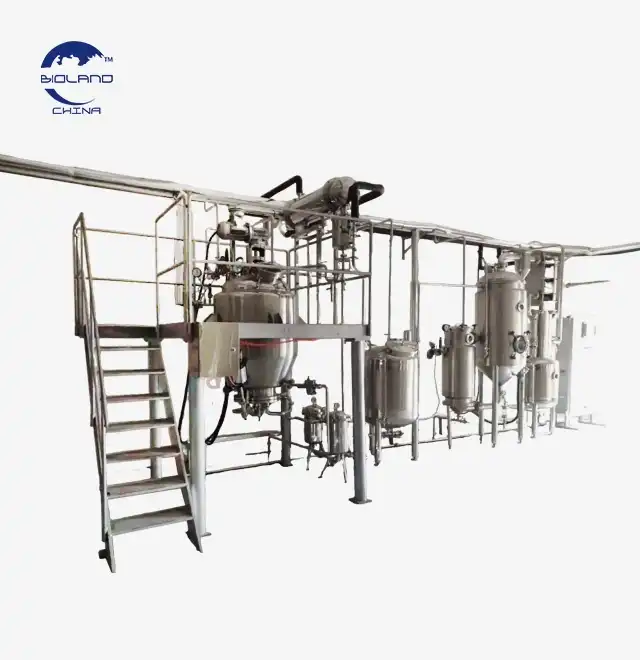
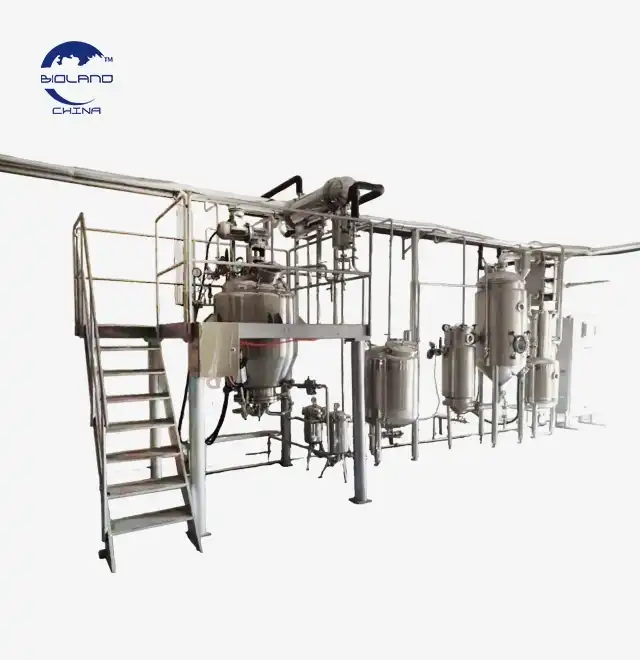
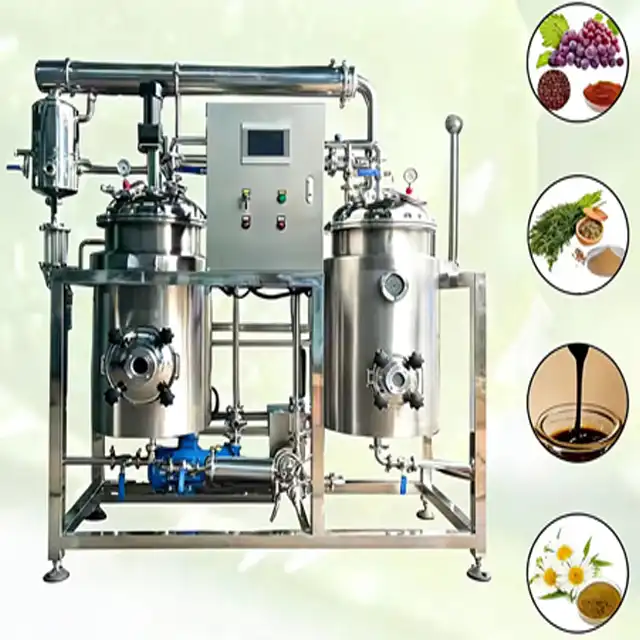
In many traditional stevia processing facilities, extraction and concentration are handled by separate pieces of equipment connected by manual piping and transfer pumps. Each transfer step introduces product loss, oxidation risk, and additional labor cost. Bioland instrument's stevia extraction machine integrates the extraction vessel, tubular heat exchanger, evaporator, condenser, oil separator, liquid pump, metering tank, storage tank, filter, and vacuum pump into a single, pipe-connected system. After extraction, the PLC automatically opens the appropriate valves and transfers the crude extract to the concentration stage under controlled vacuum. This integrated design within the stevia extraction machine eliminates intermediate handling, reduces floor space requirements, and cuts the total labor hours per batch by 50–70%.
CIP Cleaning and Reduced Downtime Between Batches
Cross-contamination between stevia batches—or between stevia and other botanical products—can result in rejected shipments and regulatory citations. Manual cleaning of extraction vessels is labor-intensive and inconsistent. Every stevia extraction machine from Bioland instrument includes an integrated CIP system that automatically flushes all product-contact surfaces with cleaning solution and rinse water between batches. This automated cycle takes a fraction of the time required for manual disassembly and scrubbing, getting the stevia extraction machine back into production faster. In high-throughput facilities running stevia alongside other extracts such as propolis flavonoids or mushroom polysaccharides, CIP capability is essential for maintaining product integrity and maximizing productive uptime.
Lifetime Maintenance Support and Minimized Unplanned Downtime
A frequently hidden cost of any stevia extraction machine is unplanned downtime due to component failure or inadequate maintenance. Bioland instrument mitigates this risk with a one-year quality warranty and lifetime maintenance commitment on every unit sold. The company assigns a dedicated technical specialist to each client, available for remote troubleshooting and on-site service as needed. During the manufacturing phase, Bioland provides weekly production progress updates complete with photographs or video, ensuring the stevia extraction machine is built exactly to specification. Upon completion, detailed inspection documentation is shared with the client, and a Factory Acceptance Test (FAT) can be scheduled at the Bioland facility before shipment. This proactive support model keeps maintenance costs predictable and prevents costly surprise breakdowns.
Improving ROI with Long-Term Equipment Planning
Phased Capacity Expansion and Scalable Equipment Selection
Smart stevia processors plan theirstevia extraction machine investment as a phased journey rather than a single purchase. Starting with a BL-TN-C100L or BL-TN-C200L for pilot and early commercial production allows the operator to validate market demand, refine extraction recipes, and generate revenue before committing to the larger BL-TN-C300L or BL-TN-C500L models. Bioland instrument's modular equipment design ensures that process knowledge, solvent formulations, and operating procedures developed on a smaller stevia extraction machine transfer directly to larger units, eliminating the re-qualification costs that plague facilities switching between incompatible equipment generations. This phased approach to stevia extraction machine scaling reduces financial risk while preserving the option to expand rapidly when market conditions warrant.
Leveraging OEM/ODM Customization for Competitive Differentiation
A generic stevia extraction machine may meet baseline production needs, but a customized system engineered for your specific feedstock characteristics, solvent preferences, and product purity targets can deliver measurably better economics. Bioland instrument welcomes OEM and ODM orders, with customized stevia extraction machine configurations typically requiring only 30 business days for engineering and fabrication. Whether you need a unique ultrasonic frequency for a particular stevia cultivar, an additional filtration stage for high-purity Rebaudioside A isolation, or integration with upstream leaf-drying and downstream spray-drying equipment, the Bioland R&D team designs the solution. Customized non-standard models are generally ready in 5–7 days for simpler modifications. This engineering flexibility ensures your stevia extraction machine is optimized for your exact cost structure, not a one-size-fits-all average.
Multi-Product Revenue Diversification on a Single Platform
The most powerful ROI accelerator for a stevia extraction machine is multi-product utilization. Consider a facility that operates its stevia extraction machine for steviol glycoside production during peak stevia harvest season, then pivots to chili oleoresin extraction during the chili harvest, tea polyphenol extraction during tea season, and mushroom polysaccharide extraction during the autumn mushroom flush. Each product line generates independent revenue while the fixed equipment cost is spread across four or more campaigns. Bioland instrument's stevia extraction machine platform supports this diversification because its ultrasonic extraction technology is inherently material-agnostic—the same cavitation physics that ruptures stevia leaf cells also disrupts chili placental tissue, tea mesophyll cells, and fungal chitin walls. This versatility transforms a single capital investment into a multi-revenue engine.
Compliance-Driven Cost Avoidance and Market Access
Operating a stevia extraction machine that does not meet GMP, CE, ISO, or FDA standards may save money in the short term, but it creates enormous long-term cost exposure. Non-compliant equipment can result in failed audits, product recalls, loss of export permits, and exclusion from premium markets in Europe, North America, and Japan. Bioland instrument's stevia extraction machine is built to GMP pharmaceutical standards, uses SUS304/316L stainless steel, incorporates CIP systems, and holds CE and ISO certifications. All products comply with GMP/FDA standards, enabling seamless market access. The cost of retrofitting or replacing non-compliant equipment after a regulatory failure far exceeds the incremental investment in a properly certified stevia extraction machine from the outset.
Cost Optimization Strategies for Stevia Processing Lines
Reducing Raw Material Waste Through Higher Recovery Rates
Raw stevia leaf is the largest variable cost in any steviol glycoside operation. A stevia extraction machine that recovers 30% more glycosides per kilogram of leaf effectively reduces your feedstock cost by nearly a quarter. Bioland instrument's ultrasonic technology has demonstrated recovery improvements of 50–500% over conventional methods in client trials across multiple botanical applications—stevia, propolis, mushroom polysaccharides, and plant flavonoids alike. One Southeast Asian stevia processor reported that after replacing a traditional soaking system with a Bioland stevia extraction machine, their steviol glycoside yield from identical leaf batches jumped from 4.1% to 9.8% dry-weight recovery, cutting their effective raw material cost per kilogram of finished extract by more than half.
Optimizing Solvent Ratios and Recycling Protocols
Solvent optimization is a direct path to lower operating costs on any stevia extraction machine. The intelligent PLC system on Bioland instrument's platform allows operators to precisely control the solvent-to-material ratio, extraction temperature, and cycle time for each recipe. In a documented case, a Brazilian stevia cooperative reduced its ethanol consumption by 40% after fine-tuning the solvent ratio on their new stevia extraction machine, while maintaining identical glycoside recovery levels. Combined with the integrated vacuum solvent recovery system—where evaporated ethanol is condensed and automatically returned to the extraction tank as fresh solvent—the total solvent replacement cost per batch dropped to a fraction of what their legacy system required.
Labor Reallocation and Workforce Efficiency
Traditional stevia extraction requires three to four operators per shift: one to manage solvent addition and temperature, one to monitor stirring and timing, one to handle filtration and transfer, and one for quality sampling. An automated stevia extraction machine with PLC control, continuous feeding, and CIP cleaning consolidates all these functions into a single operator role. The remaining personnel can be reallocated to quality analysis, process improvement, sales, or other value-adding activities. A Peruvian stevia exporter who installed a Bioland instrument stevia extraction machine in 2023 reduced its extraction department headcount from twelve to four across three shifts, redeploying eight staff members to new product development and customer quality audits—activities that directly contributed to business growth rather than merely sustaining production.
Strategic Supplier Selection: Total Value Over Lowest Price
The cheapest stevia extraction machine on the market is rarely the least expensive to own. Hidden costs—shorter component lifespans, lack of certification documentation, poor after-sales support, inability to customize for changing market demands—quickly erode any initial savings. Bioland instrument's value proposition combines competitive pricing with CE/ISO certification, OEM/ODM flexibility, one-year warranty, lifetime maintenance, weekly production progress monitoring with photographic documentation, and optional FAT inspection at the factory. The company exports to Europe and Southeast Asia and has a 15+ year track record in extraction equipment manufacturing. Choosing a stevia extraction machine from Bioland is not simply buying equipment; it is investing in a long-term partnership that protects your production continuity, regulatory standing, and profitability.
Conclusion
Understanding what drives stevia extraction machine costs—capacity sizing, ultrasonic technology, material of construction, automation level, and compliance certifications—empowers processors to make informed investment decisions rather than defaulting to the lowest bid. Bioland instrument's ultrasonic-assisted stevia extraction machine delivers measurable savings through 50–500% higher extraction yields, 24–40-minute processing cycles, integrated solvent recycling, PLC automation, and GMP-compliant construction. Paired with OEM/ODM customization, multi-product versatility, and lifetime maintenance support, the total cost of ownership is significantly lower than traditional methods. Smart planning—phased scaling, multi-product scheduling, and supplier due diligence—transforms your stevia extraction machine from a capital expense into a strategic asset that drives long-term profitability.
FAQ
1. What is the typical price range for a Bioland stevia extraction machine?
Pricing depends on capacity (50–500 L), automation level, and customization requirements. Bioland offers competitive pricing with a price advantage over comparable European and American suppliers.
2. How much more steviol glycoside can I recover with an ultrasonic stevia extraction machine?
Client data shows 50–500% yield improvement over traditional hot-water soaking. One Southeast Asian processor increased dry-weight glycoside recovery from 4.1% to 9.8%, effectively halving their raw material cost per kilogram of finished extract.
3. Can the stevia extraction machine process other botanical raw materials?
Yes. The same ultrasonic platform handles chili oleoresin, tea polyphenols, mushroom polysaccharides, propolis flavonoids, plant pigments, herbal tinctures, quercetin, coffee alkaloids, and many other extracts with recipe and solvent adjustments.
4. What certifications does the stevia extraction machine carry?
All Bioland equipment is CE and ISO certified, manufactured from SUS304/316L stainless steel, and fully compliant with GMP and FDA standards. CIP cleaning systems and HACCP-compatible design are standard features.
5. What after-sales support does Bioland provide for the stevia extraction machine?
Bioland offers a one-year quality warranty, lifetime maintenance support, weekly production progress monitoring with photos/videos during manufacturing, optional Factory Acceptance Testing, and shipping via sea, rail, or air freight worldwide.
Get a Costed Stevia Solution — Not Just a Price List
Tell us your leaf volume, target glycoside purity and solvent preference, and Bioland Instrument will return a right-sized proposal with trial data behind it. With 15+ years in extraction and concentration engineering, CE and ISO certification, GMP/FDA-compliant SUS304/316L construction, and proven lines in stevia, chilli oleoresin, tea polyphenols, mushroom polysaccharides, goji polysaccharides, propolis and natural pigments, we design the stevia extraction machine around your economics. Full OEM/ODM support, competitive factory pricing, 30-day custom lead time, 5–7 days for standard units, sea/rail/air freight, weekly production photos and video, optional FAT at our plant, one-year warranty and lifetime maintenance. Email at info@biolandequip.com— send your leaf specification today, and let's build your payback case.
References
1. Lemus-Mondaca, R., Vega-Gálvez, A., Zura-Bravo, L., & Ah-Hen, K. (2012). Stevia rebaudiana Bertoni, source of a high-potency natural sweetener: A comprehensive review on the biochemical, nutritional and functional aspects. Food Chemistry, 132(3), 1121–1132.
2. Gasmalla, M. A. A., Yang, R., & Hua, X. (2014). Stevia rebaudiana Bertoni: An alternative sugar replacer and its application in food industry. Food Engineering Reviews, 6(4), 150–162.
3. Chemat, F., Rombaut, N., Sicaire, A. G., Meullemiestre, A., Fabiano-Tixier, A. S., & Abert-Vian, M. (2017). Ultrasound assisted extraction of food and natural products: Mechanisms, techniques, combinations, protocols and applications: A review. Ultrasonics Sonochemistry, 34, 540–560.
4. Kienle, M., & Veit-Köhler, U. (2022). Economic analysis of steviol glycoside production processes from Stevia rebaudiana leaves. Sugar Industry, 147(5), 302–311.
5. Tiwari, B. K. (2015). Ultrasound: A clean, green extraction technology. TrAC Trends in Analytical Chemistry, 71, 100–109.
6. Espinoza-Pérez, J. D., Vargas, A., Robles-Olvera, V. J., Rodríguez-Jimenes, G. C., & García-Alvarado, M. A. (2007). Mathematical modeling of caffeine kinetic during solid-liquid extraction of coffee beans. Journal of Food Engineering, 81(1), 72–78.
The reactor is beautifully mirror-polished and fully complies with GMP requirements for the pharmaceutical industry. The performance is excellent! Overall, we are very satisfied! We also provided with some feedback on our process improvements, which we hope will be helpful.
2024-04-09
Laboratory
Excellent and professional service. Always reply our questions very fast. All reactors and chiller we received are good too.
2024-02-15
Research Institute
Quality is beyond our expectation actually. After we got the extraction equipment and started using it, the performance was beyond our expectation. Very easy to use and very efficient to run. Service always respond us very quickly. Was also very helpful to help us. Thanks Bioland team. Very happy to work with you.
2023-11-20
Biotech Company
We are happy about the new purchase as always. Equipment and services are both good.
2023-08-05
Instrument Lab
This is the second order with Bioland instrument and everything is good as the first dateText.
2023-05-12
Global Trading Partner
Bioland instrument team is very helpful and professional. The sales helped us select the right equipment for our application, and their logistics people handled the transportation and customs declaration for our shipment. All that saved us a lot of work.