How to Improve Propolis Yield With an Extraction Machine
Oct 12, 2026
The economic worth of propolis comes from its high concentration of flavonoids, phenolic acids, and fragrant esters. However, raw propolis usually has more than 50% beeswax and an insoluble core material that keeps the actives inside. If you use regular ethanol maceration, you can soak for one to two weeks and still get a lot of soluble chemicals out of the waste. Ultrasonic cavitation and ethanol extraction work together in a modern propolis extraction machine to get rid of this bottleneck. This breaks up the resin and wax structures so that the active ingredients can dissolve in the liquid in minutes instead of days.
Bioland Instrument Co., Ltd. has been making extraction, concentration, and separation equipment for the pharmaceutical, food, and cosmetic industries for more than 15 years. Its ultrasonic propolis extraction machine line usually achieves 50–500% higher extraction rates than traditional soaking while reducing cycle time by at least two-thirds. This article explains how a propolis extraction machine turns trapped resin value into extract that can be sold, and it also talks about why processors all over Europe and Southeast Asia are adopting the same platform.
What Factors Affect Propolis Extraction Yield and Recovery?
Raw Material Variables: Resin Type, Wax Content, and Origin
What's in propolis changes a lot depending on where it comes from and what plants it comes from. Temperate poplar propolis has a lot of flavonoids like pinocembrin, galangin, and chrysin. On the other hand, artepillin C and other prenylated phenolic acids give Brazilian green propolis its value. There can be anywhere from 8% to 18% flavonoids in crude resin, and anywhere from 10% to 35% wax. As each batch reacts differently, a propolis extraction machine needs to have ultrasonic power that can be changed, jacket temperature that can be changed, and solvent dosing that can be changed so that the process parameters can be matched to the material being used. If producers don't have this option, they either extract too many waxes, which makes the liquor cloudy and makes downstream filtering harder, or they remove too few flavonoids, which leaves money in the residue.
The Hidden Losses of Traditional Maceration and Percolation
In traditional cold maceration, propolis is soaked in 70–80% ethanol for seven to fourteen days, and it is stirred every so often. This passive diffusion is slow, incomplete, and hard to repeat because solvent channels form through the resin bed, the temperature changes with the seasons, and batch-to-batch variation is caused by handling that takes a lot of work. Producers often say that after only one pass through the maceration process, the dried residue still smells strongly of propolis, which is a clear sign that the actives have not been recovered. Each of these areas of loss is taken care of by a propolis extraction machine that uses cavitation micro-streaming for forced convection, exact jacket temperature control, and repeated PLC-programmed cycles. This turns what used to be a guess from an expert into a data-driven unit operation.
Process Intensification as a Yield Strategy
The most reliable way to raise recovery is to intensify mass transfer rather than simply extend soak time. Ultrasonic-assisted extraction increases the effective diffusion coefficient by orders of magnitude, allowing a compact propolis extraction machine to achieve in 24–40 minutes what a maceration vessel needs two weeks to approach. For a processor shipping standardized tincture or dry extract, that means more batches per week, less tied-up solvent inventory, and a wax-poor extract that filters and concentrates cleanly. When evaluating an upgrade, buyers should ask vendors for comparative recovery data on their own raw material—a reputable supplier will run laboratory trials and share documentation before contract signing, exactly as Bioland's technical team does for every propolis extraction machine quotation.
How Does Ultrasonic Cavitation Improve Compound Release?
The Mechanics of Cavitation Bubble Collapse
Ultrasonic transducers bonded to the extraction vessel emit high-frequency waves—typically 20–40 kHz—through the solvent. These waves alternately stretch and compress the liquid, creating microscopic vacuum bubbles that grow and then violently collapse. Each implosion generates localized hot spots, micro-jets, and intense shear that puncture cell walls and fracture the brittle propolis resin matrix, dramatically increasing contact area between solvent and solute. Inside a well-designed propolis extraction machine, transducer placement and tank geometry are engineered so cavitation energy distributes evenly across the entire batch, avoiding the dead zones that plague simple probe-type laboratory setups and ensuring the last kilogram of resin receives the same treatment as the first.
Faster Mass Transfer Without Aggressive Chemistry
Cavitation accelerates the three steps that govern any extraction: solvent penetration into the matrix, dissolution of active compounds, and diffusion back into the bulk liquid. Documented results from ultrasonic propolis extraction machine installations show extraction rates 50–500% higher than conventional soaking, with total cycle time reduced by more than two-thirds. Because the mechanism is physical rather than chemical, no corrosive reagents are required—food-grade ethanol and water remain the workhorse solvents. This keeps the extract label-friendly, simplifies regulatory documentation, and makes the same propolis extraction machine compatible with other botanical feedstocks, from stevia leaves to ginkgo biloba, giving processors valuable production flexibility.
Protecting Heat-Sensitive Flavonoids and Phenolic Acids
Many propolis actives, including caffeic acid phenethyl ester and several flavonoid aglycones, degrade at elevated temperature. Ultrasonic extraction achieves high recovery at 40–60°C, a window gentle enough to protect thermolabile compounds while still fluidizing the wax fraction for clean phase separation. Low-temperature operation also translates directly into energy savings: heating demand drops, condenser load shrinks, and the vacuum concentration stage that follows can hold evaporation between 60–100°C under −0.085 MPa system vacuum. A propolis extraction machine designed around this thermal window consistently delivers extracts with higher flavonoid titers, better color, and stronger antioxidant activity numbers on the certificate of analysis.
Field Result: A European Tincture Producer Doubles Output
A mid-sized European herbal tincture producer approached Bioland instrument with a familiar complaint: ten-day maceration cycles, and flavonoid results that swung between drums of poplar-type propolis. After laboratory trials confirmed recovery on their own raw material, they installed a BL-TN-C100L ultrasonic propolis extraction machine with 50 kg/h evaporation capacity.
Results after three months were decisive. Extraction cycles compressed to 35 minutes, single-pass flavonoid recovery rose 62%, and monthly throughput doubled without adding shifts. Solvent consumption fell roughly 30% thanks to closed-loop condensate reflux, and the standardized tincture passed EU food-supplement documentation on the first audit. The producer has since ordered a second tincture extraction machine line for echinacea and valerian on the same platform.
How Can Solvent Ratio and Particle Size Be Optimized?
Ethanol Concentration and Solvent-to-Material Ratios
For poplar-type propolis, 70–80% (v/v) aqueous ethanol is the standard solvent: concentrated enough to dissolve flavonoids and phenolic acids, yet diluted enough to limit wax extraction. Solvent-to-material ratios between 8:1 and 12:1 typically maximize recovery before returns diminish. The propolis extraction machine from Bioland instrument integrates a metering tank and calibrated dosing pumps, so operators program the ratio once and every batch repeats it exactly. Online concentration monitoring takes the guesswork further, signaling when soluble solids plateau so the cycle ends at peak yield rather than at an arbitrary timer setting—protecting both quality and throughput.
Particle Size Engineering for Maximum Surface Area
Propolis is a brittle resin at room temperature, which makes size reduction straightforward: chill crude blocks, then mill to a 10–40 mesh particle range. Finer particles expose more surface area and shorten diffusion paths, raising the recovery ceiling of any propolis extraction machine. The trade-off is filtration: particles below roughly 100 mesh can blind filter media and carry wax fines into the extract. Bioland instrument's process engineers help clients pin down this balance during trial runs, often drawing on grinding and sieving protocols already proven on their chilli oleoresin extraction plant projects and mushroom polysaccharide lines, where particle strategy is equally decisive.
Multi-Purpose Flexibility Across Botanical Feedstocks
One of the strongest economic arguments for an ultrasonic propolis extraction machine is utilization. The same vessel runs other high-value extraction campaigns between propolis seasons: stevia glycosides from leaves and stems, capsaicin and chilli oleoresin, tea polyphenols and coffee caffeine, quercetin from sophora buds, flavonoids from ginkgo and bamboo leaf, and polysaccharides from ganoderma, shiitake, and goji berry. Producers diversifying their catalogs amortize equipment cost across multiple SKUs instead of one seasonal feedstock, and Bioland's growing application library—built on real stevia, tea extraction machine, and natural pigment production lines—shortens the learning curve for each new material.
Case: A Southeast Asian Producer Runs Three Products on One Line
A Southeast Asian functional-food manufacturer originally purchased a 200 L system as a stevia extraction machine for stevioside and rebaudioside recovery from leaves. When propolis tincture demand rose, the same propolis extraction machine configuration—new solvent recipe, adjusted ultrasonic power—ran poplar propolis at 92% single-pass recovery of target flavonoids.
Six months later the client added a lion's mane polysaccharide campaign. Three product families, one certified line, and an eleven-month payback period turned the CFO into a vocal reference customer, and Bioland now cites their throughput data in proposals across the region.
How Do Temperature and Extraction Time Influence Final Yield?
The 40–60°C Window for Maximum Recovery
Temperature acts on yield in two opposing directions: higher temperature lowers solvent viscosity and softens wax, accelerating diffusion, but beyond roughly 65°C volatile aromatics evaporate and thermolabile flavonoids begin to break down. Field data from propolis extraction machine installations converge on 40–60°C as the optimum window—fast enough for complete release, cool enough for protection. Jacket heating regulated at 0.09–0.3 MPa jacket pressure holds this band within ±2°C for the entire cycle, which is precisely the stability that manual gas burners and steam sparging can never provide, and it is one reason a propolis extraction machine outperforms open-vessel methods season after season.
From Hours to 24–40 Minutes
Time is capacity: every hour a batch occupies a vessel is an hour of tied-up tank space, solvent, and labor. Ultrasonic cycles typically reach maximum recovery in 24–40 minutes, a reduction of more than two-thirds versus Soxhlet or maceration approaches. Because the propolis extraction machine logs each cycle's temperature, power, and concentration curve, engineers can verify that short cycles sacrifice nothing in yield. One nutraceutical client confirmed identical flavonoid titers between a 30-minute ultrasonic run and their legacy five-day maceration reference, then retired the maceration vessels entirely and redeployed the floor space for packaging.
Vacuum Concentration and Closed-Loop Solvent Recovery
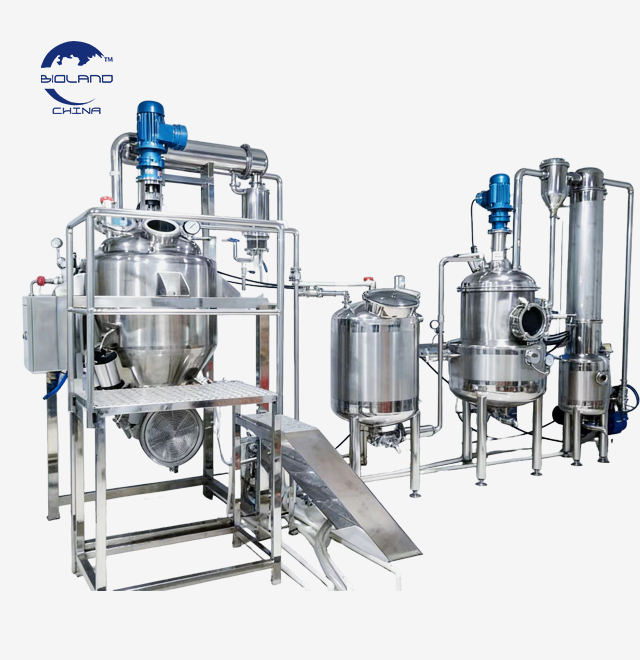
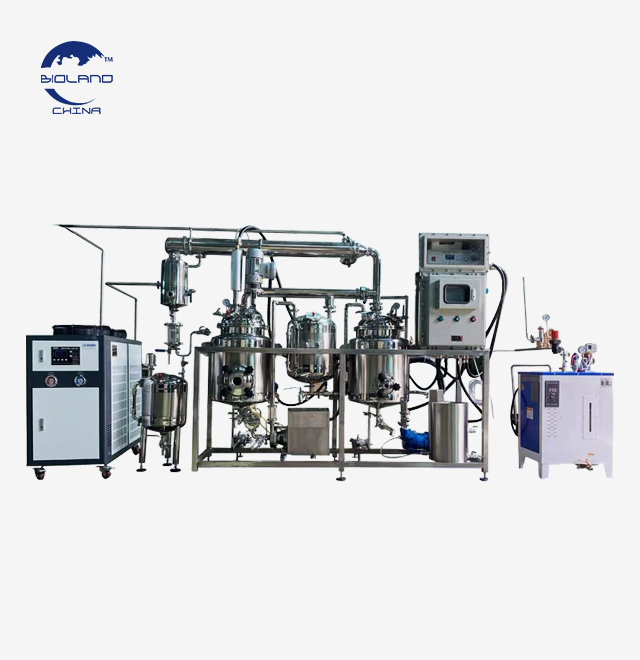
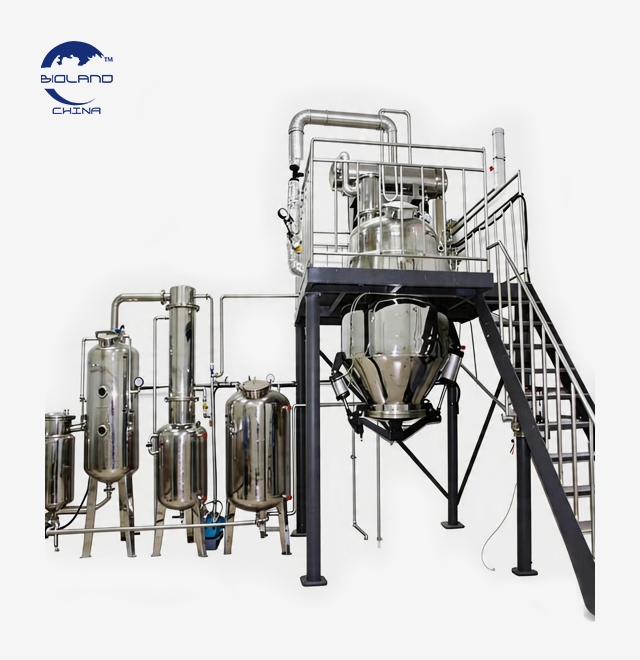
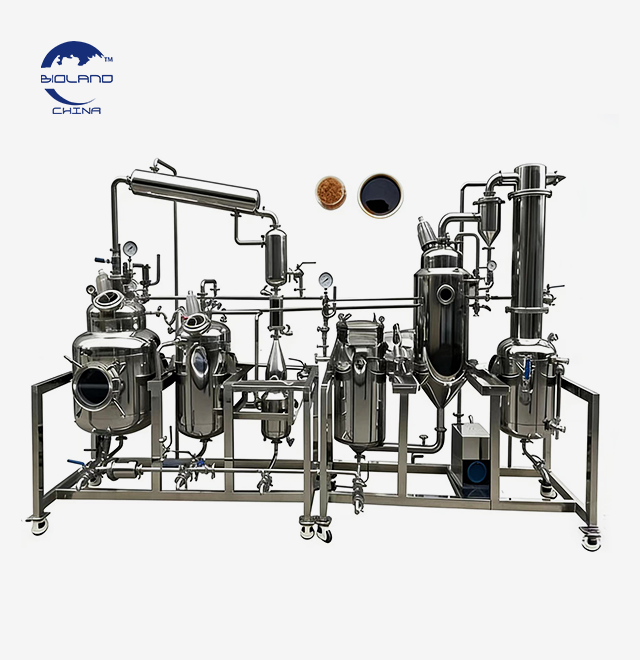
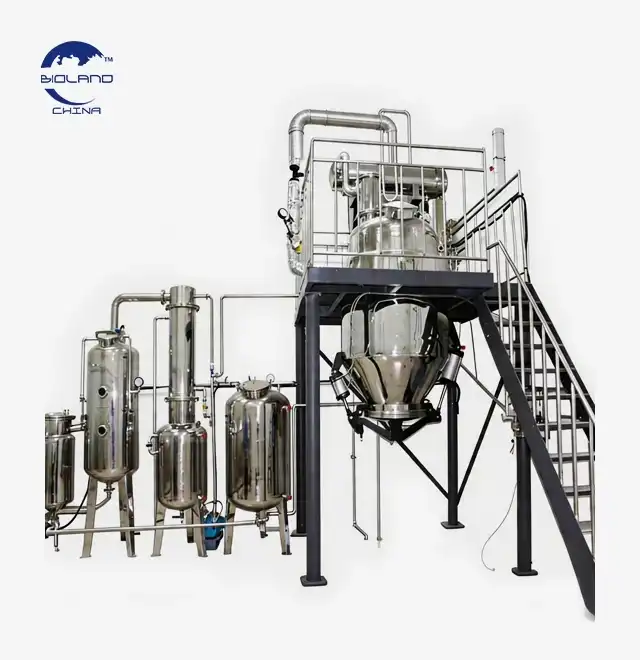
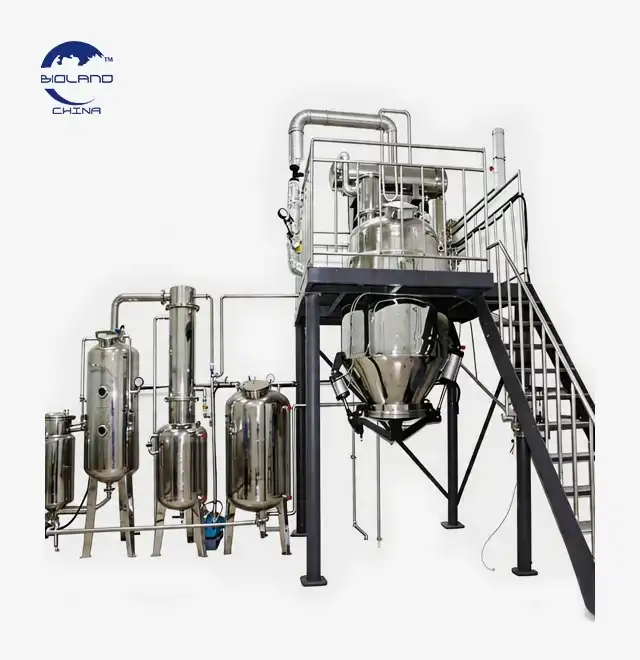
Extraction is only half the process; the extract must then be concentrated and the solvent reclaimed. The complete propolis extraction machineskid from Bioland instrument pairs the ultrasonic extraction tank with a tube-type heater, evaporator, condenser, oil separator, collection vessels, filter, and vacuum pump operating at −0.05 to −0.09 MPa. Secondary steam condenses and flows back into the extraction tank as fresh solvent, creating a hot-reflux loop that continuously recovers ethanol until the extract reaches target density. The system runs safely under negative, atmospheric, or positive pressure, handles water, ethanol, or solvent extraction, and facilities without steam boilers can specify a thermal-oil heating system—an option chosen by several 50 L and 100 L laboratory and pilot customers.
How Can Automated Extraction Improve Batch-to-Batch Consistency?
PLC Control, Online Monitoring, and Automatic Discharge
Consistency is where manual processes fail and automation earns its keep. The propolis extraction machine runs on an intelligent PLC electrical system with online concentration monitoring, automatic discharge, and an in-place automatic cleaning sequence. Operators load material, select a validated recipe, and the machine sequences solvent dosing, ultrasonic activation, temperature hold, and transfer to the concentrator without intervention. Continuous feeding and continuous discharge modes turn extraction into a fully pipelined operation for higher-throughput plants. Every batch generates a data trail that quality departments attach directly to batch records—indispensable during GMP audits and customer certifications.
Hygienic Design, CIP, and GMP-Compliant Materials
All wetted parts are fabricated in SUS304 or 316L stainless steel with three-layer insulation and clean-in-place coverage, satisfying GMP pharmaceutical and food HACCP requirements. Defoamers on the extraction tank and evaporator steam outlets prevent product carryover. The same hygienic architecture has already passed scrutiny on Bioland's natural pigment and anthocyanin extraction lines, where color carryover between campaigns is the acid test of cleanability. For a waxy, sticky feedstock like propolis, the propolis extraction machine's smooth surfaces and automated CIP keep changeovers measured in hours rather than days, and the design complies fully with GMP and FDA expectations.
A Scale-Up Path from 50 L Trials to 500 L Production
Bioland instrument's standardized propolis extraction machine models span the entire development journey: BL-TN-C50L for R&D, BL-TN-C100L and C200L for pilot lines, and BL-TN-C300L and C500L for production, with evaporation capacities from 20 to 200 kg/h and consistent −0.085 MPa system vacuum. Because every model shares the same control logic and wetted-path design, parameters proven on a 50 L laboratory unit transfer directly to the 500 L production line. Universities, research institutes, and corporate pilot plants use the small systems for method development, and the process they validate scales without re-engineering—protecting months of development work and budget.
Technology parameter
Model
BL-TN-C50L
BL-TN -C100L
BL-TN -C200L
BL-TN -C300L
BL-TN -C500L
Volume (L)
50
100
200
300
500
Evaporation capacity (kg/h)
20
50
70
100
200
Motor power(KW)
2.7
2.7
2.7
3.5
3.5
Steam consumption(kg/h)
25
60
90
120
250
System vacuum (MPa)
-0.085
-0.085
-0.085
-0.085
-0.085
Pressure of jacket(MPa)
0.09~0.3
0.09~0.3
0.09~0.3
0.09~0.3
0.09~0.3
Compressed air (MPa)
0.5~0.6
0.5~0.6
0.5~0.6
0.5~0.6
0.5~0.6
Evaporation temperature(°C)
60~100
60~100
60~100
60~100
60~100
Case: Six Product Lines, One Equipment Supplier
A Chinese plant-extract group operating stevia, tea polyphenol, chilli oleoresin, goji polysaccharide, natural pigment, and propolis lines consolidated purchasing with Bioland instrument after a propolis extraction machine trial beat their incumbent supplier's recovery numbers by 40% on identical raw material.
Weekly production updates—photos and videos from a dedicated tracking specialist—kept the multi-line rollout on schedule, and the group completed a Factory Acceptance Test on the final skid before shipment. Their quality director now credits the shared PLC recipes for cutting cross-line deviation complaints to near zero within a single quarter, and the group has become a repeat OEM/ODM partner.
Conclusion
Improving propolis yield is less about working harder and more about removing the physical barriers that trap flavonoids and phenolic acids inside waxy resin. Ultrasonic cavitation breaks those barriers in minutes, controlled temperature protects the compounds traditional heating destroys, and automation makes every batch match the last. A propolis extraction machine from Xi'an Bioland Instrument Co., Ltd. combines all three levers—documented 50–500% extraction-rate gains, 24–40 minute cycles, and GMP-compliant stainless construction—inside one integrated extraction-concentration skid. Supported by 15 years of engineering experience, CE and ISO certification, and flexible OEM/ODM service, this propolis extraction machine platform converts propolis processing from a yield lottery into a repeatable, profitable operation ready for audits and expansion.
FAQs
Q1: How much can a propolis extraction machine improve my yield?
A: Ultrasonic installations typically achieve 50–500% higher extraction rates than maceration, with cycle times cut from days to 24–40 minutes.
Q2: Which solvent does it use?
A: Food-grade 70–80% aqueous ethanol is standard; the closed-loop condensate system recovers and recycles solvent automatically.
Q3: Can one machine process other botanicals?
A: Yes. The same platform runs stevia, chilli oleoresin, mushroom polysaccharide, flavonoid, quercetin, and natural pigment extraction campaigns.
Q4: Is the equipment GMP-compliant?
A: All wetted parts are SUS304/316L stainless steel with CIP cleaning, meeting GMP, FDA, and HACCP requirements.
Q5: What about lead time and warranty?
A: Standard units ship in 5–7 days, custom builds in about 30 business days, with a one-year warranty and lifetime maintenance.
Ready to Raise Your Propolis Yield? Talk to Bioland Instrument Today
Every point of recovery left in the residue is margin you will never see. Bioland Instrument—Xi'an Bioland Instrument Co., Ltd.—brings more than 15 years of extraction engineering, an experienced in-house R&D team, CE and ISO certification, and a proven propolis extraction machine platform already running in stevia, tea polyphenol, chilli oleoresin, mushroom polysaccharide, and natural pigment plants across Europe and Southeast Asia. Whether you need a 50 L laboratory system or a 500 L production line, we offer OEM/ODM customization, weekly photo and video production updates, optional Factory Acceptance Tests, one-year quality warranty, and lifetime maintenance. Send your raw material specifications and target extract standards to info@biolandequip.com, and our engineers will respond with a tailored process solution and costed proposal—usually within one business day.
References
1. Bankova, V. (2005). Chemical diversity of propolis and the problem of standardization. Evidence-Based Complementary and Alternative Medicine, 2(1), 29–32.
2. Trusheva, B., Trunkova, D., & Bankova, V. (2007). Different extraction methods of biologically active components from propolis: a preliminary study. Chemistry Central Journal, 1, 13.
3. Chemat, F., Rombaut, N., Sicaire, A.-G., Meullemiestre, A., Fabiano-Tixier, A.-S., & Abert-Vian, M. (2017). Ultrasound assisted extraction of food and natural products: mechanisms, techniques, combinations, protocols and applications. Ultrasonics Sonochemistry, 34, 540–560.
4. Zhang, Q.-W., Lin, L.-G., & Ye, W.-C. (2018). Techniques for extraction and isolation of natural products: a comprehensive review. Chinese Medicine, 13, 20.
5. Salatino, A., Fernandes-Silva, C. C., Righi, A. A., & Salatino, M. L. F. (2011). Propolis research and the chemistry of plant products. Natural Product Reports, 28, 925–936.
6. Huang, S., Zhang, C.-P., Wang, K., Li, G. Q., & Hu, F.-L. (2014). Recent advances in the chemical composition of propolis. Journal of Apicultural Research, 53(1), 1–13.
The reactor is beautifully mirror-polished and fully complies with GMP requirements for the pharmaceutical industry. The performance is excellent! Overall, we are very satisfied! We also provided with some feedback on our process improvements, which we hope will be helpful.
2024-04-09
Laboratory
Excellent and professional service. Always reply our questions very fast. All reactors and chiller we received are good too.
2024-02-15
Research Institute
Quality is beyond our expectation actually. After we got the extraction equipment and started using it, the performance was beyond our expectation. Very easy to use and very efficient to run. Service always respond us very quickly. Was also very helpful to help us. Thanks Bioland team. Very happy to work with you.
2023-11-20
Biotech Company
We are happy about the new purchase as always. Equipment and services are both good.
2023-08-05
Instrument Lab
This is the second order with Bioland instrument and everything is good as the first dateText.
2023-05-12
Global Trading Partner
Bioland instrument team is very helpful and professional. The sales helped us select the right equipment for our application, and their logistics people handled the transportation and customs declaration for our shipment. All that saved us a lot of work.