Difference Between Crystallization Reactor and Synthesis Reactor System
Jul 13, 2026
Process engineers sourcing new pilot equipment often ask whether they need a crystallization reactor, a chemical synthesis reactor, or something that can do both without forcing a mid-process transfer. This question comes up constantly during scale-up planning, when a process validated at bench scale suddenly needs equipment that can handle reaction, purification, and isolation without adding new contamination or handling risk. Xi'an Bioland Instrument Co., Ltd. has spent more than 15 years answering that question with a chemical synthesis reactor platform that also performs crystallization and filtration inside the same transparent GG17 glass vessel, removing the equipment-selection dilemma entirely for most pharmaceutical and fine-chemical clients. This article breaks down the functional, design, and application differences between a dedicated crystallization reactor and a broader chemical synthesis reactor, then shows how Bioland's combined system lets clients run reaction, crystallization, and filtration as one documented sequence, backed by real customer results.
Comparing Core Functions and Reaction Process Requirements
A crystallization reactor is purpose-built to convert dissolved material into solid crystals by controlling cooling rate and solubility, while a chemical synthesis reactor is designed around forming new chemical bonds through controlled reaction conditions like temperature, pressure, and mixing. Understanding which function a given process step actually needs is the first decision point before selecting equipment, since buying the wrong type often means adding a second piece of equipment later anyway.
What a crystallization reactor is optimized to do
A crystallization reactor works by heating or cooling through a jacketed vessel wall to change the solubility of dissolved material, causing the target compound to crystallize out of solution while filtration happens inside the same chamber. This function alone does not build new chemical bonds; it purifies and isolates a compound that has already been synthesized elsewhere.
What a chemical synthesis reactor is optimized to do
A chemical synthesis reactor, by contrast, is built to host the reaction itself — controlling temperature, agitation, pressure, and atmosphere so that raw materials convert into the target compound with the desired selectivity and yield. Because Bioland's chemical synthesis reactor also includes crystallization and filtration capability, clients are not forced to choose between the two functions when sourcing equipment.
Where the two functions overlap in real production
In practice, many pharmaceutical and fine-chemical processes need both functions back-to-back: react, then crystallize, then filter. A chemical synthesis reactor that also handles crystallization removes the transfer step between these stages, which is exactly the gap a standalone crystallization reactor cannot close on its own since it was never designed to run the initial reaction. Attempting to force a crystallization-only vessel into a full synthesis role usually means poor temperature control, limited chemical resistance, and no way to run the reaction safely under controlled atmosphere.
Programmable control across both functions
Bioland's chemical synthesis reactor uses programmable stirring and temperature control to support both reaction chemistry and controlled crystal growth within the same recipe, improving repeatability across both functions rather than requiring separate validated procedures for two pieces of equipment. This shared, unified control system is one of the clearest efficiency advantages over running a dedicated crystallization reactor and synthesis reactor as separate units.
Analyzing Design Features and Operational Performance Differences
Design choices explain most of the performance gap between a standalone crystallization reactor and a combined chemical synthesis reactor. Vessel material, filtration integration, and temperature range all differ depending on whether the equipment is built for one function or both, and these differences show up directly in cycle time, contamination risk, and total cost of ownership over the life of the equipment.
GG17 borosilicate glass construction across the full process
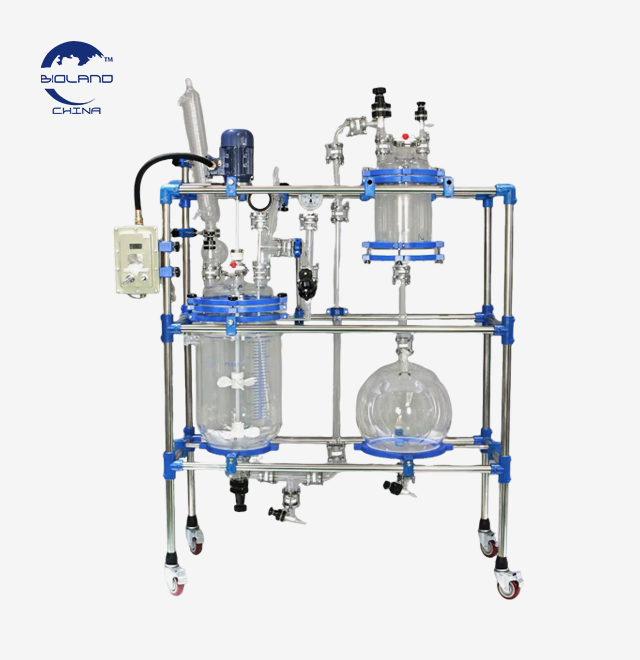
Both crystallization and synthesis steps benefit from GG17 borosilicate glass because it resists strong acids, strong bases, and organic solvents without leaching metal ions into the product. Because Bioland's chemical synthesis reactor uses the same glass construction throughout reaction, crystallization, and filtration, clients avoid the material-compatibility gaps that appear when synthesis and crystallization equipment come from different vendors with different vessel materials, which can otherwise introduce trace contamination between processing stages.
Integrated PTFE filtration versus standalone filter equipment
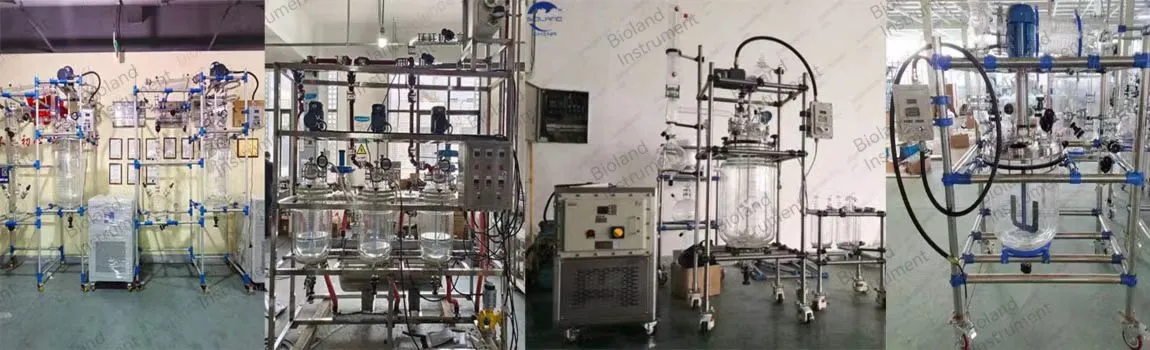
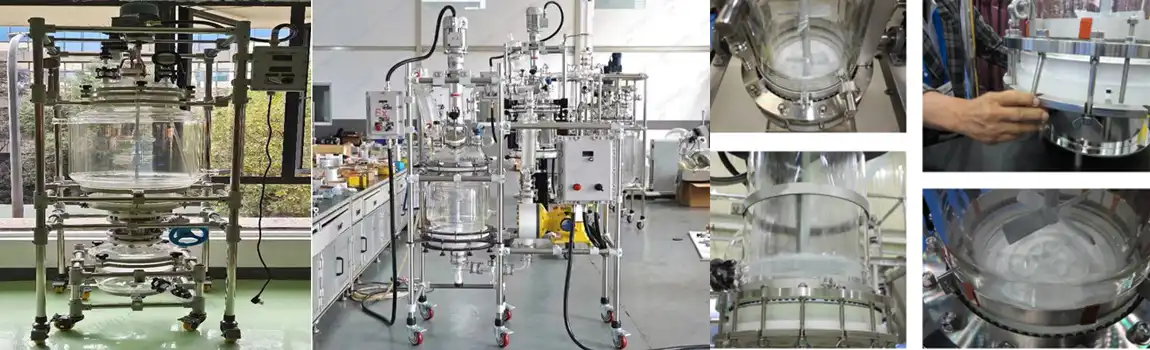
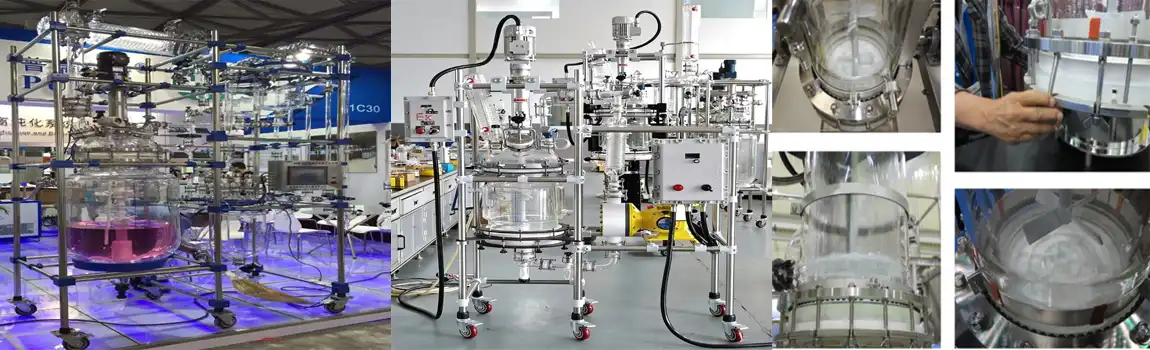
A standalone crystallization reactor typically still requires a separate filter station to isolate the crystallized solid, while Bioland's chemical synthesis reactor includes a standard PTFE sintered-disc filter plate, with stainless steel, titanium, or custom filter cloth and membrane options, built directly into the vessel. This integration eliminates the extra transfer and setup time a standalone crystallization workflow requires.
Wide temperature range for both reaction and cooling
Because it has to heat reactions and cool crystallization, a chemical synthesis reactor designed for mixed use needs a wider temperature range than a crystallization-only unit. Bioland's dual-jacket design can handle temperatures from -20°C to 200°C, so operators can do a high-temperature step for synthesis and then a controlled cooling ramp for crystallization without having to switch equipment in the middle of the process.
Explosion-proof and modular configuration options
When working with dangerous chemicals, a chemical synthesis reactor can be made to meet explosion-proof standards. It can also have electric lift mechanisms and PLC-based full automation, which aren't often found in simpler crystallization units that stand alone. Bioland has these configurations available in 20L, 30L, 50L, and 100L sizes so that customers can choose the level of automation and safety rating that best fits their process risk.
Evaluating Applications in Chemical and Pharmaceutical Manufacturing
Both types of reactors are used in the chemical, pharmaceutical, oil, metalworking, and new materials industries. However, a mixed chemical synthesis reactor is usually better when a process needs to react and clean up at the same time, instead of doing each step separately on different machines. When people are looking at tools for the first time, they often don't realize how much time and output is lost just moving materials between different reaction and filtering stations.
Pharmaceutical intermediate synthesis and purification
A chemical synthesis reactor is often used to make pharmaceutical intermediates and active ingredients. This is because most APIs need to crystallize right after the reaction that makes them in order to reach their goal purity. When you do both steps in the same chemical synthesis reactor, the sensitive intermediate stays in a controlled, neutral atmosphere the whole time. This is especially important for oxidation-sensitive or chiral compounds, because even a short contact to air during a transfer can cause them to break down or racemate.
Case snippet: chiral API intermediate purification in Europe
A European biotech business was working on a chiral API intermediate, but they were having trouble with failed reactions, low crystallization purity and yield, and the risk of cross-contamination from frequent moves in a system that was very harsh on the chemicals. Bioland provided a custom 100-liter glass chemical synthesis reactor that could do reaction, crystallization, and filtration all at once while being protected by nitrogen at 0–5°C. This increased crystal purity to over 99.5% and yield by about 15%.
Precious metal and fine-chemical catalyst production
Fine-chemical companies that make precious metal catalysts often need to do a solid-phase reaction at high temperatures and then filter the mixture to get the catalyst and any metal that is left over from the mother liquor. A chemical synthesis reactor designed for this sequence protects both the reaction yield and the downstream recovery rate in a single closed tank. This is better than losing material during a separate filter transfer, which is a typical way for the cost of making valuable metal catalysts to go up.
Case snippet: precious metal catalyst recovery in Poland
A Polish chemical manufacturer developing palladium and platinum catalysts faced low recovery rates, corrosive material attacking standard equipment, and catalyst deactivation from high-temperature solid-phase reactions that had previously forced multiple equipment changeovers. Bioland supplied a customized 50-liter glass chemical synthesis reactor to run solid-phase reaction at 150°C followed by direct in-vessel filtration, recovering more than 90% of residual precious metal and lowering overall production cost.
Choosing the Suitable Reactor System for Process Optimization
Selecting between a standalone crystallization reactor, a dedicated synthesis vessel, or a combined chemical synthesis reactor should depend on how many process steps a given workflow actually requires and how sensitive the intermediate is to handling and transfer. Rushing this decision based on price alone often costs more later, once rework, contamination, and additional equipment purchases are factored into the total project budget.
Matching equipment to process step count
If a process genuinely needs only crystallization, a dedicated crystallization reactor may be sufficient and more cost-effective. But whenever reaction, crystallization, and filtration all occur in sequence, a chemical synthesis reactor that handles all three eliminates transfer-related yield loss and contamination risk that a single-function unit cannot address on its own. This is especially true for multi-step syntheses where the intermediate is unstable in air or moisture and cannot tolerate extended exposure between processing stages.
Customization for non-standard process requirements
Bioland customizes each chemical synthesis reactor in size, shape, material, and internal structure according to a client's specific experimental or production requirements, including explosion-proof systems, PLC automation, integrated temperature control, and combination distillation modules. This non-standard customization is often the deciding factor for clients whose process does not fit a catalog-standard configuration.
Regulatory documentation and GMP validation support
Clients preparing for GMP-style pilot validation benefit from a chemical synthesis reactor's ability to log reaction, crystallization, and filtration parameters as one continuous, timestamped record rather than reconciling data from separate pieces of equipment, which simplifies audit trails considerably when regulators request full batch history. Xi'an Bioland Instrument Co., Ltd. is a professional manufacturer and solution provider for R&D, production, and sales of distillation, concentration, reaction, extraction, separation, filtration, purification, crystallization, emulsification, mixing, and drying equipment, alongside supporting heating, cooling, and vacuum devices, with more than 15 years of experience in the field.
Certification, pricing, and after-sales reliability
Every Bioland chemical synthesis reactor carries ISO safety certification and CE marking, is manufactured to GMP/FDA-aligned standards, and is backed by a dedicated specialist tracking weekly production progress with photos or video, plus optional Factory Acceptance Testing before shipment. Customized units typically ship within 30 business days, standard units in 5–7 days, supported by sea, rail, or air freight and a one-year warranty with lifetime maintenance, all at competitive OEM/ODM-friendly pricing.
Conclusion
A dedicated crystallization reactor purifies what has already been synthesized, while a chemical synthesis reactor forms the compound in the first place, and most real production processes need both functions back-to-back. Bioland's chemical synthesis reactor combines reaction, crystallization, and filtration inside one GG17 glass vessel, backed by 15-plus years of engineering experience, CE/ISO/GMP/FDA-aligned manufacturing, and full customization support, giving pharmaceutical and chemical clients a documented, single-vessel path from raw material to purified solid.
FAQ
Q1: Can a chemical synthesis reactor also perform crystallization?
A: Yes, Bioland's units combine reaction, crystallization, and PTFE filtration in one vessel.
Q2: What temperature range does it support?
A: Typically -20°C to 200°C, covering both synthesis and crystallization steps.
Q3: Is a standalone crystallization reactor ever the better choice?
A: Yes, if the process needs crystallization only, without a prior reaction step.
Q4: Can the chemical synthesis reactor be explosion-proof?
A: Yes, explosion-proof and PLC-automated configurations are available on request.
Q5: What volumes are available?
A: Standard sizes include 20L, 30L, 50L, and 100L configurations.
Talk to Bioland About Your Reactor System Selection
If you're unsure whether your process needs a crystallization reactor, a synthesis vessel, or both combined, Xi'an Bioland Instrument Co., Ltd. can help you choose. Our chemical synthesis reactor platform combines reaction, crystallization, and PTFE filtration in one GG17 glass vessel, backed by 15-plus years of engineering experience, CE and ISO certification, and GMP/FDA-aligned manufacturing. With full OEM/ODM customization, weekly production tracking, and Factory Acceptance Testing available, we help clients avoid costly equipment-selection mistakes. Contact us at info@biolandequip.com to discuss your process and get a quote on your next chemical synthesis reactor.
References
1. Levenspiel, O. Chemical Reaction Engineering. John Wiley & Sons.
2. Mullin, J. W. Crystallization. Butterworth-Heinemann.
3. Mersmann, A. Crystallization Technology Handbook. CRC Press.
4. Nauman, E. B. Chemical Reactor Design, Optimization, and Scaleup. John Wiley & Sons.
5. Perry, R. H., and Green, D. W. (Eds.). Perry's Chemical Engineers' Handbook. McGraw-Hill.
6. Wakeman, R. J., and Tarleton, E. S. Solid/Liquid Separation: Principles of Industrial Filtration. Elsevier.
The reactor is beautifully mirror-polished and fully complies with GMP requirements for the pharmaceutical industry. The performance is excellent! Overall, we are very satisfied! We also provided with some feedback on our process improvements, which we hope will be helpful.
2024-04-09
Laboratory
Excellent and professional service. Always reply our questions very fast. All reactors and chiller we received are good too.
2024-02-15
Research Institute
Quality is beyond our expectation actually. After we got the extraction equipment and started using it, the performance was beyond our expectation. Very easy to use and very efficient to run. Service always respond us very quickly. Was also very helpful to help us. Thanks Bioland team. Very happy to work with you.
2023-11-20
Biotech Company
We are happy about the new purchase as always. Equipment and services are both good.
2023-08-05
Instrument Lab
This is the second order with Bioland instrument and everything is good as the first dateText.
2023-05-12
Global Trading Partner
Bioland instrument team is very helpful and professional. The sales helped us select the right equipment for our application, and their logistics people handled the transportation and customs declaration for our shipment. All that saved us a lot of work.