Plant Essential Oil Extractor vs Traditional Distillation: Pros & Cons
Nov 13, 2026
Choosing between aplant essential oil extractorand traditional distillation is not simply a choice between new and old equipment; it is a decision about feedstock, target aroma profile, batch size, labor, and cost per kilogram of recovered oil. Bioland Instrument’s configurable plant essential oil extractor combines controlled heating, visible condensation and oil-water separation, and modular sizing in one platform for research and production.
Steam or hydro-distillation may be used in both methods. In real life, the comparison is usually between a simple pot still and an engineered, instrumented line, not between distillation and a completely different physical principle. Bioland instrument also sells ultrasonic and supercritical CO₂ equipment for situations where a different way of extracting is needed. These methods can create different extracts and are not always interchangeable with distilled essential oils.
Key Differences Between Modern and Conventional Extraction
Traditional distillation still earns its place
In traditional hydro-distillation, plants are submerged in water. In steam distillation, vapor moves through a packed bed. In both cases, volatile chemicals move with the steam and then settle to separate. For small amounts of lavender, rosemary, mint, lemongrass, and some citrus, a simple still can be useful, familiar, and not too expensive. The same vapor-condensation idea can be used in a plant essential oil extractor, which also has controls for the process.
When recipes are stable, batches are small, and the facility is set up for manual operation, conventional equipment can be a good choice. As production grows, however, workers may have to deal with heating problems that don't work right, odd basket packing, unclear receivers, trouble getting rid of waste biomass, or having to make multiple moves. These problems with process control are not proof that distillation doesn't work. In steam distillation, cleaner output and process design have been important for a long time.
Modern integration changes process control
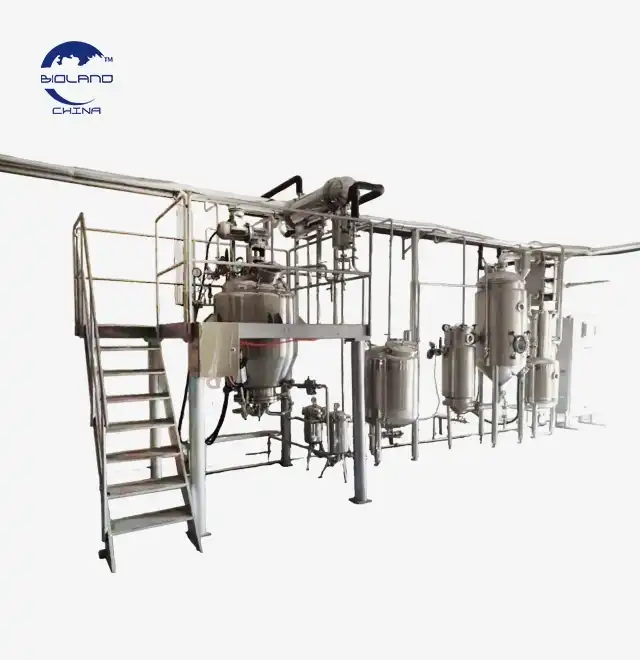
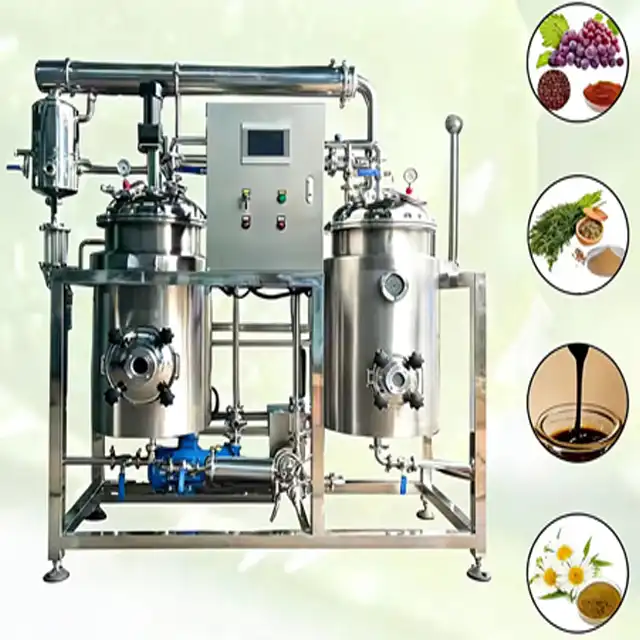
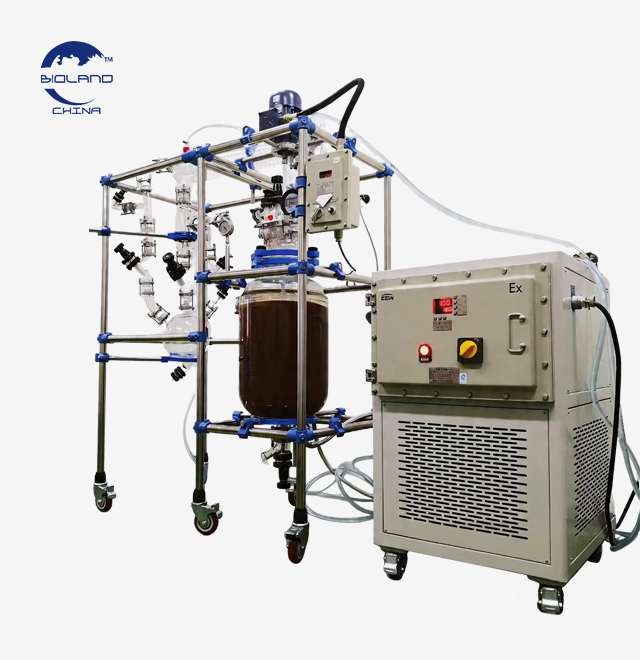
The heater, condenser, oil-water separator, and collection receiver are all connected by an integrated plant essential oil extractor. Bioland instrument's glass setup has a multi-layer distillation basket and an open-top loading system that makes it easier to load botanicals and get rid of the spent charge. High-borosilicate glass in the condenser and divider lets you see how the vapor and phases form while the machine is running.
The digital display or tablet control can be set up to handle temperatures from room temperature to 100°C. It is claimed to have a control precision of ±0.5°C, dual-zone regulation, and low-liquid safety. A new plant essential oil extractor doesn't change the way distillation works thermodynamically, but it does make it easier to set, watch, record, and repeat important conditions. One of its downsides is that it might cost more to set up and require more planning for utilities and controls.
Feedstock decides the right route
Steam distillation works well for volatile aromatic parts found in herbs, flowers, roots, leaves, and some peels. However, fixed oils from grape seed or castor are high in triglycerides and can't be recovered as essential oils through steam distillation. Pressing or solvent-based systems work better for these types of oils. You shouldn't just choose a plant essential oil extractorbecause the feedstock is called a "oil" plant; you should also look at the chemistry.
The amount of water, particle size, and volatile profile of lavender, rose, lemongrass, mint, thyme, ginger, clove, star anise, and citrus may mean that they need different recipes. Before suggesting a standard model or an OEM/ODM configuration, Bioland instrument's engineering team can look at the plant material, the target batch size, the heating source that is available, and the downstream separation needs.
How Extraction Methods Affect Essential Oil Quality
Control thermal history, not just the setpoint
The make-up of essential oils can change over time, depending on temperature, oxygen exposure, and how the plant is handled. Reviews of the stability of essential oils talk about how handling and storage conditions can change flammable chemicals. Controllable heating in a plant essential oil extractor can help users avoid unwanted temperature changes and long periods of idle heating, but exact control doesn't mean that all heat-sensitive compounds will stay the same.
The plant essential oil extractor's stated control range of ambient to 100°C and precision of ±0.5°C only describe its control abilities, not the guarantyd composition of the product. The material and recipe determine the result, as the steam and plant temperatures can be different. When a goal standard depends on the quantities of constituents, test sample batches using the right analytical tools, like GC-MS.
Make condensation and separation easier to observe
How well the air condenses and how the oil and water phases separate also affect the quality of the product. Bioland instrument requires condenser and separator parts made of high-borosilicate glass, as well as a sight glass with lighting and a level indicator in the right configurations. A plant essential oil extractor with a clear separator lets people see the interface and see if the oil floats or forms a lower layer, which depends on how dense the oil is.
Short-return or droplet-form condenser designs are meant to speed up condensation, but the flow rate and temperature of the cooling water will depend on the spot. A clear view helps with observation, but it doesn't take the place of keeping track of temperatures, following safe operating procedures, or doing analytical release tests. The plant essential oil extractor from Bioland instrument can be set up with obvious collection parts that work with the process.
Match the extraction route to the quality specification
For lavender or lemongrass, steam distillation might give the buyer the volatile oil profile they want. Ultrasound-assisted extraction can help move mass more efficiently in a solvent, but supercritical CO₂ can create a different fraction profile and needs equipment that can handle high pressure. There may be a plant essential oil extractor product family that has these routes, but the outputs should be compared analytically instead of being thought of as the same oil.
First, decide what you want to find. It could be a chromatographic fingerprint, a sensory profile, a marker compound, or a certain volatile fraction. Then, use matched raw materials and appropriate analytical methods to compare the distilled product from a plant essential oil extractor with any other method. It is important to know this because the term "natural extract" can refer to different products with different makes-ups when it comes to botanical ingredients used in food, cosmetics, fragrances, and research.
Comparing Oil Yield Across Different Extraction Processes
Define yield using a consistent basis
When one supplier reports oil per wet biomass and another reports it per dry biomass, it's not easy to tell the difference between the yields. Make a note of the feed mass and moisture. Next, figure out the essential oil yield by dividing the recovered oil mass by the dry plant mass and multiplying by 100. You shouldn't just look at how much condensate a plant essential oil extractor collects; you should also look at how much oil it recovers that meets the requirements.
Write down the length of the batch, the amount of oil left in the spent biomass, the oil that wasn't collected in the separator, and any quality losses. Even if there is a lot of oil at the exit, the amount that can be sold may not be very high if the feed bed channels or an emulsion makes recovery harder. When comparing runs, make sure they all use the same cultivar, harvest period, comminution, moisture, and charge mass. Standardized loading and collection can make it easier to compare these tests with a plant essential oil extractor, but the result is still based on the feedstock and recipe.
Lavender case: a 500 L system for clearer batch comparisons
A lavender producer wanted to understand why recovered-oil volumes varied between batches and why operators could not easily follow the oil-water interface. Variable flower moisture, inconsistent basket packing, and hand transfers to separate receivers made yield comparisons and cleaning more difficult. The team needed a visible, larger-batch setup rather than an unsupported promise of a specific yield increase.
Bioland instrument’s supplied project profile features a 500 L plant essential oil extractor, model BL-JT-500, with steam heating, a 4 m² cooling area, and a 35 L separator. Its multi-layer basket arranges the botanical material for steam contact, while the open-top format supports loading and spent-material removal. The visible glass collection path helps operators observe condensation and separation.
Operators can standardize lavender moisture, cut size, charge mass, steam conditions, and cooling-water settings, then record oil mass against dry feed. Thisplant essential oil extractor provides a platform for testing those variables and reducing transfers. Any yield improvement should be confirmed against the producer’s baseline using the same botanical lot and agreed analytical criteria.
Compare steam, ultrasound, and CO₂ on equal terms
Solvent extraction with ultrasound might help move more matter and get back compounds that steam doesn't pick up. There may also be parts of the extract that don't disappear. As the temperature and pressure of supercritical CO₂ change, you can get back a bigger range of materials that like fat. There should be no difference between the plant essential oil extractors you choose and those that can make a volatile oil or a botanical extract.
With the same raw materials, pre-treatment, and dry-basis formulas, run tests next to each other. Check out the output of the oil, the chemical pattern, the taste qualities, the cycle time, and the limits for residues that matter. There is no one best way to choose a plant essential oil extractor. Instead, look for a method that has been tried and tested and a filter that works well.
Energy Consumption and Processing Costs Compared
Compare utility use per kilogram of saleable oil
These stills may be cheaper to buy and can be used with either direct fire or a simple steam source. Power costs depend on how much water is in the feed, how well insulated the tank is, how good the steam is, how long the batch lasts, how much water flows through the condenser, and whether the heat stays on during loading and unloading. The best way to judge a plant essential oil extractor is to see how much energy and cooling water it uses per kilogram of oil that can be sold. Don't just assume that automation saves energy.
Write down how much gas or electricity is used, how fast the water cools, how many hours were worked, how long it took to clean up, and how much trash was made from each batch. It is best to use similar material and temperature circumstances. The unit cost can change a lot if the amount of oil collected or the time a batch runs changes. This is because essential oil outputs can be small. Price quotes from suppliers should say what they are based on. This plant essential oil extractor should be judged based on real process data.
Match heating and condensing capacity
Bioland instrument makes models that are 50, 100, 200, and 300 L. They can be heated with either electricity or steam. The 500, 1,000, and 2,000 L types, on the other hand, heat with steam. The BL-JT-50 has a cooling area of 1 m² and a divider that holds 15 L. The BL-JT-100 has a cooling area of 1.5 m² and a separator that holds 15 L. The BL-JT-200 has a cooling area of 2 m² and a separator that holds 20 L. BL-JT-300 has a cooling area of 3 m² and a separator that holds 25 L.
BL-JT-500 has 4 m² and 35 L, BL-JT-1000 has 8 m² and 50 L, and BL-JT-2000 has 15 m² and 70 L. How much air a plant essential oil extractor can handle should be matched by the size of its condenser. Make sure you have the final model datasheet and know what the process conditions will be before you size the utilities.
A project's utility balance is important. If there isn't enough cooling, condensation and collection will take longer, and if the utility systems are too big, they may cost more than they need to. The BL-JT-500 has a 35-liter divider and a cooling area of 4 m². The BL-JT-1000 covers 8 m² and has a 50 L divider. Before making a decision, look at each plant essential oil extractor's cooling water entry temperature, flow, exit conditions, and projected vapor rate.
Include labor, cleaning, and ownership costs
An integrated system can cut down on the amount of work that needs to be done by hand by combining the loading basket, controlled heating, condensation, and clear separation of oil and water. In a pilot room, a small size might be useful, and an easy-to-reach upper lid can make it easier to load, empty, and clean. The buttons on a plant essential oil extractor can be digital or touch screen. If you want to use gas-direct, electric thermal-oil jacket, or steam heating, you should think about the final design and the site.
Adding up the costs of spare parts, seals, cleaning, user training, utility hookups, validation, and downtime is fair. It may be worth the money to buy a plant essential oil extractor with batch records that can be used over and over again, even if the savings on electricity are small. Looking at vessel prices alone isn't enough. You should also ask for a process-specific plan that lists all the parts that are included and the amount of service that is needed.
Which Extraction Technology Suits Industrial Production Best?
Size the line for actual throughput
Start by looking at the seasonal availability of feed, the charge density, the target batches per shift, the cleaning turnaround, and the amount of crude oil that can be stored. The types on the list run from 50 L to 1,000 L, but the volume of the vessel alone doesn't tell you how much material and plants are in a batch; the shape of the basket and the material's bulk density do. A pilot recipe and a realistic throughput calculation should be used to figure out the right size for a plant essential oil extractor.
Researchers may start with 50–200 L to test the process, while manufacturers with steady demand may look at 500–1,000 L systems. You can use a plant essential oil extractor with condensate gathering and drying or filtering further down the line, depending on your needs. The utilities, operator access, and cleaning should all be planned as a whole with the process train.
Lemongrass case: a 1,000 L production line
A lemongrass processor faced a common scale-up challenge: seasonal volumes were increasing, while a small pot required frequent manual adjustment and gave operators limited visibility during collection. The team wanted to manage larger charges, streamline collection, and retain an accessible cleaning route.
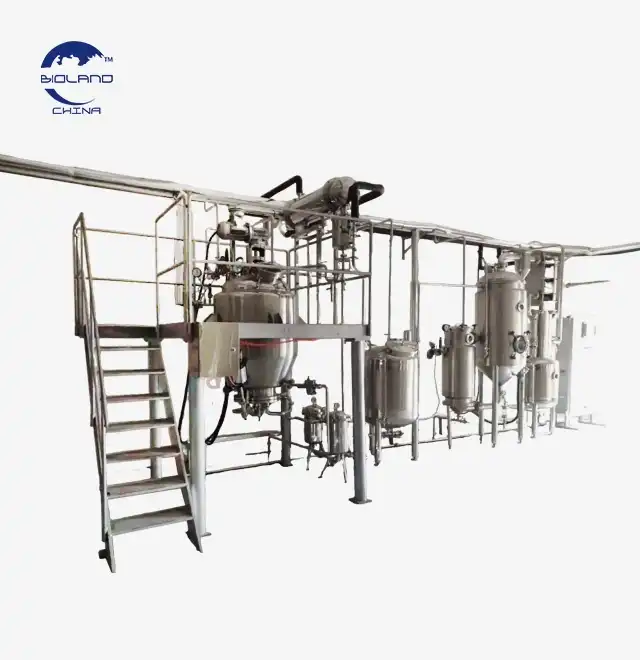
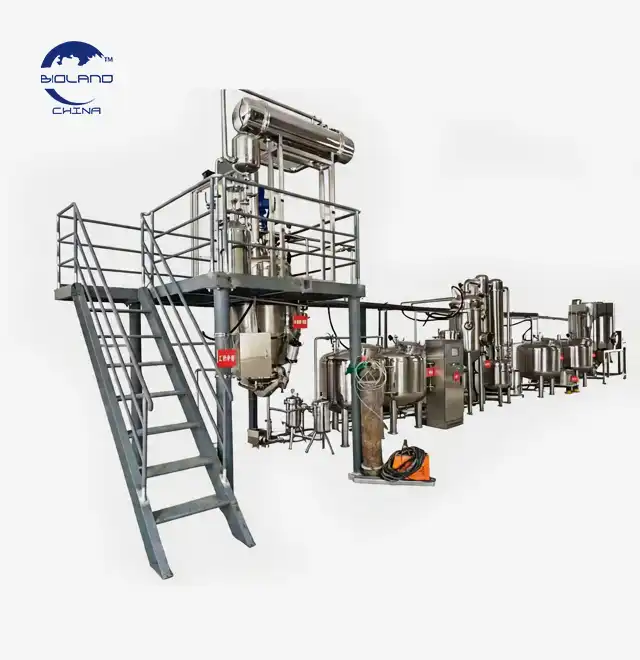
The Bioland instrument 1,000 L plant essential oil extractor reference configuration uses steam heating, an 8 m² cooling area, and a 50 L separator. A layered distillation basket and transparent condenser and separator help organize the biomass and observe phase formation. Temperature, cooling-water, and collection settings can be recorded through a digital or touchscreen control system.
Before production release, operators should establish charge mass, feed moisture, steam conditions, cooling-water settings, run endpoint, and cleaning procedure. This plant essential oil extractor project provides a basis for process development as well as capacity: clearer operating observations and fewer manual transfers. Yield remains specific to cultivar and recipe.
Specify engineering and service alongside the equipment
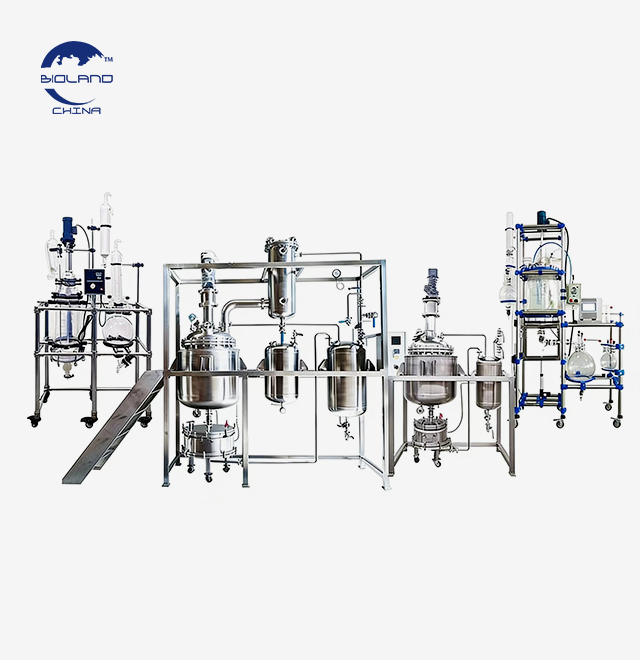
Bioland Instrument has more than 15 years of experience in process equipment and supplies extraction, distillation, reaction, separation, concentration, crystallization, drying, heating, cooling, and vacuum systems. Its wider portfolio includes ultrasonic, ethanol, and CO₂ extraction equipment. The company’s R&D and engineering team can configure a plant essential oil extractor through OEM/ODM work, including capacity, basket, condenser, separator, controls, and line integration.
Bioland reports CE and ISO certifications and GMP/FDA-oriented product compliance; buyers should request the certificates and documentation relevant to the selected model and application. Standard units are typically ready in 5–7 days, while customized systems generally require about 30 business days, subject to confirmation. Production updates include weekly photos or videos, followed by final inspection and an optional FAT. Bioland also offers sea, rail, or air freight, a one-year warranty, and lifetime maintenance. Confirm the final plant essential oil extractor scope and lead time in writing.
Conclusion
Traditional distillation remains a familiar and effective route for volatile oils, while a modernplant essential oil extractor adds process control, visible separation, accessible loading, and a wider range of scale options. It is most valuable when inconsistent results, labor-intensive handling, or scale-up—not novelty—are the real production problems. Yield, aroma profile, energy use, and cost should be measured using matched feedstock and a consistent dry-mass basis.
Ultrasound and supercritical CO₂ are alternatives only when their different extract profiles suit the target product. Bioland instrument’s 50–2,000 L configurations, heating options, glass collection components, and OEM/ODM engineering can support development and production planning. Before choosing a model, request a process review, model-specific datasheet, utility check, and trial plan. The best system is the one that delivers repeatable, specification-compliant oil at an acceptable total cost.
FAQs
Q: Is a plant essential oil extractor different from traditional distillation?
A: It may use the same steam principle, with added controls, visibility, and process integration.
Q: Can it process lavender and lemongrass?
A: Yes. Confirm the recipe, basket arrangement, and utility sizing for the intended feedstock.
Q: Does ±0.5°C control guarantee aroma retention?
A: No. It describes temperature control; composition depends on process conditions and should be validated.
Q: How do I select capacity?
A: Base the decision on feed density, batch size, throughput, and cleaning turnaround.
Q: Can steam distillation recover fixed oils?
A: Generally no. Seed and other fixed oils typically need pressing or a suitable alternative process.
Plan Your Essential Oil Process with Bioland Instrument
Ready to compare your existing still with a modern extraction line? Send Bioland Instrument your botanical name, batch volume, moisture range, target oil specification, available utilities, and current challenge—such as low recovery, long cycles, unclear separation, or labor-intensive cleaning. Our engineering team can help assess steam distillation or determine whether ultrasonic or supercritical CO₂ extraction better suits your product, then propose a plant essential oil extractor configuration with an appropriate vessel, basket, condenser, separator, and controls. With competitive pricing, OEM/ODM engineering, CE and ISO credentials, production updates, optional FAT, global freight, a one-year warranty, and lifetime maintenance, Bioland Instrument supports process planning as well as equipment delivery. Email info@biolandequip.com to request a technical review and model-specific quotation.
References
1. Başer, K. H. C., and Buchbauer, G., eds. Handbook of Essential Oils: Science, Technology, and Applications. 2nd ed. CRC Press, 2015.
2. Turek, C., and Stintzing, F. C. “Stability of Essential Oils: A Review.” Comprehensive Reviews in Food Science and Food Safety, 12(1), 2013, 40–53.
3. Masango, P. “Cleaner Production of Essential Oils by Steam Distillation.” Journal of Cleaner Production, 13(8), 2005, 833–839.
4. Chemat, F., Abert Vian, M., and Cravotto, G. “Green Extraction of Natural Products: Concept and Principles.” International Journal of Molecular Sciences, 13(7), 2012, 8615–8627.
5. Reverchon, E., and De Marco, I. “Supercritical Fluid Extraction and Fractionation of Natural Matter.” The Journal of Supercritical Fluids, 38(2), 2006, 146–166.
6. Azmir, J., et al. “Techniques for Extraction of Bioactive Compounds from Plant Materials: A Review.” Journal of Food Engineering, 117(4), 2013, 426–436.
The reactor is beautifully mirror-polished and fully complies with GMP requirements for the pharmaceutical industry. The performance is excellent! Overall, we are very satisfied! We also provided with some feedback on our process improvements, which we hope will be helpful.
2024-04-09
Laboratory
Excellent and professional service. Always reply our questions very fast. All reactors and chiller we received are good too.
2024-02-15
Research Institute
Quality is beyond our expectation actually. After we got the extraction equipment and started using it, the performance was beyond our expectation. Very easy to use and very efficient to run. Service always respond us very quickly. Was also very helpful to help us. Thanks Bioland team. Very happy to work with you.
2023-11-20
Biotech Company
We are happy about the new purchase as always. Equipment and services are both good.
2023-08-05
Instrument Lab
This is the second order with Bioland instrument and everything is good as the first dateText.
2023-05-12
Global Trading Partner
Bioland instrument team is very helpful and professional. The sales helped us select the right equipment for our application, and their logistics people handled the transportation and customs declaration for our shipment. All that saved us a lot of work.