Solve CBD Purity Issues with a CBD Crystallization Reactor
Aug 18, 2026
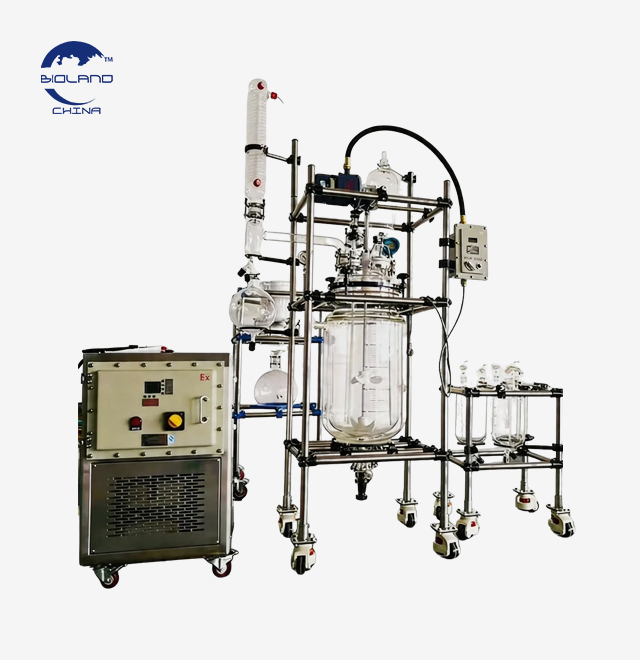
Your COA comes back at 96.8% when the buyer specified 99%. The crystals look faintly amber instead of white. Residual solvent sits stubbornly above limit. Most processors respond by re-crystallizing — burning solvent, time and yield to chase a number that better equipment would have delivered first time. Purity problems in CBD isolate are almost never chemistry failures; they are separation and handling failures. A properly specified CBD crystallization reactor removes those failure points by keeping dissolution, controlled cooling, crystal growth, filtration, washing and vacuum drying inside a single sealed vessel. Xi'an Bioland Instrument Co., Ltd. builds its CBD crystallization reactor from high-borosilicate glass with a large-diameter PTFE sintered filter plate, jacketed precision cooling, programmable low-shear agitation and full vacuum capability, with optional explosion-proof construction and PLC automation. Standard 20 L, 30 L, 50 L and 100 L capacities, full OEM/ODM customization, CE and ISO certification, GMP/FDA-compliant materials, factory-direct pricing, one-year warranty and lifetime maintenance. Here is how it fixes purity, problem by problem.
Improving CBD Purity Through Controlled Crystallization
Diagnosing Where Purity Actually Goes Wrong
Before buying anything, identify your loss mechanism. Amber colour usually means occluded mother liquor trapped inside fast-grown crystals. Low potency with clean colour often means residual solvent from incomplete drying. Erratic batch-to-batch variance points to uncontrolled cooling. Each has a different fix, and a CBD crystallization reactor addresses all three because it controls the cooling profile, the washing step and the drying step within one apparatus. Guessing is expensive; the transparent glass body of a CBD crystallization reactor lets you actually watch which stage is failing.
Cooling Rate Is the Single Biggest Purity Lever
Crash-cooling a saturated CBD solution produces a blizzard of tiny crystals that grow so fast they physically enclose pockets of impurity-rich mother liquor. No amount of washing removes what is trapped inside a crystal. Slow, controlled cooling through the metastable zone — around 1–2°C per hour — grows larger, better-formed crystals that reject impurities at the growing face. The jacketed CBD crystallization reactor paired with a stainless-steel high-low temperature all-in-one circulator holds that ramp precisely, which is simply impossible in a freezer or an uncontrolled vessel.
Seeding and Nucleation Control
Spontaneous nucleation is unpredictable; seeding is not. Introducing a measured quantity of high-purity seed crystals at the correct supersaturation gives you a defined crystal population and consistent size distribution. Bioland can integrate ultrasonic crystallization into theCBD crystallization reactorfor producers who want to trigger uniform primary nucleation without seed handling. Programmable stirring supports both approaches — gentle during nucleation to prevent secondary nucleation by attrition, then adjusted during the growth phase to keep suspension even.
Visual Confirmation Instead of Guesswork
Because the vessel is high-transparency borosilicate glass, operators can see the first nucleation cloud form, judge whether it appeared too early, and watch crystal size develop over the following hours. In an opaque vessel all of this is invisible until the batch is filtered and analysed days later. Customers repeatedly tell Bioland this visibility is what compressed their process development from months of blind trials into a handful of instrumented batches on a single CBD crystallization reactor.
Reducing Impurities with Optimized Reactor Performance
Eliminating the Transfer Step That Ruins Batches
Every time slurry is poured, pumped or scooped from one vessel to another it picks up atmospheric moisture, warms toward re-dissolution, and leaves product behind on walls and hoses. A CBD crystallization reactor ends this. The filter plate is integrated into the base, so mother liquor drains under vacuum while the crystal bed remains exactly where it grew, never exposed to air or handling. Producers who consolidate reaction, crystallization, filtration and drying into one CBD crystallization reactor routinely close their mass balance for the first time.
Material Purity: No Metal Ions, No Contamination
High-borosilicate glass and PTFE are the only wetted materials in a standard Bioland CBD crystallization reactor. Nothing leaches. No iron, nickel or chromium enters the product, and no passivation layer degrades under acidic wash conditions. For processors supplying pharmaceutical or nutraceutical markets where heavy-metal specifications are tight, this alone can decide the equipment choice. The same chemical stability lets the vessel handle ethanol, pentane, heptane and acidic or basic washes without attack.
Oxidation and Degradation Control
CBD degrades to CBN under heat, light and oxygen. Because a CBD crystallization reactor operates sealed under vacuum or nitrogen blanket throughout crystallization, washing and drying, oxygen exposure is minimized across the entire cycle. Drying occurs at mild jacket temperatures under vacuum rather than in a hot open tray, so thermal degradation stays low and the finished isolate holds its white colour and potency through storage.
Enhancing Separation Efficiency During CBD Processing
Filter Media Matched to Crystal Size
Separation efficiency starts with correct media selection. Standard configuration on the Bioland CBD crystallization reactor is a PTFE sintered core, with stainless steel, titanium, and a full range of filter cloths and membranes available in various specifications. Well-grown coarse crystals filter freely on a moderate pore rating. Fines-heavy or needle-shaped material needs a finer medium or a cloth overlay. Because the assembly is quick-release, swapping media between development batches takes minutes, not a workshop visit.
Staged Vacuum Protects Both Speed and Purity
The most common operator error is pulling maximum vacuum instantly. Fines compact against the plate, the cake blinds, drainage stalls, and mother liquor stays trapped in the bed — directly damaging purity. Correct practice on any CBD crystallization reactor is staged suction: begin gently around -0.02 MPa until a supporting cake forms, step up progressively, and reserve maximum vacuum for final deliquoring. The large-diameter filter design then delivers the fast drainage it was engineered for.
Displacement Versus Reslurry Washing
Two washing strategies exist and both run in-vessel. Displacement washing pushes cold solvent through an intact cake to sweep away surface mother liquor — solvent-efficient and suited to crack-free beds. Reslurry washing lowers the agitator blade to remix the cake with fresh cold solvent before re-filtering, and it is the reliable answer to occluded impurities and stubborn colour bodies. Switching between them inside the same CBD crystallization reactor requires no containment break, and operators can literally see cracks forming through the glass wall and change tactics immediately.
A Polish Precious-Metal Recovery Case
A Polish fine-chemicals producer developing palladium and platinum catalysts faced low metal recovery, corrosive attack on equipment, catalyst deactivation during high-temperature reaction, slow separation and costly cleaning.
Bioland delivered a customized 50 L glass filter-crystallization reactor forming a closed reaction-and-recovery loop. Precursors reacted with organic ligands at 150°C; borosilicate glass tolerated the short high-temperature exposure without deactivating catalyst.
The PTFE filter assembly then separated solid catalyst in place, recovering over 90% of residual precious metal from the mother liquor. Double-jacket control spanned -80°C to 200°C, and quick-release filtration eliminated residue carryover.
Achieving Stable Purity Results in Production Systems
In-Situ Vacuum Drying Finishes the Job
Residual solvent is a purity failure as surely as colour is. Transferring wet cake to a tray dryer reintroduces moisture, loses material and exposes operators. Drying inside the CBD crystallization reactor under vacuum with mild jacket heat and slow blade rotation breaks clumps, exposes fresh surface and drives solvent to specification without a single transfer. Because you can see the bed through the glass, drying endpoint is judged visually as well as by vacuum reading.
Automation Removes Operator Variance
Three shifts operating manually produce three different products. A PLC and touchscreen equipped CBD crystallization reactor executes stored recipes — cooling ramp, agitation speed and position, staged vacuum profile, timed wash charges, drying dwell — and logs every parameter for export. Bioland supplies material certificates, pressure and vacuum test reports and calibration data with each unit, shortening IQ/OQ work considerably. Xi'an Bioland Instrument Co., Ltd. has more than 15 years of experience building exactly this class of reaction, filtration, purification, crystallization and drying equipment.
Cleaning, Changeover and Cross-Contamination Control
Multi-grade facilities lose purity at changeover. Glass carries no weld seams, crevices or passivation layer, so CIP with appropriate solvent and rinse cycles restores a validated clean state quickly. Between products, remove the PTFE plate from the CBD crystallization reactor, backflush with compatible solvent and inspect for embedded fines — a twenty-minute task. This discipline is what keeps a THC-remediated grade from contaminating a full-spectrum batch.
Safe Operation, Customization and Support
Glass rewards discipline: ramp jacket temperature no faster than about 3–5°C per minute, pre-condition solvents before charging, respect rated pressure, verify clamp torque and frame level before each campaign, and confirm seal integrity daily by holding vacuum on the empty vessel for ten minutes. Every CBD crystallization reactor can be customized in size, shape, material and structure — including certified explosion-proof systems, electric lifting, integrated temperature control, ultrasonic crystallization and combined rectification columns. Customized units ship in about 30 business days, catalogue units in 5–7 days, with weekly photo or video progress updates, optional Factory Acceptance Testing in Xi'an, one-year warranty and lifetime maintenance.
Conclusion
CBD purity problems trace back to four controllable variables: cooling rate, transfer handling, washing method and drying completeness. A Bioland CBD crystallization reactor governs all four inside one sealed borosilicate vessel — 1–2°C per hour ramps, zero transfers, in-vessel displacement or reslurry washing on a large-diameter PTFE plate, and vacuum drying in place under nitrogen. Field results across the same platform speak plainly: 99.5% purity, 15% yield gain, over 90% recovery. Backed by CE and ISO certification, GMP/FDA-compliant construction, explosion-proof and PLC options and 15+ years of engineering, Bioland Instrument delivers purity solutions, not just glassware.
FAQ
1. Why are my crystals amber instead of white?
Usually occluded mother liquor from crash cooling. Slow the ramp to 1–2°C per hour and reslurry wash.
2. What filter media are standard?
PTFE sintered core, with stainless steel, titanium, filter cloths and membranes available in various specifications.
3. How do I avoid blinding the filter plate?
Use staged vacuum — gentle first, increasing only after a supporting cake has formed.
4. Can the reactor dry crystals to spec?
Yes — in-situ vacuum drying with mild jacket heat and slow agitation removes residual solvent without transfer.
5. What sizes and options are available?
20 L, 30 L, 50 L and 100 L standard, plus custom builds, explosion-proof systems and PLC automation.
Fix Your Purity Numbers with Bioland Instrument
Stop re-crystallizing to rescue a failing COA. Xi'an Bioland Instrument Co., Ltd. engineers every CBD crystallization reactor around your solvent system, cooling profile, impurity challenge and purity target — including certified explosion-proof construction, PLC full automation, electric lifting, ultrasonic crystallization and integrated solvent recovery. You gain CE and ISO certified quality, GMP/FDA-compliant materials, factory-direct pricing, weekly photo and video production updates, optional Factory Acceptance Testing, a one-year warranty and lifetime maintenance. Catalogue units ship in 5–7 days; fully customized systems in 30 business days by sea, rail or air. Send us your current COA, solvent system and target specification at info@biolandequip.com, and our engineers will return a tailored process and equipment proposal.
References
1. Mullin, J. W. Crystallization, 4th Edition. Butterworth-Heinemann.
2. Myerson, A. S., Erdemir, D., Lee, A. Y. Handbook of Industrial Crystallization, 3rd Edition. Cambridge University Press.
3. Tarleton, E. S., Wakeman, R. J. Solid/Liquid Separation: Equipment Selection and Process Design. Butterworth-Heinemann.
4. ElSohly, M. A., Gul, W. "Constituents of Cannabis sativa," in Handbook of Cannabis. Oxford University Press.
5. am Ende, D. J. Chemical Engineering in the Pharmaceutical Industry: R&D to Manufacturing. Wiley.
6. ICH Q3C Impurities: Guideline for Residual Solvents. International Council for Harmonisation.
The reactor is beautifully mirror-polished and fully complies with GMP requirements for the pharmaceutical industry. The performance is excellent! Overall, we are very satisfied! We also provided with some feedback on our process improvements, which we hope will be helpful.
2024-04-09
Laboratory
Excellent and professional service. Always reply our questions very fast. All reactors and chiller we received are good too.
2024-02-15
Research Institute
Quality is beyond our expectation actually. After we got the extraction equipment and started using it, the performance was beyond our expectation. Very easy to use and very efficient to run. Service always respond us very quickly. Was also very helpful to help us. Thanks Bioland team. Very happy to work with you.
2023-11-20
Biotech Company
We are happy about the new purchase as always. Equipment and services are both good.
2023-08-05
Instrument Lab
This is the second order with Bioland instrument and everything is good as the first dateText.
2023-05-12
Global Trading Partner
Bioland instrument team is very helpful and professional. The sales helped us select the right equipment for our application, and their logistics people handled the transportation and customs declaration for our shipment. All that saved us a lot of work.