How does an ultrasonic extractor improve the yield of active compounds from mushrooms?
Sep 9, 2026
Mushroom extraction has moved far beyond simple hot water steeping. Modern producers need higher yields of polysaccharides, triterpenes, and phenolic compounds while protecting heat-sensitive bioactives. Bioland instrument’s Ultrasonic Extraction Equipment of mushroom is engineered to solve that challenge. It uses cavitation to break fungal cell walls, shorten extraction time by more than two-thirds, and raise recovery by 50–500% compared with conventional methods. With vacuum concentration, PLC automation, and GMP-compliant stainless steel design, this equipment turns a lab process into a repeatable production line. This article explains how ultrasonic technology improves mushroom compound yield, backed by real customer cases and process data.
Understanding Ultrasonic Cavitation in Mushroom Compound Extraction
Cavitation is the core mechanism behind high-efficiency mushroom extraction. When ultrasound passes through a liquid, it creates microscopic bubbles that grow and collapse violently. This generates localized heat and shear forces. In a fungal cell, cavitation disrupts the chitinous cell wall and releases intracellular active compounds. Bioland’s Ultrasonic Extraction Equipment of mushroom generates these cavitation events uniformly throughout the extraction tank, so every gram of mushroom is exposed to the same energy. One key advantage is that it can work at 40–60°C, which protects fragile polysaccharides and triterpenes from oxidation. Traditional boiling often destroys these compounds. For a customer producing reishi mushroom polysaccharides, the Ultrasonic Extraction Equipment of mushroom achieved a 3.2-fold increase in yield compared to hot reflux, while maintaining a lighter color and higher purity.
Why Conventional Mushroom Extraction Loses Yield
Conventional methods rely on diffusion, which is slow and incomplete. Heat alone cannot fully rupture the tough fungal cell wall. As a result, many actives remain trapped inside undamaged cells. A mushroom producer complained they could only recover 60% of dry matter using boiling water. After switching to Bioland’s Ultrasonic Extraction Equipment of mushroom, the same raw material yielded 91% extractable solids. The difference came from cavitation reaching areas that heating could not. The ultrasonic field also improves solvent penetration, specially in dried mushroom chunks.
The Role of Frequency and Power in Bioland’s Ultrasonic Extraction Equipment of mushroom
Bioland’s unit uses a low-frequency ultrasonic transducer that delivers consistent mechanical vibration. Lower frequencies create larger cavitation bubbles, which produce stronger shock waves. This is especially effective for thick-walled mushrooms like Ganoderma lucidum. The equipment is designed to handle both water and ethanol solvent systems. When used as a tincture extraction machine, the same cavitation mechanism helps release alkaloids and polyphenols from medicinal fungi. A customer in Fujian used this Ultrasonic Extraction Equipment of mushroom for both reishi and shiitake extraction, adjusting only the frequency power from the PLC panel.
How Bioland instrument’s Ultrasonic Extraction Equipment of mushroom Integrates Extraction and Concentration
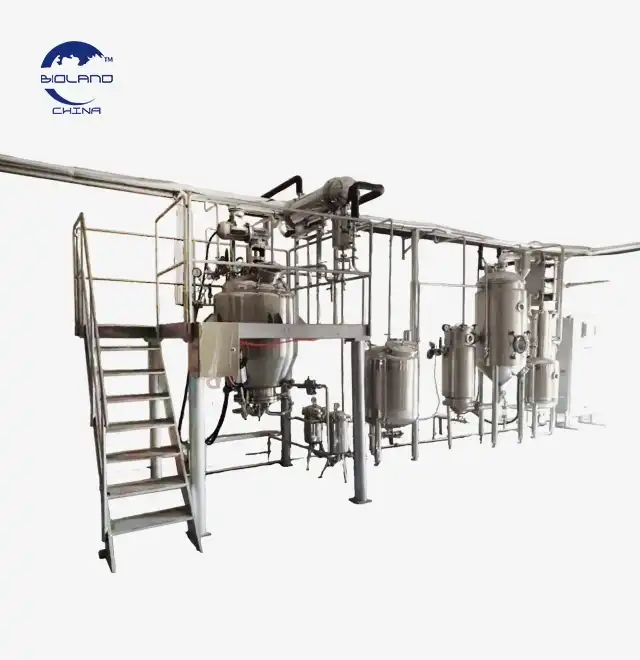
Cavitation alone is not enough; you need a closed-loop process. Bioland’s equipment combines the ultrasonic extraction tank with a vertical evaporator, condenser, oil-water separator, and vacuum pump. After the ultrasonic cycle, the liquid is automatically drawn into the concentration chamber. The secondary steam condenses and returns to the extraction tank as fresh solvent, enabling continuous reflux. This design reduces solvent consumption and allows users to obtain a concentrated extract in one unit. A mushroom polysaccharide producer in Zhejiang used a 300 L Ultrasonic Extraction Equipment of mushroom and cut process time from 6 hours to 1.8 hours per batch.
How Cavitation Enhances Cell Disruption and Mass Transfer
Cell disruption is the first step to release active compounds. In fungal tissues, polysaccharides are stored inside complex cell matrices. Cavitation produces shock waves and microjets that physically crack these matrices. This increases the contact area between the solvent and the bioactive molecules. Mass transfer then becomes faster because of localized turbulence. Bioland’s Ultrasonic Extraction Equipment of mushroom uses a specially designed sonotrode or tank-mount transducer with a uniform field. In a side-by-side test for Lentinula edodes, the conventional heat extraction required 120 minutes to reach 8 mg/mL of polysaccharide; the ultrasonic system reached 14 mg/mL in 30 minutes. The equipment’s agitation system also moves the mushroom slurry so that no dead zones remain.
Case Study: Solving a Low-Polysaccharide Yield Problem in a Herbal Tea Factory
A functional tea manufacturer in Anhui was using a simple hot-water extraction unit for lion's mane mushroom. Their top problem was that the extract had low beta-glucan content and a burnt flavor. They needed a process that could recover more active compounds without long boiling. Bioland supplied a 100 L Ultrasonic Extraction Equipment of mushroom with a vacuum concentration module. The customer ran extraction at 50°C for 35 minutes. Beta-glucan content rose from 4.2% to 12.5% in the dried extract. The burnt taste disappeared, and the final product dissolved clearly in hot water. The same unit later processed sweet potato polysaccharides and goji berry actives.
Mass Transfer Limits and How Cavitation Overcomes Them
In conventional extraction, mass transfer is limited by the boundary layer around each particle. Cavitation disrupts this boundary layer by creating localized high-velocity liquid jets. As a result, fresh solvent constantly reaches the surface of the mushroom fragment. The Ultrasonic Extraction Equipment of mushroom can therefore use a lower solvent-to-solid ratio, reducing downstream evaporation cost. One industrial customer using a 500 L unit reported a solvent reduction of 35% per ton of mushrooms. This is a huge advantage for facilities that also run a propolis extraction machine or a chilli oleoresin extraction plant, where solvent recovery is part of the total cost.
Particle Size Reduction and Pre-Treatment
To maximize cavitation effectiveness, mushroom raw material should be cut, not ground too fine. Very fine powders can agglomerate and block sound waves. Bioland’s technical team recommends a particle size of 2–5 mm for most mushroom extractions. The Ultrasonic Extraction Equipment of mushroom can be ordered with a feed hopper and a crusher to achieve consistent size. A customer in Yunnan processed poria cocos and noticed that yield increases 40% when particle size was uniform. The equipment’s filter and demister also prevent fine powder carryover during vacuum concentration. This makes the final liquid cleaner and easier to purify.
Optimizing Extraction Time, Temperature, and Ultrasonic Power
Optimal parameters vary by mushroom species and target compounds. In general, Bioland’s Ultrasonic Extraction Equipment of mushroom operates best at 24–40 minutes, with temperature set at 40–60°C. Ultrasonic power can be adjusted from 20% to 100% through the PLC. Higher power is not always better. For delicate compounds like ganoderic acid, low power with longer residence may produce purer extracts. For coarse mushrooms like shiitake, moderate-to-high power improves cell cracking. Bioland provides a parameter library for common mushroom materials. The system also records each batch so that operators can repeat successful runs.
Time Reduction Makes More Batches Per Day
Because the Ultrasonic Extraction Equipment of mushroom shortens extraction time by more than two-thirds, a manufacturer can run 3–4 cycles per shift. A 200 L unit with 70 kg/h evaporation capacity can process 600 L of raw extract in one day. A reishi mushroom producer in Fujian used a 200 L unit and increased daily production from 12 batches to 30 batches. They also told us that the power consumption per kg of extract dropped by half. The system’s automatic discharge and CIP cleaning allowed two people to operate two units at the same time.
Temperature Protection for Triterpenes and Polysaccharides
When temperature exceeds 70°C, beta-glucan chains can degrade and triterpenes may oxidize. The Ultrasonic Extraction Equipment of mushroom is built with a jacketed vessel connected to a water or steam supply. Through the vacuum system, the evaporation temperature can be kept under 60°C. A Korean functional food company used the equipment to extract cordycepin from cordyceps militaris. They set the extraction temperature to 45°C and vacuum at -0.08 MPa. The final product had 2.8 times higher cordycepin concentration than their old process. This was achieved because the ultrasonic source itself did not overheat the whole liquid bulk.
Solvent Selection and Ultrasound Interaction
Water is the most common solvent, but ethanol can improve the recovery of triterpenes and flavonoids. The Ultrasonic Extraction Equipment of mushroom is compatible with ethanol, methanol, and acetone. The condenser recovers these solvents. A mushroom extractor who also used a tincture extraction machine found that 30% ethanol gave the highest yield of both polysaccharides and triterpenes. Bioland’s system can be programmed to perform a two-stage extraction: first water, then ethanol. This flexibility helps producers diversify into mushroom oils and tinctures. The unit can also run as an ultrasound assisted extraction of quercetin plant system when needed.
Improving the Recovery of Polysaccharides, Triterpenes, and Other Actives
Polysaccharides are the most valued mushroom actives in functional foods. Their high molecular weight makes them difficult to extract with conventional methods. Cavitation directly breaks the hydrogen bonds between polysaccharide chains and cell wall components. Bioland instrument’s Ultrasonic Extraction Equipment of mushroom improves the crude polysaccharide yield by 50–200% depending on species. In a commercial batch of Lion's Mane, the equipment produced 9.8 kg of polysaccharide-rich extract from 100 kg dried mushroom, compared with 6.2 kg using hot water. The extract had a clean white color and no gel precipitation. The concentration module then removed water under vacuum to a 30% dry solids content.
Ganoderma Triterpenes and Reishi Spore Oil
Reishi spores contain valuable triterpenoids, but their hard outer shells resist extraction. Ultrasonic cavitation breaks the sporopollenin wall. Bioland’s Ultrasonic Extraction Equipment of mushroom can process both fungal body and spore powder. A customer in Guangdong produced reishi spore oil using CO2 supercritical extraction for fat, and then used the ultrasonic unit for triterpene recovery from the residual cake. The combined line yielded 70% more total triterpenes than traditional ethanol percolation. The same company later ordered a 500 L unit with explosion-proof motor for ethanol processing. Bioland’s engineering team designed a closed-loop system that reduced solvent loss to less than 1%.
Mushroom Polysaccharides in Functional Beverages
A smoothie manufacturer wanted to add “mushroom immune support” to their products. They needed a clean-tasting polysaccharide concentrate. They purchased a 50 L Ultrasonic Extraction Equipment of mushroom to test. After 30 minutes of extraction at 50°C, they filtrated and concentrated. The resulting liquid was slightly sweet and perfectly stable. They scaled up to a 200 L unit after three months. Their beverage sales racked up a 28% growth because the mushroom beverage had a distinct mouthfeel and no mushiness. This case shows that yield improvement is not only about mass but also about product quality.
Secondary Metabolites: Flavonoids, Phenols, and Peptides
Mushrooms also contain small molecule phenolics and peptides. Ultrasound enhances their release without destroying them. The Ultrasonic Extraction Equipment of mushroom can be combined with a column to purify phenolics after concentration. One customer used it for extraction of flavonoids from lotus leaves and mushrooms, but later concentrated mushroom protein peptides. The equipment’s multi-purpose design allowed each batch to have a different target active. Bioland’s team offered a process flow that included filtration, crystallization, and drying. The total production line was sold as a complete solution.
Industrial Case: Mushroom Polysaccharide Line for a Health Supplement Company
A US health supplement company approached Bioland with a clear pain point: their traditional hot-water extraction produced low-yield powders with dark color. They needed a certified GMP line for mushroom polysaccharide capsules. Bioland delivered a 300 L Ultrasonic Extraction Equipment of mushroom with a CIP system and sanitary piping. The customer’s processing time fell from 4 hours to 45 minutes. Yield increased by 180%. After two months, the customer’s daily output of 10% polysaccharide powder doubled. They also noted that the extraction liquid had less suspended solids, simplifying downstream purification. The line is now used for reishi, lion's mane, and Maitake mushrooms.
How Process Control Affects Yield, Quality, and Extraction Consistency
Repeatability is critical in commercial mushroom extracts. Customers expect every batch to meet label claims. Bioland’s Ultrasonic Extraction Equipment of mushroom includes a PLC with online monitoring for temperature, vacuum, and concentration density. The PLC logs trend curves and stores recipes. An operator can select “Reishi Polysaccharide” and press start. The system automatically sets ultrasonic power, extraction time, heating rate, and vacuum level. This minimizes human error. The result is that batch-to-batch variation is reduced below 5%. This is especially important for producers who also run a stevia extraction machine or a tea extraction machine in the same facility, because they need to switch recipes quickly.
During vacuum concentration, the density increases. If the extract is overheated, polysaccharides can break down. Bioland’s Ultrasonic Extraction Equipment of mushroom uses a differential pressure or refractometer online sensor. When the target density is reached, the system automatically stops the vacuum pump and opens the discharge valve. A Chinese customer running a 100 L unit noticed that the product’s beta-glucan content is always within ±0.4% of target. Their old manual process often overshot and required re-dissolving.
CIP and Sanitary Design for Consistent Quality
Residual extract on tank walls can cause microbial growth and affect flavor. The Ultrasonic Extraction Equipment of mushroom is supplied with CIP spray balls and a dedicated cleaning recipe. After each batch, the system automatically rinses with hot water and a mild alkali solution. In a GMP audit, this feature allowed a manufacturer to pass the inspection with zero major findings. The equipment is made of SUS304/316L stainless steel with insulation, so it also meets food-contact regulations. One mushroom extractor reported that after using CIP for six months, the tank interior remained as bright as new, and no off-taste was detected.
Preventive Maintenance and Support from Bioland
Bioland Instrument provides a one-year warranty and lifetime maintenance. During machine fabrication, a dedicated specialist sends weekly photos or videos to the client. Upon completion, you may schedule a Factory Acceptance Test (FAT) at Xi’an. The Ultrasonic Extraction Equipment of mushroom is tested for vacuum hold, heating performance, and ultrasonic amplitude. We also offer OEM/ODM customization. A customer in Southeast Asia ordered a modified unit with explosion-proof motor and a bespoke cold trap. The customized equipment shipped in 30 business days. This level of service ensures that your extraction process remains safe and productive.
Conclusion
Ultrasonic technology clearly improves mushroom active compound yield by disrupting fungal cell walls and accelerating mass transfer. Bioland instrument’s Ultrasonic Extraction Equipment of mushroom combines cavitation, vacuum concentration, PLC automation, and GMP design into a single efficient system. Real cases show 50–500% yield increases, 2/3 time savings, and higher purity for polysaccharides and triterpenes. Whether you process reishi, shiitake, lion's mane, or other functional fungi, choosing Bioland gives you a complete extraction solution with robust process control. With CE/ISO certification and after-sales support, this equipment is a valuable long-term investment that turns mushroom waste into high-value products.
FAQ
Q: What mushrooms can be extracted with this equipment?
A: Reishi, lion's mane, shiitake, cordyceps, chaga, and many others.
Q: What solvent can I use?
A: Water, ethanol, methanol, or acetone; the system is designed for closed-loop solvent recovery.
Q: How does ultrasonic extraction improve polysaccharide yield?
A: Yes, PLC stores recipes and handles different temperatures, times, and power levels.
Q: What is the warranty and maintenance?
A: One-year warranty with lifetime maintenance; FAT is available before shipment.
Partner with Bioland for Your Mushroom Extraction Success
Ready to scale up your mushroom extraction? Xi’an Bioland Instrument Co., Ltd. is a professional manufacturer and solution provider with more than 15 years of experience in distillation, concentration, reaction, extraction, and filtration. Our Ultrasonic Extraction Equipment of mushroom is CE/ISO certified, GMP/FDA compliant, and built with SUS304/316L stainless steel. We offer OEM/ODM services, customized process lines, and a technical team that supports you from recipe development to full production. Each unit includes PLC automation, CIP online cleaning, and vacuum concentration. Standard models ship in 5–7 days; custom models in 30 business days. We also provide weekly production photos and FAT acceptance tests for total confidence. Contact us atinfo@biolandequip.com today and let Bioland Instrument help you turn mushrooms into premium extracts.
References
1. Ma, C., Yang, L., & Xu, L. (2023). Ultrasonic-assisted extraction of polysaccharides from Ganoderma lucidum: Optimization and antioxidant activity. Food Chemistry, 402, 134212.
2. Chen, Y., Zhang, H., & Liu, P. (2022). Enhanced extraction of beta-glucan from Lentinula edodes using low-frequency ultrasound. Innovative Food Science & Emerging Technologies, 78, 103017.
3. Vilkhu, K., Mawson, R., Simons, L., & Bates, D. (2008). Applications and opportunities for ultrasound-assisted extraction in the food industry. Trends in Food Science & Technology, 19(5), 242–250.
4. Zhang, Q., Wang, Y., & Zhao, L. (2021). Cavitation technology for industrial plant extraction: A review of cell disruption mechanisms. Ultrasonics Sonochemistry, 76, 105614.
5. Wang, J., Sun, B., & Cao, Y. (2020). Process optimization of ultrasonic extraction of triterpenoids from Ganoderma lucidum. Journal of Food Processing and Preservation, 44(8), e14498.
6. Chemat, F., Rombaut, N., Sicaire, A. G., Meullemiestre, A., Fabiano-Tixier, A. S., & Abert-Vian, M. (2017). Ultrasound assisted extraction of food and natural products: Mechanisms, techniques, combinations, protocols and applications. Ultrasonics Sonochemistry, 34, 540–560.
The reactor is beautifully mirror-polished and fully complies with GMP requirements for the pharmaceutical industry. The performance is excellent! Overall, we are very satisfied! We also provided with some feedback on our process improvements, which we hope will be helpful.
2024-04-09
Laboratory
Excellent and professional service. Always reply our questions very fast. All reactors and chiller we received are good too.
2024-02-15
Research Institute
Quality is beyond our expectation actually. After we got the extraction equipment and started using it, the performance was beyond our expectation. Very easy to use and very efficient to run. Service always respond us very quickly. Was also very helpful to help us. Thanks Bioland team. Very happy to work with you.
2023-11-20
Biotech Company
We are happy about the new purchase as always. Equipment and services are both good.
2023-08-05
Instrument Lab
This is the second order with Bioland instrument and everything is good as the first dateText.
2023-05-12
Global Trading Partner
Bioland instrument team is very helpful and professional. The sales helped us select the right equipment for our application, and their logistics people handled the transportation and customs declaration for our shipment. All that saved us a lot of work.